





 Portuguese
  English
  Spanish
  6 min of reading
  0 comments


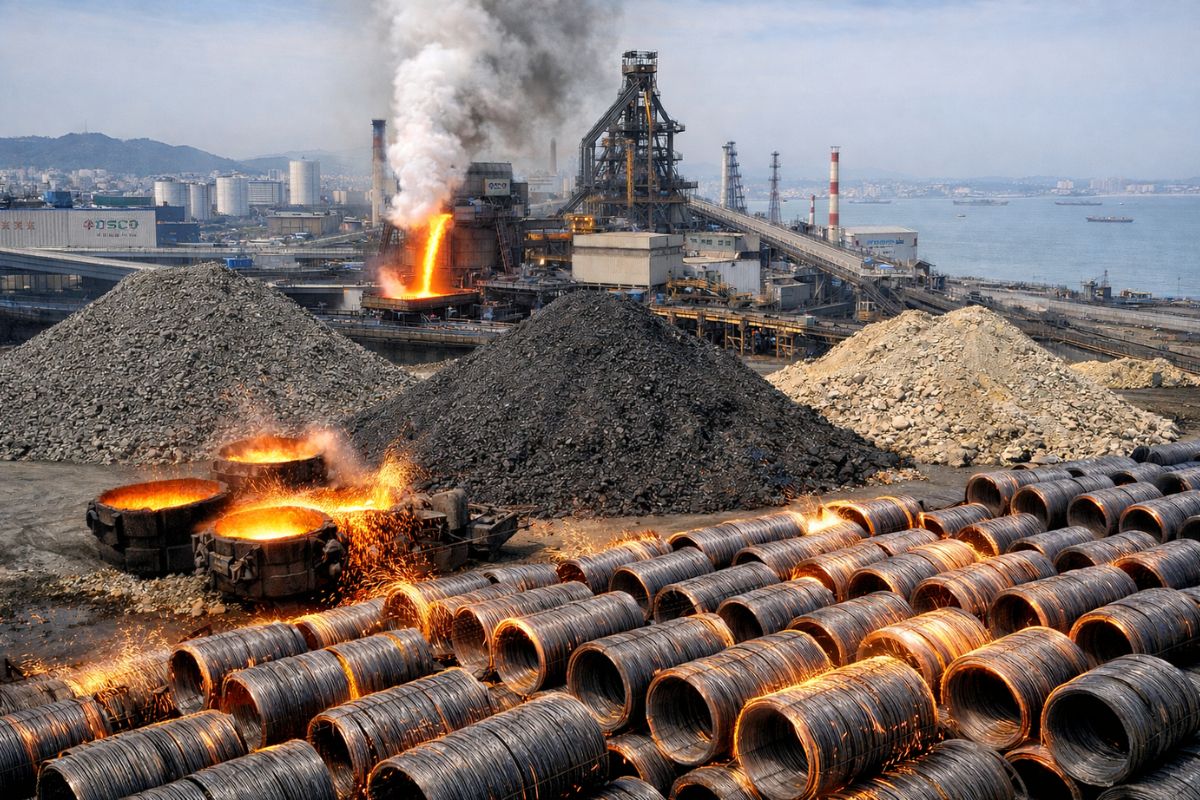
From Port to Blast Furnace, POSCO’s Steel Plant Transforms Ore and Coal into Steel in a Continuous Production Process Ending in Wire Rod.
At Korea’s largest steel mill, POSCO operates a giant factory where ore and coal become a continuous flow of metal. The process begins at the port, with ships unloading iron ore and coal into huge buckets and conveyor belts, goes through sintering, coke ovens, and the blast furnace at 1500°C, and ends with two-ton wire rod rolls ready to be shipped by train or truck.
At first glance, everything appears to be a huge living organism. Smaller buckets move in sequence as if they were a larva feeding, conveyor belts cross the yard non-stop, furnaces glow with molten steel, and at each stage, what were once ordinary stones begins to take on industrial form. POSCO transforms ore and coal into steel in a 24-hour cycle, recycles slag as input for asphalt or cement, and is already planning to replace carbon with hydrogen by 2050 to reduce the climate impact of steelmaking.
Where the Line Begins: From Ship to Ore Yard
The starting point for transforming ore and coal into steel is POSCO’s own port. There, ships loaded with iron ore and coal are unloaded by large equipment into giant buckets. These buckets remove the ore from the ship’s hold, in an operation that can take several hours.
-
Historic bankruptcy of Centauro shocks the market, and the century-old company puts more than 500,000 products, machines, and complete infrastructure up for online auction.

-
New shoe factory in Ceará is expected to create 400 jobs and strengthen the local economy.

-
No one imagined it, but a mixture of sawdust with a mineral that fights fires surprises scientists with a result that changes the course of fire-resistant construction.

-
From empty land to a high-end house, wooden construction uses a lightweight system, metal structure for the foundation, ventilated ceramic cladding, and special windows to create an efficient and comfortable living space throughout the year.

To gain efficiency, machines that use smaller yet continuous buckets come into play, capable of maintaining an uninterrupted flow.
It is this succession of small “bites” that creates the visual effect of a larva feeding, carrying ore and coal to conveyor belts.
From the belts, the ore moves to the yard, where it is stockpiled. At first glance, it looks like just a pile of ordinary stones, but it is already the raw material that will soon become steel.
Sintering: Preparing the Ore for the Blast Furnace
From the yard, the iron ore is sent via belts to the processing plant. Before it turns into steel, it goes through the sintering stage.
Sintering is the process that helps bond the fine particles of ore, turning powder into more cohesive blocks.
This stage is critical because sintering directly influences the quality of the final product. A well-formed sinter feeds the blast furnace better, burns more efficiently, and allows for a more stable flow of materials inside the burden column.
It is here that POSCO begins to shape the efficiency of its “assembly line,” preparing the ore to react with coke further along.
From Coal to Coke: The Fuel That Powers the Transformation
To transform ore and coal into steel, it is not enough for the ore to be ready. The coal also needs to be upgraded.
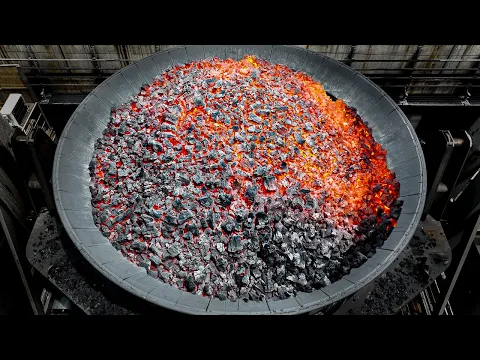
It enters special furnaces, where it is subjected to thermal coverage at around 1000°C. The result is coke, a purer coal in carbon and with ideal characteristics for the blast furnace.
In this process, raw coal turns into coke, which exits the furnace and falls into a large “bowl” on the other side.
After that, it is cooled for several hours until it reaches the suitable condition for handling. The coke will be an essential part of the blast furnace charge, functioning as both fuel and reducing agent that enables the chemical reaction that transforms ore into metallic iron.
Blast Furnace at 1500°C: The Heart of the Plant

With the iron ore sinter ready and the coke updated, the materials are stacked in layers inside the blast furnace.
In the lower region, a blast of hot air at about 1500°C is continuously blown in. It is in this extreme environment that the magic of engineering happens.
As the solid material descends, reaction after reaction transforms the ore into elemental iron. The carbon monoxide generated from the combustion of coke reacts with the iron oxides from the sinter, removing oxygen and leaving liquid metal behind.
It is this sequence of reactions that, in practice, completes the first major step in the journey of ore and coal into steel.
In the end, the molten steel flows into a storage system. Meanwhile, freight trains wait to carry the product to other units and processes, confirming that the plant operates as a huge production line in motion.
Slag: Separation, Purification, and Recycling
Inside the blast furnace, in addition to the molten steel, slag forms, a byproduct that floats on top of the liquid metal.
Before the steel moves on, this slag must be removed from the surface, in a process similar to removing impurities from a thick liquid.
The slag follows to a specific area, where it is unloaded into containers lined with refractory bricks, capable of withstanding extremely high temperatures.
Instead of being simply discarded, this slag is recycled as material for asphalt or cement, returning part of what would be waste to other productive chains.
The molten steel, on the other hand, goes through refining stages. There are successive chemical processes to adjust the composition, reduce impurities, and meet more demanding quality standards. The repetition of refining is essential to produce special and high-performance steels.
Continuous Casting: Transforming Liquid Steel into Solid Bars
When the steel reaches the necessary purity level, it is transferred to a large ladle that feeds the continuous casting.
The molten metal flows through the lower feed hole and moves into molds that shape it into a solid bar.
During this descent, a gray powder is used as a lubricant, helping the steel move through the molds without getting stuck.
When it exits, this steel bar is called a bloom, a large and massive piece that still needs to be processed.
This process operates continuously, in a 24-hour cycle, with automatic cutting to the desired length.
The vision is of a line that never stops, giving physical form to the concept of ore and coal into steel transformed into an industrial product.
From Bloom to Billet and Wire Rod
After casting, the bloom needs to be reheated to be mechanically deformed. The reheating brings the steel to the ideal plasticity point, allowing it to be passed through a series of rollers that thin and elongate it.
This stage reduces the bloom to a narrower shape known as a billet. On the rolling lines, the billets pass through multiple rollers under intense pressure, while cooling water jets control the temperature and prevent overheating.
Irregular ends are cut off, and the bars are adjusted to the specified length. It is at this point that the product is numbered, with surface marking for traceability.
Next, some billets are reheated again for wire rod production. The rollers transform the billet into a much thinner and longer steel wire, which is then used in the manufacturing of bearings, tires, bolts, and other industrial items.
At the end of the line, this wire rod is coiled and tied, each with about two tons, ready to be weighed and loaded onto trucks or trains.
A 24-Hour Assembly Line and the Plan for Hydrogen
What impresses at POSCO is not only the scale but the continuity. The flow of ore and coal into steel is designed as a practically uninterrupted process, where ships unload raw materials, conveyor belts feed factories, blast furnaces receive sinter and coke, steelmaking refines the metal, and rolling mills produce blooms, billets, and wire rod without pause.
At the same time, the company is already looking to the future. POSCO plans to build a system 100% based on hydrogen by 2050, which would mean replacing part of the current logic with routes that emit less carbon into the atmosphere.
If this transition materializes, the same line that today transforms ore and coal into steel could, in the future, transform ore and hydrogen into steel, with a lower environmental impact.
In a scenario where the world still heavily relies on steel for infrastructure, energy, transportation, and technology, understanding how this “assembly line” operates helps to better see both the industrial gains and the environmental challenges that come along.
And you, looking at all this, do you think the priority should be making the current steel process less polluting or accelerating the replacement of steel with other materials in some applications?








Seja o primeiro a reagir!