





 Portuguese
  English
  Spanish
  5 min of reading
  0 comments


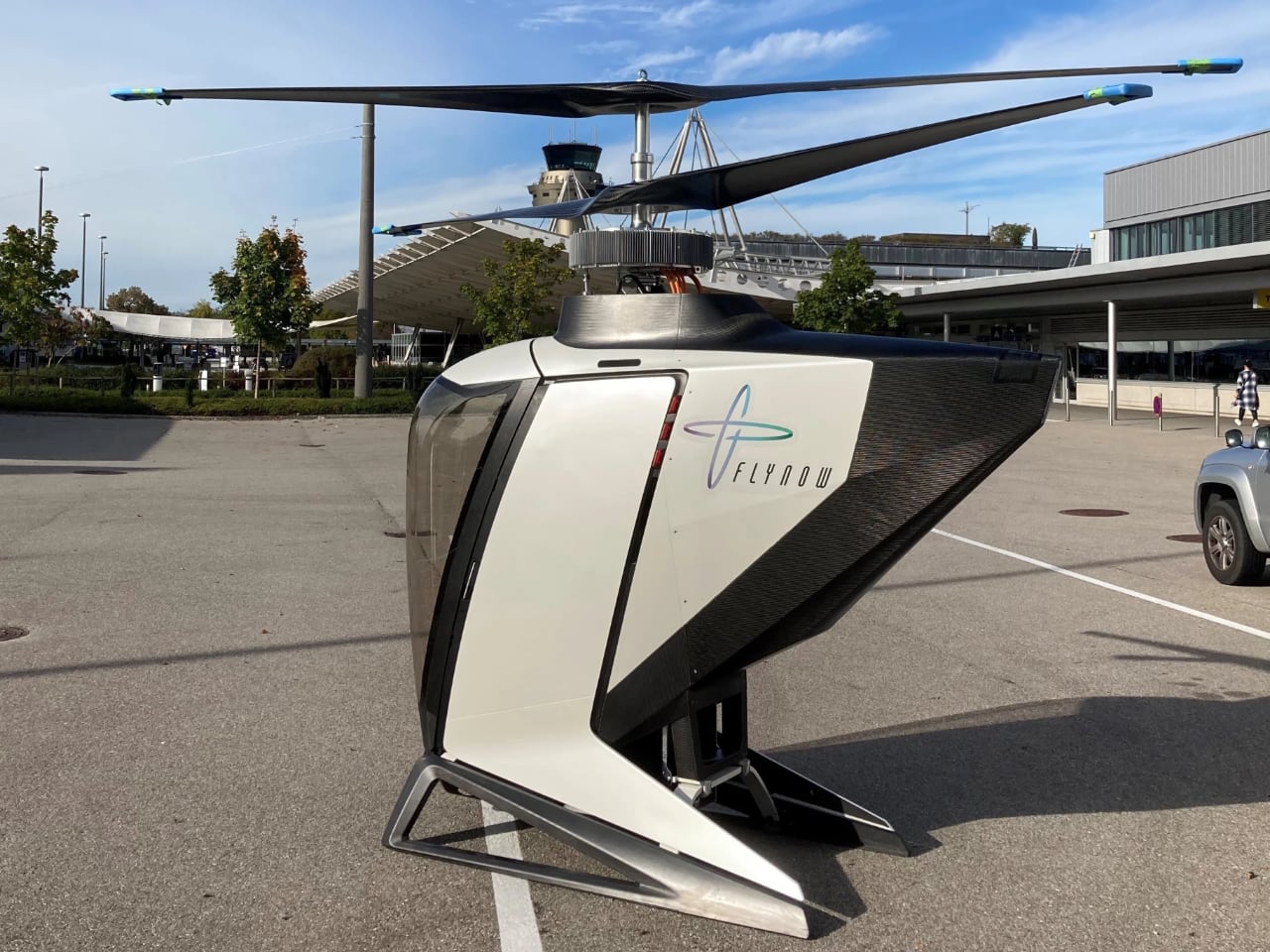
FlyNow Aviation Presents the eCopter, a Battery-Powered Helicopter That Dispenses With a Tail and Uses Dual Blades to Ensure Quieter and More Sustainable Flights. Discover the Future of Clean Air Mobility with This Pollution-Free Helicopter Innovation
The Austrian company FlyNow Aviation introduced its revolutionary new project: the eCopter, a battery-powered helicopter, tail-less and equipped with dual rotors. With a recent test flight conducted around Vienna, the model stands out for being compact, efficient, and emission-free, making it a promising solution for urban air mobility.
The first field test demonstrated that the prototype can fly stably and safely, even with a minimalist structure. By using two sets of rotors at opposite ends and digital control technology, the eCopter eliminates the need for a rear rotor while still ensuring efficient performance with low noise.
A Pollution-Free Helicopter Focused on Sustainability
The eCopter represents a direct response to the growing demand for sustainable aerial vehicles. Its electric configuration and freedom from fossil fuels classify the model as a pollution-free helicopter, ideal for cities seeking to reduce their carbon emissions.
-
Chaos On Airplane Could Be Expensive: Proposal Aims To Prevent Disruptive Passengers From Flying For Up To 1 Year In Brazil And Face Fines Of Up To R$17,500

-
Man Arrested After Halting Takeoff of Fire Department Helicopter During Child Rescue in Guaratuba

-
With 37 Tons of Cargo, Over 8,000 km Range, and Ability to Land on Unpaved Runways, the Airbus A400M Demonstrates How Europe Created a Military Giant That Transports Armored Vehicles, Aerially Refuels Fighters, and Operates in Conflict Zones and Humanitarian Missions Worldwide

-
Emergency Landing in Campos Amarais After Bird Strike on Small Plane


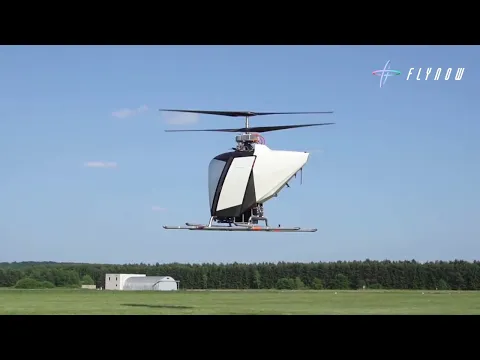

By adopting state-of-the-art lithium-ion batteries, the aircraft maintains adequate autonomy for short flights, promising low operational costs.
This urban and ecological flight model follows global trends in clean mobility, reinforced by environmental goals from the European Union and guidelines from ICAO (International Civil Aviation Organization).
Dual Blades Ensure Safety and Stability
The main differentiator of the project is the use of dual coaxial blades — two rotating sets at each end of the helicopter. These systems spin in opposite directions, canceling out lateral torque and ensuring a more controlled vertical takeoff.
This technology is already used in some military models and professional drones but rarely appears in civilian helicopters. FlyNow bets on this configuration to allow landings and takeoffs in constrained spaces, such as building tops, parking lots, and compact heliports.
According to the company’s engineers, the absence of a tail rotor also reduces failure points and enhances the aircraft’s maneuverability in dense urban environments, offering safer and more accessible operations.
Test Flight Confirms Potential of the Battery-Powered Helicopter
The inaugural flight of the eCopter, featured in a video released at the end of July, showed the prototype rising with precision and stability in a test field in Vienna. Still at a reduced scale, the model successfully validated aerodynamics, electronic control, and electric motor performance.
FlyNow Aviation highlighted that the collected data was satisfactory and consistent with the parameters set for the future full-size version. The next step is to build a full-size model capable of one occupant and a range of up to 50 km per charge — ideal for commuting between urban centers and airports.
The company aims to have the commercial version in manned tests by the end of 2026, with possible operation starting in 2027.
FlyNow Aviation Aims to Democratize Clean Air Mobility
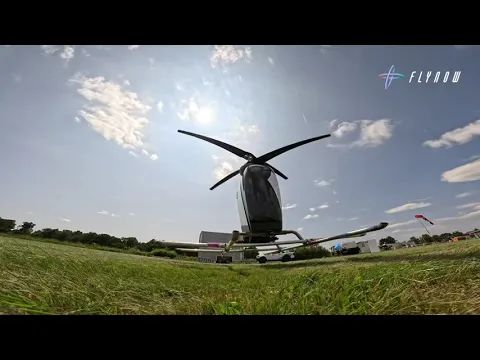
FlyNow Aviation, based in Austria, is investing heavily in lightweight, accessible, and sustainable air transport solutions. With the eCopter, the company aims to democratize the use of battery-powered helicopters, offering lower prices, simplified maintenance, and automated operations.
The strategic plan includes creating a modular production system, using 3D printing to reduce costs and accelerate mass production. The batteries used will also adhere to European recycling and safe disposal standards, reinforcing the brand’s environmental commitment.
Additionally, FlyNow is already seeking partnerships with municipal governments to implement dedicated “aerial corridors,” linking strategic points in cities for fast, clean, and congestion-free transport.
Tail-Less Helicopter Could Revolutionize Urban Transport
Eliminating the tail is more than a design choice: it’s a revolution in helicopter engineering. Traditionally, helicopters have a rear rotor to neutralize the torque generated by the main rotor. In the eCopter, this is addressed with two sets of dual blades, one at each end.
This innovative system reduces the number of moving parts, the risk of accidents, and maintenance costs. Additionally, the compact design allows for takeoffs in limited spaces, enabling use in urban areas without dedicated aerial infrastructure.
The lightness and simplicity of the model also mean it can be controlled in a semi-autonomous manner, with automatic stabilization systems and sensor-assisted landing.
eCopter Stands Out as a Viable Pollution-Free Helicopter
As cities face issues with pollution, noise, and mobility, the concept of a pollution-free helicopter becomes increasingly relevant. The eCopter emerges as a practical, adaptable, and sustainable solution for quick moves in metropolitan areas.
According to the report Future of Air Mobility by McKinsey & Company, electric aircraft can reduce emissions by up to 80% per kilometer in urban segments. Furthermore, studies indicate that the operational costs of electric helicopters can be up to 60% lower than conventional models, mainly due to simpler motor maintenance.
These benefits make the eCopter an attractive option for both the private sector and governments wishing to implement sustainable air transport services.
Challenges and Next Steps for FlyNow Aviation
Despite advancements, the path to commercial operation of the eCopter still involves strict regulatory steps. FlyNow needs to obtain certifications from the European Union Aviation Safety Agency (EASA), which requires extensive reliability, durability, and safety testing.
The company is already collaborating with Austrian and German universities to validate navigation and flight control systems. The goal is to ensure that the model meets international airworthiness standards and can be operated safely in urban environments.
The expectation is that, with regulatory approval and the start of mass production, the eCopter will become a landmark in electric air mobility in Europe.
Why FlyNow’s Electric Helicopter Could Change the Future of Urban Transport
The launch of the eCopter by FlyNow Aviation signals an important shift in how we think about urban air transport. By uniting efficiency, sustainability, and structural innovation with dual blades and the absence of a tail, the company sets a new standard for compact helicopters.
As a battery-powered helicopter, the eCopter addresses the needs of a world transitioning to clean energy and less impactful mobility solutions. Its compact, pollution-free design aimed at scalable production positions it as a potential protagonist in city skies in the coming decades.
If FlyNow can overcome regulatory challenges and establish a financially viable production line, the eCopter could pave the way for a new market of personal and commercial electric aircraft — cleaner, quieter, and tailored for the modern urban environment.










-

-

-

-

-

-

64 pessoas reagiram a isso.