





 Portuguese
  English
  Spanish
  4 min of reading
  0 comments


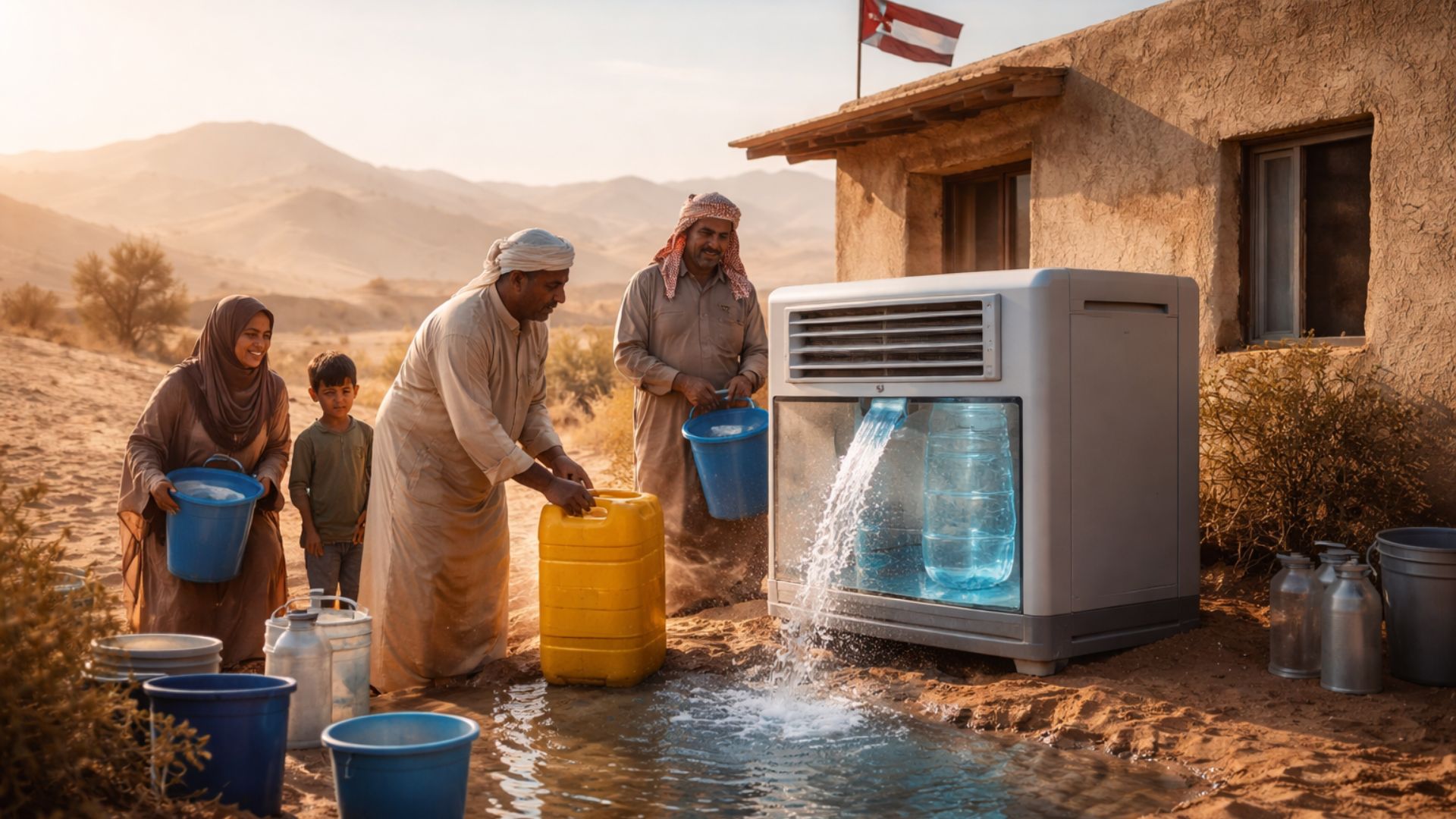
Technology Developed In Jordan Converts Minimal Desert Air Humidity Into Drinking Water Using Advanced Nanomaterials And A Compact Equipment Comparable To An Air Conditioner. System Promises To Produce Up To 35 Liters Per Day And Emerges As An Alternative In The Face Of Severe Water Scarcity Faced By The Country’s Population.
A technology created in Jordan has been drawing international attention by proposing an alternative for regions affected by extreme water scarcity.
The system uses humidity present in the desert air to generate drinking water, through a compact equipment, roughly the size of an air conditioner, capable of producing up to 35 liters per day even when the relative humidity is only 20%.
The innovation arises in one of the countries considered most vulnerable to lack of water resources in the world.
-
These living root bridges and ladders are over 700 years old and help indigenous people survive in one of the rainiest regions in the world.

-
From sertanejo star to international investor: Ana Castela invests millions in a mansion in the USA, creates a themed accommodation in Orlando, and shows that the “boiadeira” also wants to grow away from the stage.

-
The 10 most stunning motorhomes in the world: a $3 million trailer with a rooftop nightclub and garage for a Ferrari, “palaces on wheels” with Italian marble, private cinema, and five-star hotel luxury for billionaires.

-
Trump wanted to spend $400 million on the White House, but the courts prohibited the million-dollar construction.


Jordan faces a chronic water scarcity scenario, exacerbated by an arid climate, population growth, and pressure on underground reserves.
In this context, technologies capable of capturing water directly from the atmosphere have begun to be analyzed as complementary alternatives to traditional supply.
Water Scarcity Shapes Daily Life In Jordan


Limited access to water directly influences the daily life of a large part of the Jordanian population.
In many cities, the supply of piped water occurs intermittently, which leads families to organize household tasks around the periods when the supply is available.
Cooking, washing clothes, and cleaning the house often need to be done within short distribution windows.
Records indicate that urban areas have, on average, about 36 hours of supply per week, forcing residents to store water in tanks or reservoirs to cope for the following days.
This permanent restriction scenario has led governments, researchers, and companies to seek solutions capable of increasing access to drinking water without relying solely on rivers, reservoirs, or underground aquifers.
Technology Uses Nanomaterials To Capture Air Vapor
The solution developed by the startup associated with the AquaPoro project utilizes a relatively simple principle, but applied with new materials.
The equipment pulls ambient air into the system and passes it through structures made of porous nanomaterials designed to capture water molecules present in atmospheric vapor.
These materials have microscopic surfaces with grooves and cavities capable of retaining moisture present in the air, even in environments with low relative humidity levels.
Once saturated, the material releases the absorbed water when subjected to controlled heating.
In the next step, the released vapor is condensed, turning back into liquid.
The system also performs filtration and mineralization processes, aiming to make the water suitable for human consumption.
The entire process occurs within the equipment, which operates continuously throughout the day, gradually accumulating the collected water.
Equipment Can Produce Up To 35 Liters Of Water Per Day
According to information released by the project, the equipment can produce up to 35 liters of water per day under humidity conditions of approximately 20%, a common rate in desert regions.
The efficiency in extremely dry environments is one of the highlighted points by the developers.
Conventional atmospheric collection technologies typically perform better in locations with higher humidity levels, such as coastal or tropical regions.
For this reason, the adaptation of the technology for arid climates represents one of the main differentiators of the project.
The expectation is that such systems can operate in places where other similar solutions face technical difficulties or high costs.
Reduced Energy Consumption May Enhance Viability
Another point highlighted by those responsible for the technology is the attempt to reduce the energy consumption of the process.
Capturing water from the air typically requires energy for air circulation, heating of absorbing materials, and vapor condensation.
According to information released about the project, the use of nanomaterials would allow reducing the amount of energy needed to capture and release the absorbed water.
This could make the system more viable for domestic use or in isolated communities.
The reduction of operational costs is considered fundamental for such technologies to reach scale and be applied in regions with lower purchasing power or limited infrastructure.
Project Plans Free Distribution To Families
The project’s first customer is reported to have been the Jordanian government itself, which started negotiations for the acquisition of units of the equipment.
The proposed plan includes the possibility of free distribution to families in different regions of the country.
The initiative has also been associated with discussions with international development agencies interested in evaluating the potential of the system for use in other countries with water scarcity.
If such programs advance, the technology could be applied in rural communities, refugee camps, and areas where traditional supply infrastructure is insufficient.
Technological Solutions Gain Ground Amid Water Crisis
Experts point out that solutions for capturing water from the air do not completely replace conventional supply systems, but can serve as an important complement in regions where water resources are limited.
In scenarios of prolonged drought or in areas far away from distribution networks, technologies capable of producing water locally can reduce dependence on transport, water tankers, or well drilling.
The advancement of research into new absorbent materials, such as the nanomaterials used in this project, also expands the possibilities for adapting these technologies to different climates and humidity levels.
Jordan continues to be one of the natural laboratories for this type of innovation, as the country faces one of the most severe water shortages on the planet and constantly seeks solutions to ensure the supply for its population.








-

-

-

-

4 pessoas reagiram a isso.