





 Portuguese
  English
  Spanish
  6 min of reading
  0 comments


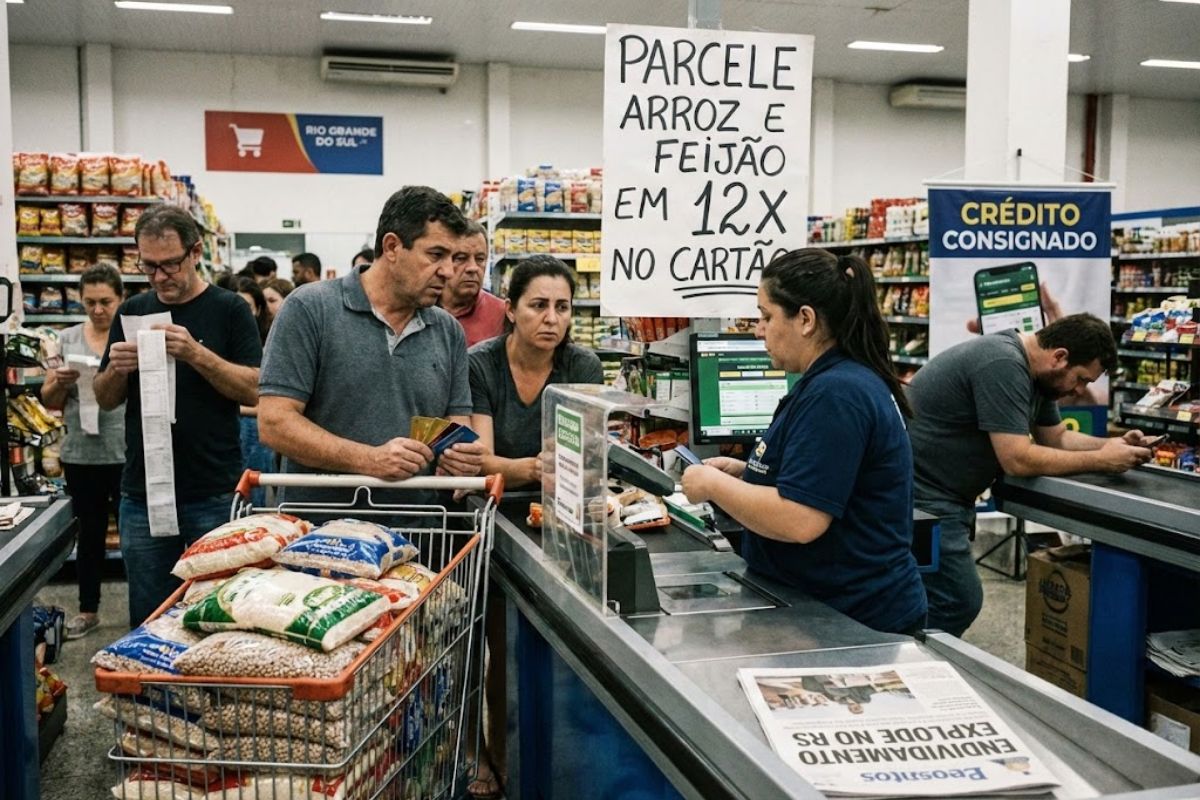
With the Budget Blown in 2025, Gaúcha Chains Are Already Financing Rice, Beans, and Monthly Purchases on Credit Cards, While Workers Bury Their Salaries in Bets and FGTS Consigned Credit. Experts Warn That Families Are Now Financing Food as If It Were a Refrigerator and Live in a True Monthly Snowball in Their Budgets.
Since the beginning of 2025, supermarkets in Rio Grande do Sul have started allowing customers to finance even the purchase of rice, beans, and other basic items on credit cards, an extreme portrait of indebtedness that drags on throughout the year.
In an interview given at the end of 2025, the president of the Gaúcha Supermarkets Association, Lindo Honor Peruso Júnior, stated that the practice, previously limited to refrigerators, stoves, and household items, is now used as a attempt to avoid food shortages at the table of families drowning in bets and FGTS consigned credit.
When Rice and Beans Enter Credit
Financing purchases at supermarkets is not exactly new, but financing food has always been the exception, not the rule.
-
Brazilian city bets on the business environment to generate jobs and attract investments in the energy sector — secretary reveals strategy at Macaé Energy 2026.

-
50 viaducts, 4 tunnels, 28 bridges, and 40 kilometers of bike paths: BR-262 in Espírito Santo will receive 8.6 billion reais for the largest engineering project in the state’s history, inspired by the Immigrant Highway in São Paulo.

-
Brazil produces too much clean energy and doesn’t know what to do with it: over 20% of solar and wind capacity was wasted in 2025 while investors flee and 509 renewable generation projects were abandoned in the last year.

-
Piauí will produce a new fuel that replaces diesel without needing to change anything in the truck’s engine and reduces pollutant gas emissions by half: truck drivers from all over the Northeast are already celebrating the news that will arrive later this decade.


Traditionally, credit was reserved for durable goods, such as appliances and household items.
According to Lindo Honor Peruso Júnior, the current movement began last year and accelerated in 2025.
In some chains, the proportion of sales that customers finance has risen from 3% to 8% in just one year, showing that family indebtedness is not isolated; it is growing and persistent.
The president of the organization acknowledges that not all supermarkets are financing food yet, but “many chains are already doing so” to avoid losing customers.
The logic is simple and harsh: if the competitor allows consumers to finance their shopping cart, those who do not comply risk seeing their revenue plummet.
The problem is that, unlike a refrigerator, which you buy once and use for years, rice and beans return to the shopping list every month.
When families finance today what they will eat this week, they postpone installments without stopping new food expenses in the following month. The result is the infamous “snowball.”
Bets and Consigned: Salary Disappears Before It Reaches the Cash Register
Behind this phenomenon lies an explosive combination.
On one side, there is consigned credit tied to the Guarantee Fund (FGTS), which allows workers to anticipate part of this reserve, paying interest that, according to the leader, can reach up to 15% per month.
On the other side, there is the rise of online betting houses. Industry reports indicate that many consumers enter into consigned loans, take out expensive money, gamble on bets, lose, and end up with the debt.
The loan installment is deducted directly at the source before the salary reaches the hands of the worker, reducing the money available for supermarkets, rent, and basic bills.
Lindo Honor Peruso Júnior reports a concrete case within his own network. About 31% of employees have already taken out loans using FGTS consigned credit, a figure he believes reflects the average of other supermarkets in the country.
This path has a serious side effect: the worker consumes the fund that should serve as protection during unemployment or retirement.
When they lose their job, they no longer find the saved money because part has turned into loans and interest.
To make matters worse, many still turn to family, friends, and acquaintances, opening new fronts of informal debt.
Bets Take Over the Screen and Compete for Market Money
The president of Agas describes what he sees as a “national epidemic” of bets in 2025. He recounts having watched a recent Brazilian Championship match where he counted seven different betting houses advertising during the same game, occupying almost the entire advertising space.
According to him, the profitability of the sector is so high that the revenue of bets is already approaching 20% to 25% of the total revenue of supermarkets, according to figures cited by the Brazilian Supermarkets Association.
This means that a significant portion of the money that used to pay for supermarkets, gas, and rent is being drained into the promise of “easy winnings” in sports betting.
Businesspeople from other sectors report the same scenario. A bar owner in Porto Alegre, for example, says he faces serious debt problems with bets among employees and customers, to the point of compromising the business’s revenue.
The complaint is echoed across different sectors, reinforcing the perception that the monthly income of the population is being sucked up by this type of gambling.
The assessment of the business bloc that gathers supermarkets and other entities is harsh: the combination of easy credit with massive betting advertising is financially sickening a significant portion of the population and pressuring the consumption of essential items.
Supermarkets Become Financial Aid and Lose Margin
In practice, when supermarkets start allowing customers to finance the basics of their pantry, they end up taking on part of the role of an informal bank.
The consumer without limits in other channels sees retail as the last chance to fill the fridge, even if that means piling up installments.
The leader explains that selling on credit costs the supermarket more than selling for cash because credit card fees are higher. This erodes profit margins, especially at a time when the sector is already feeling the impact of overall indebtedness on store cash flow.
He mentions that in his group, only about 20% of sales are still made in cash, with checks practically disappearing.
The remainder goes through electronic means, mainly credit and debit cards.
At the same time, there has been a decline in both the average ticket and the frequency with which consumers go to supermarkets, which further pressures revenue.
Even so, retail continues to allow customers to finance the purchase of food.
The sector’s reading is that if they abruptly cut off this option, many families simply will not be able to maintain the same minimum level of supply, which would make the social situation even more delicate and reduce sales sharply.
Classes C and D Feel the Blow the Most
The effect of indebtedness and food financing affects the entire state, but not equally.
The president of Agas states that the problem affects all of Rio Grande do Sul, but with a more visible impact among classes C and D, precisely the audience that has historically relied more on financing to purchase durable goods.
Now, the novelty is that this same audience has started financing basic food items. Families that previously divided the cost of a refrigerator or stove over ten installments are now financing their cart filled with rice, beans, and meat to make ends meet.
Income is lower, the cost of living remains high, and betting appears as an attempt to “make it big,” which, in practice, ends in more debts.
The intense use of cell phones exacerbates the situation. Before, mobile games consumed mainly time; now, many of them involve real money.
People who start winning small prizes are encouraged to increase their bet amounts and end up losing entire savings, which pushes their supermarket visits directly to the limits of their credit cards.
Pressure for Changes and Fear of What Comes in 2025
In light of this situation, Gaúcha business entities are organizing into a bloc to advocate for change.
Agas supports an initiative led by state representative Thiago Simon aimed at restricting advertising from betting houses, especially in soccer, the main showcase for these ads. The assessment is that excessive advertising accelerates the cycle of indebtedness.
For supermarket operators, financing rice and beans has become a thermometer for social emergencies.
If it is already difficult to secure the basics in December 2025, the question is how families will navigate 2026 with part of their salaries tied up in consigned loans and bets, and on top of that, divided food purchases into multiple installments.
Meanwhile, the retail sector stands at a crossroads: if it does not allow customers to finance their monthly purchases, it loses revenue and pushes families toward shortages; if it maintains financing, it takes on the risk of margin decline and coexists with an increasingly indebted clientele.
And in your home or among your friends, how many people do you already see financing their supermarket purchases just to make it to the end of the month?










-

-

-

-

7 pessoas reagiram a isso.