





 Portuguese
  English
  Spanish
  3 min of reading
  0 comments


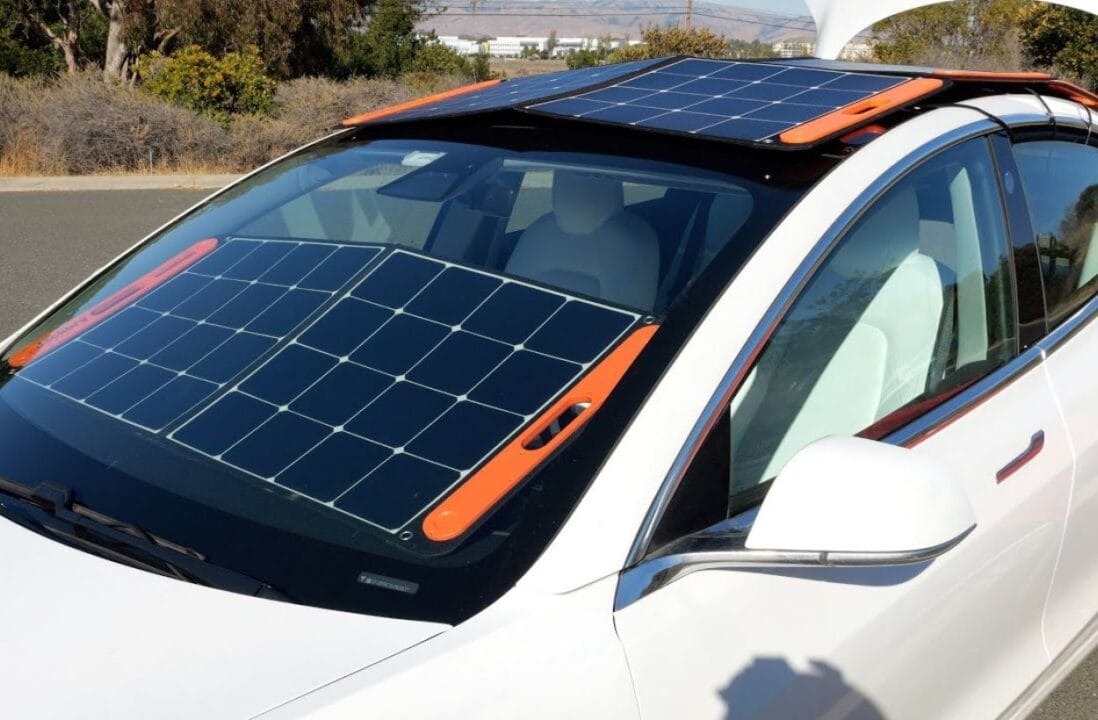
Discover How Many Solar Panels Are Needed To Operate An Electric Car Without Energy Costs, Turning Sunlight Into Its Renewable Fuel Source.
The electric car revolution is gaining momentum, and many are wondering about the potential of solar panels to support these vehicles without the burden of energy bills, thus enjoying the benefits of solar energy. Let’s explore the energy consumption of an electric car and how many photovoltaic panels are needed to keep it running.
Using the Nissan Leaf as an example, with its average consumption of 14 kWh per 100 km, we calculated the energy need for someone who drives 50 km per day. This results in a daily consumption of 7 kWh, totaling 210 kWh per month. This number is close to the average residential consumption, highlighting the energy efficiency of these vehicles.
How Many Solar Panels Are Needed To Charge An Electric Car?
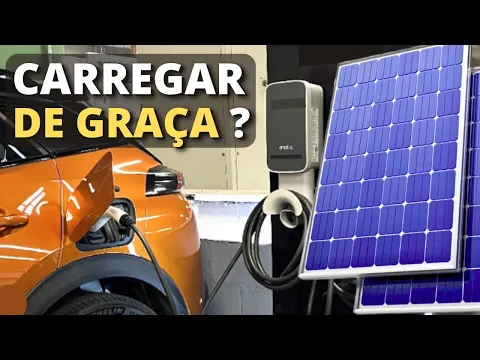

To neutralize this consumption with solar energy, we consider 450-watt panels. With an average of 5.3 hours of sun per day in Recife and adjusting the efficiency to 75% (considering losses), each panel can generate approximately 53.6 kWh per month. Therefore, about 4 panels of 450 watts would be needed to meet the monthly demand of 210 kWh of an electric car.
-
A 250cc motorcycle that can reach 560 km with a 14-liter tank, features disc brakes on both wheels and is among the most well-known in Brazil.

-
Man finds over 200 rare cars abandoned on a lot and tries to do the impossible in 8 hours with a surprise at the end.

-
An irregular parking case gains attention after a Mercedes Classe A was removed in such a strange way that it even raised doubts about damage to the car.

-
Costing R$ 16,000, the new Yamaha features a 125 cc hybrid engine with electric assistance, delivers 8.3 hp, includes ABS, optimized fuel consumption, Y-Connect connectivity, 25 liters of storage space, and a surprising 4-year warranty in the urban segment.


This equation varies according to the power of the solar panels and local sunlight conditions, but the basic rule remains: divide the vehicle’s monthly consumption by the estimated monthly production per panel. In the case of 350-watt panels, for example, 5 panels would be needed to cover the same consumption.
Thus, with about 4 to 5 high-power solar panels, it is possible to fuel an electric car for moderate daily use, proving that sustainability in mobility is not only feasible but increasingly accessible.
How Much Do Solar Panels For An Electric Car Cost?
The price of solar panels can vary significantly depending on the brand, efficiency, and origin. For electric cars, considering that we need enough capacity to produce around 1.8 kW peak, the cost of solar panels of 560 watts peak each can be estimated. On average, the price of a high-quality and efficient solar panel can range from R$ 1,500 to R$ 2,500 in Brazil. Thus, for two 560-watt peak panels needed to efficiently charge an electric vehicle, the total cost could range between R$ 3,000 and R$ 5,000, excluding other components necessary for installation, such as inverters and energy storage systems.
Adopting solar energy to charge electric cars is a financially accessible and technologically advanced initiative. Portable solar kits, which can vary in price, offer a practical solution, although it is essential to evaluate their safety and effectiveness. The integration of solar panels into vehicles is still under development, with prices estimated based on the technology and necessary capacity.
A solar panel has a remarkable lifespan, potentially exceeding 25 years. Although its efficiency gradually decreases, the annual degradation of 0.5% to 1% still allows for significant performance over time, representing a lasting and reliable investment.
And The Electric Car, How Long Does It Take To Charge With Solar Energy?
The time to fully charge an electric car battery with solar energy varies depending on several factors, such as battery capacity and solar panel power. Under ideal sunlight conditions, the process may take a few hours, making it a viable and eco-efficient alternative for vehicle refueling.
At the heart of the solar charging system are batteries, with lithium-ion batteries being the most suitable due to their superior efficiency and higher storage capacity, despite the higher cost compared to lead-acid batteries. These batteries store the converted solar energy, ensuring energy availability for vehicles whenever needed.







-

Uma pessoa reagiu a isso.