





 Portuguese
  English
  Spanish
  4 min of reading
  1 comment





Aluminum Formwork System Transforms Construction Sites into Assembly Lines, Reduces Craft Stages, and Invests in Weekly Concrete Cycles to Gain Predictability, Geometric Control, and Material Reuse in Residential Construction.
Residential construction that relies on bricks, mortar corrections, and thick layers of plaster is beginning to share space with a system that replaces the “wall made piece by piece” with a planned cycle of concreting using reusable aluminum formwork.
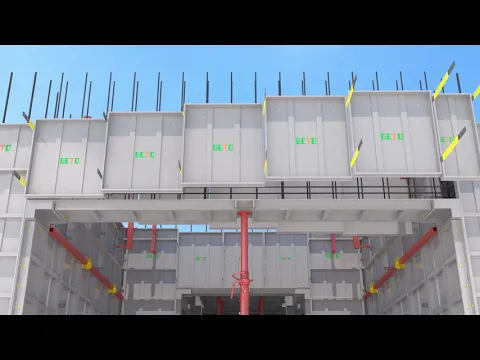
In this model, modular metal panels are assembled as a precise mold, receive reinforcements and installation points as outlined in the project, and allow for the concreting of walls and slabs all at once, with standardized dimensions, reducing rework and geometric variations on site.
Known internationally as aluminum formwork, the technique appears in many markets associated with the name Mivan, a business reference that promoted lightweight, removable, and reusable sets, bringing the industrialization of the mold to the center of the structural schedule.
-
The lack of welders, electricians, and operators becomes a structural threat in 2025, with the construction industry and manufacturing already suffering from delays, cost pressures, and labor shortages in Brazil.
-
Brazil and Paraguay are just 46 meters away from a historic union on the bioceanic bridge that promises to revolutionize trade between the Atlantic and the Pacific.

-
With 55 km over the sea, a cost of US$ 20 billion, and enough steel to build 60 Eiffel Towers, China’s largest project has connected Hong Kong, Zhuhai, and Macau in a colossal bridge that defies the logic of engineering.

-
A trick with joint compound transforms a Styrofoam ceiling into a plaster-like ceiling: leveled panels, wires and mesh at the joints, sand, paint, and change the environment while spending little today.

Rather than the progression of the project depending on masonry and successive adjustments, the most critical stage becomes the organization of the cycle, with a repetitive sequence of assembly, checking, concreting, initial curing, de-shuttering, and moving the set to the next floor.
7-Day Cycle per Floor and Project Planning

The promise that draws the most attention outside the industry is the cadence, because technical revisions and academic works describe cycles close to one week per floor under standardized conditions, with fluctuations related to weather, logistics, team, and type of concrete used.
To maintain this pace, planning needs to synchronize the assembly of the formwork with the delivery of reinforcements, checking for plumb and level, positioning of embedded electrical and plumbing fixtures, and the concreting window, avoiding conflicts in the same workspace.
In this logic, the construction site approaches an assembly line, as the modules arrive numbered, designed for that project, and are assembled as a kit that defines the final geometry, including openings and alignments, with systematic control of measurements.
In addition to speed, the method shifts part of the effort to the “invisible work” of inspection and sequencing, because errors that could previously be corrected with thick layers of finishing become more expensive after concreting, when the structure is already consolidated.
Monolithic Concreting and Impact on Finishing
In practice, aluminum formwork favors a more integrated structural shell, often described as monolithic concreting, when walls and slabs are shaped continuously, which alters the way to coordinate structure, installations, and execution tolerances.
As the metal panels tend to deliver more regular surfaces, part of the market works towards reducing thick plaster, replacing it with thinner layers of leveling, although the final solution depends on the required standard, assembly control, and finishing project.
Even with precision gains, the system does not eliminate the need for engineering, supervision, and compliance, and in Brazil, there is specific regulatory reference for cast-in-place concrete walls, which establishes requirements and procedures for this type of construction solution.

On the other hand, the efficiency of aluminum formwork often decreases when the architectural design has many cuts, layout changes, and frequent variations in ceiling height, as they increase special pieces, adjustments on-site, and interferences that disrupt the planned repetition of the cycle.
Initial Cost, Reuse, and Economic Viability
In traditional systems, wooden formwork can be improvised on-site, with a lower initial investment, but with greater variability in quality, higher material consumption, and more waste, which increases rework and makes standardization of stages more difficult.
Conversely, in the aluminum system, acquiring or renting the set represents a significant cost at the beginning of the project, and economic viability often depends on a high number of reuse cycles, especially when there are many floors and similar layouts.
Technical publications and recent comparisons point to high reusability as a central characteristic, frequently mentioning hundreds of possible cycles under adequate maintenance conditions, although the number actually achieved varies according to handling, transportation, cleaning, and damage control.
Thus, the calculation shifts from being merely the cost of the material to considering the cost per use, the predictability of the timeline, and the effect of the repetitive cycle on labor, equipment, and financing, as series delays tend to propagate floor by floor.

Less Wood and More Control on Site
Regarding waste, the replacement of large volumes of wood with reusable metal panels tends to reduce disposal on-site, although the final outcome depends on the number of reuses and logistics, including transportation and the need for part replacement.
Meanwhile, process control becomes decisive, as de-shuttering on time depends on the concrete’s initial strength and dimensional stability, factors cited in studies on slab cycles and productivity in industrialized formwork systems.
Correct assembly, with checked bracing and alignments, also influences safety and quality, as the precision promised by aluminum is only realized when the team follows procedures, training, and inspection routines compatible with the cadence.
Despite the change at the heart of the schedule, the method does not “replace” the entire project, as foundation, site preparation, waterproofing, frames, installations, coverings, and other finishes still require their own coordination and careful execution control.
By bringing industrial logic into the construction site, aluminum formwork repositions the design as part of the production process, as the design needs to engage with the modulation to sustain repetition and speed without increasing rework in later stages.








Quero conhecer essa técnica, já temos essas opções aqui no Brasil?