





 Portuguese
  English
  Spanish
  6 min of reading
  3 comments


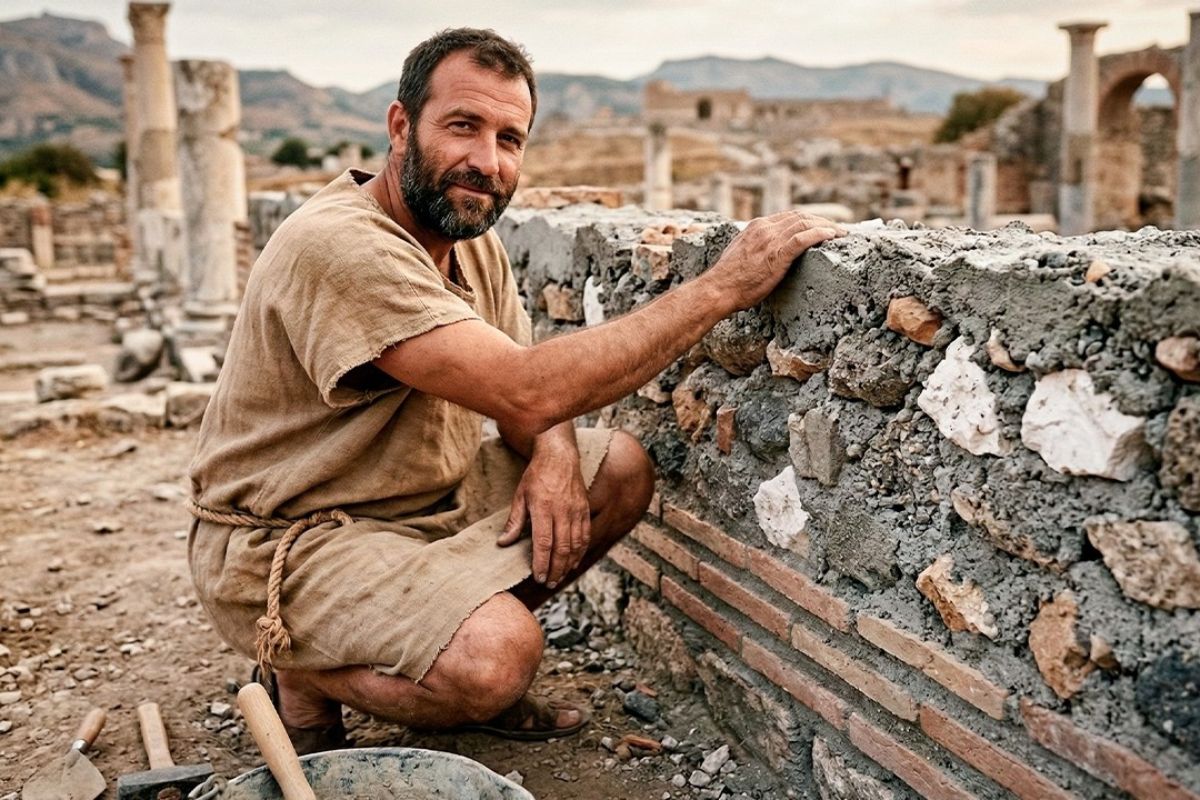


Roman Concrete Back to the Center of Debate After Engineers Showed That Its Combination With Lime, Volcanic Ashes, and Hot Mix Can Seal Cracks, Reinforce the Pantheon, and Repeat in Pompeii the Same Chemical Logic That Keeps Ancient Structures Active for Centuries, Even Under Water, Rain, and Continuous Stress
The Roman concrete is back at the center of engineering after researchers showed that the mix used in works like the Pantheon not only withstands time but can also close cracks on its own. The discovery repositions an ancient technique as a possible answer for a sector that builds quickly but deals with structures that age too soon.
At the most sensitive point of this story is the lime, and not just the list of ingredients. The secret of Roman concrete was not just in what the Romans mixed but in how they mixed it. The analysis of ancient samples and of a construction site frozen in Pompeii showed that the sequence of the work altered the entire chemistry of the material and created a concrete capable of continuing to react for decades and even centuries.
The Contrast Between the Pantheon and Modern Concrete
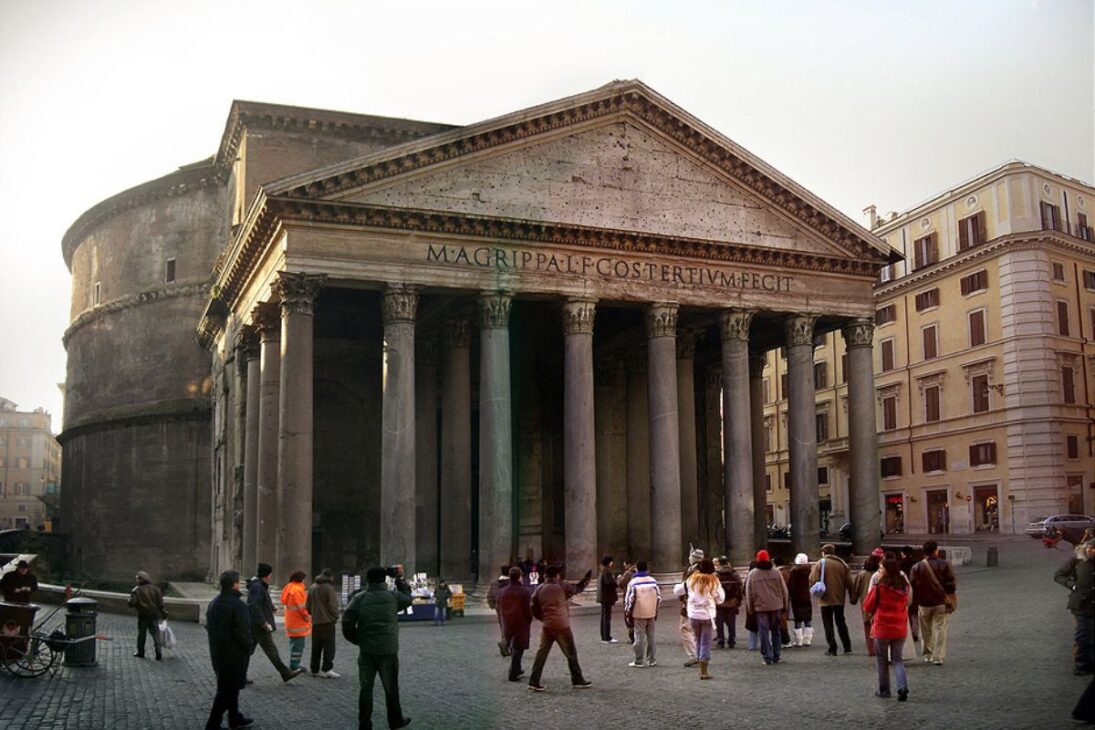
The Pantheon has stood for about 1,900 years with a dome 43.3 meters in diameter, without steel, rebar, tension cables, or expansion joints.
-
With 30 meters in length, a house in England appears to float in the air and surprises engineers and architects around the world due to its visual effect and construction method suspended over sloped terrain.

-
Called El Inmortal, the building that survived earthquakes in Ecuador seems to balance, defies the laws of physics, and impresses with its bold construction structure.

-
A gigantic dam project in the Himalayas could solve one crisis but silently create another for millions of people.
-
Nikola Tesla said that intelligent people tend to have fewer friends, and now science partially confirms this: a study with over 15,000 people showed that for the more intelligent, socializing too much can even reduce life satisfaction.


The structure weighs 4,535 metric tons and, according to the data presented, has not needed repairs since Antiquity.
This longevity contrasts with the performance of much of modern concrete, whose projected lifespan usually ranges between 50 and 100 years, with constant maintenance.
This contrast helps explain why Roman concrete is again being treated as a technical issue and not just as an archaeological curiosity.
In the United States, for instance, over 42,000 bridges are classified as structurally deficient, while 168 million vehicle trips cross these structures every day.
The central discomfort is simple: modern engineering has built faster but has not been able to replicate the permanence that the Romans had already demonstrated.
The Detail Ignored for Centuries Was in the Lime
For a long time, the most accepted explanation was that the differential of Roman concrete was in the volcanic ashes, especially the pozzolana from the region near the Bay of Naples.
This part was correct but incomplete.
The problem was that, even repeating the recipe in the laboratory with lime, water, and volcanic material, researchers could not reproduce the behavior of the original.
The material cracked and aged like ordinary concrete.
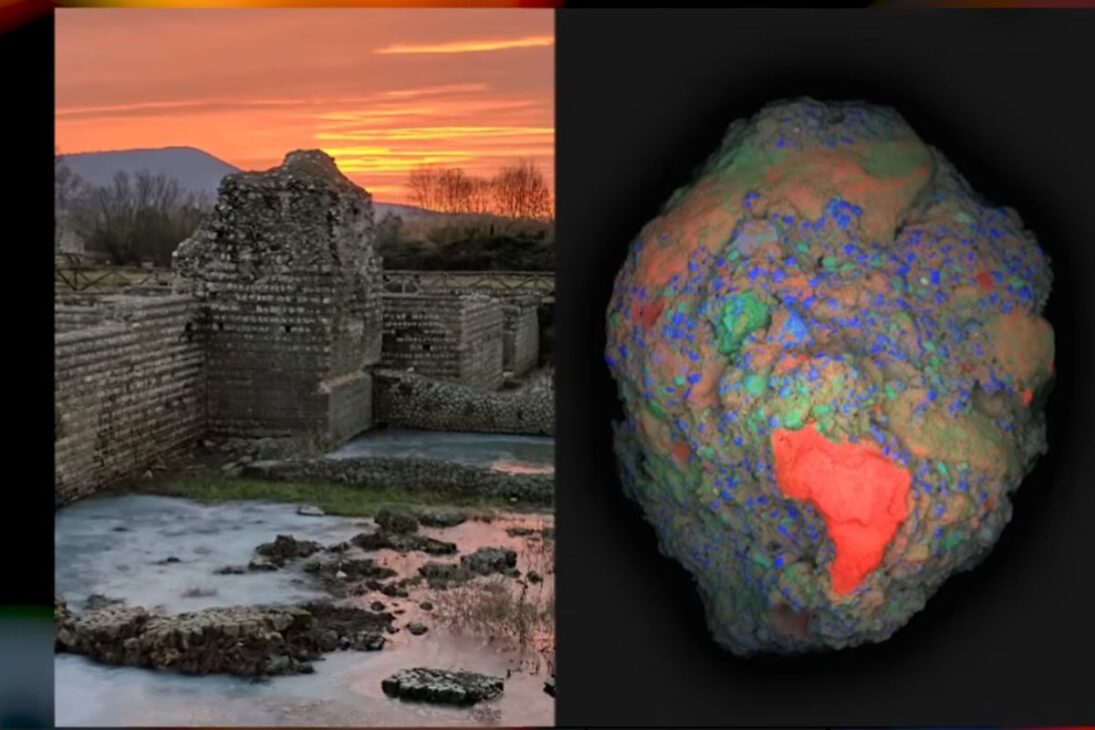
The turning point came when Professor Admir Masic from MIT decided to take a closer look at small white fragments scattered across the samples.
For decades, these points had been treated as a sign of poorly made mixing.
But the new analysis showed something else: they were intentional remnants of lime inserted into the material through a hot mix.
These fragments were not construction errors; they were chemical reserves left within the concrete to react in the future.
How the Hot Mix Changes the Whole Chemistry
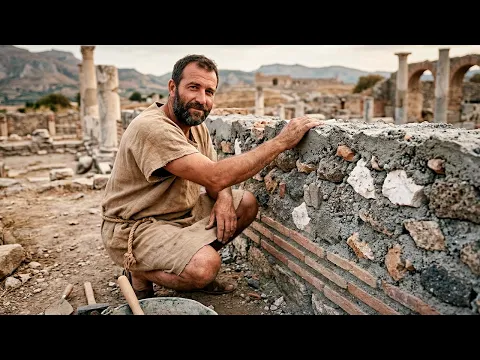

In the method reconstructed from ancient samples, the Romans did not hydrate the lime before mixing.
They placed the lime directly with the still dry volcanic ashes and only then added water.
This contact generated a strongly exothermic reaction, with internal temperatures above 200°C. This heat created compounds that simply do not form at room temperature.
This process is the core of the extraordinary behavior of Roman concrete.
Since the lime did not dissolve completely, some of it remained trapped inside the hardened mass as light clasts.
When water entered through small cracks, it reached these reactive points, dissolved the available calcium, and created a solution that traveled through the fissure.
Then, this material recrystallized as calcium carbonate and sealed the opening. It was not a superficial patch, but the generation of new binding material within the damaged point.
Pompeii Frozen the Work and Confirmed the Process
The decisive confirmation did not come only from the laboratory. It also appeared in Pompeii, where a Roman construction site was preserved by the eruption of Vesuvius in 79 A.D.
In the Regio IX district, archaeologists found walls in different stages of execution, tools, organized tiles, and, mainly, distinct piles of raw materials ready for use.
For Masic’s team, that worked like a time capsule of ancient construction.
The analysis published in 2025 showed that the dry material was organized exactly as predicted by the hypothesis of the hot mix.
There was lime pre-mixed with volcanic ashes before the water was added. Moreover, the volcanic composition was more diverse than previously thought, with several minerals reacting at different rates.
Pompeii confirmed that Roman concrete did not harden all at once; it continued transforming after it was ready.
Why Roman Concrete Gets Stronger With Time
The explanation for the strength gain lies in the fact that Roman concrete remains chemically active.
The fragments of lime react when water arrives, while the volcanic components continue to form new mineral deposits over long periods.
This means that the material not only seals cracks but also continues to fill micropores and consolidate its internal matrix.
The tests mentioned in the data reinforce this point. Samples reproduced with the ancient method were broken and subjected to water flow.
In about two weeks, the fissures closed, and the flow dropped to zero. Meanwhile, the concrete made without lime, following the modern pattern with hydrated lime, continued allowing water to pass through even after 30 days.
This difference explains why Roman concrete not only lasts longer but can actually become stronger over time.
What This Discovery Exposes About Current Construction
The rediscovery of Roman concrete also exposes an environmental and economic discomfort.
The production of Portland cement accounts for approximately 8% of global carbon dioxide emissions, and all of this supports a material that often only lasts a few decades of optimal performance.
Meanwhile, the total investment gap in infrastructure in the United States has been estimated at US$ 3.7 trillion, with US$ 191.3 billion just to rehabilitate bridges.
This does not mean that the Roman method will replace all modern concrete. The data itself recognizes limitations of curing times, labor, and availability of pozzolanic materials.
Still, for foundations, retaining walls, patios, walls, and structures where permanence weighs more than speed, Roman concrete seems rational again.
The discovery does not prove that the ancients knew everything, but it shows that modern engineering abandoned a solution that effectively addressed the durability problem.
What engineers and scientists discovered was not just an ancient recipe but a construction principle that had been misread for centuries.
The Roman concrete of the Pantheon and Pompeii showed that lime, used in the correct order, transforms the material into an active system capable of sealing cracks and continuing to evolve long after hardening.
In the end, the great irony is clear. While modern construction prioritized speed, standardization, and immediate cost, the Romans produced a material that was slower, more labor-intensive, and much more durable.
Do you think current engineering should recover part of this logic of Roman concrete, or will the sector continue to prefer faster materials, even knowing that they age too soon?






A engenharia moderna poderia tentar recuperar a técnica romana na construção aliada a padrões modernos pensando na construção civil de maneira que proteja o meio ambiente, as pessoas que utilizam essas construções modernas para moradias e também como aqueles edifícios comerciais que abrigam inúmeras setes humanos que trabalham para apoiar e inovar o progresso tecnológico no mundo. Não sou dessa área, mas, achei muito interessante a pesquisa e essa descoberta. Parabéns aos pesquisadores.
Deveriam adotar o método usado na construções de Pompeia e do Panteão, com certeza!
mas acho que já estão fazendo testes , acho que foi uma estudante que descobriu e já está sendo utilizado. Pois qdo ouvi a reportagem achei muito interessante , pois minha casa está caindo aos poucos 🤔🤭🤷🏼♀️