





 Portuguese
  English
  Spanish
  7 min of reading
  4 comments


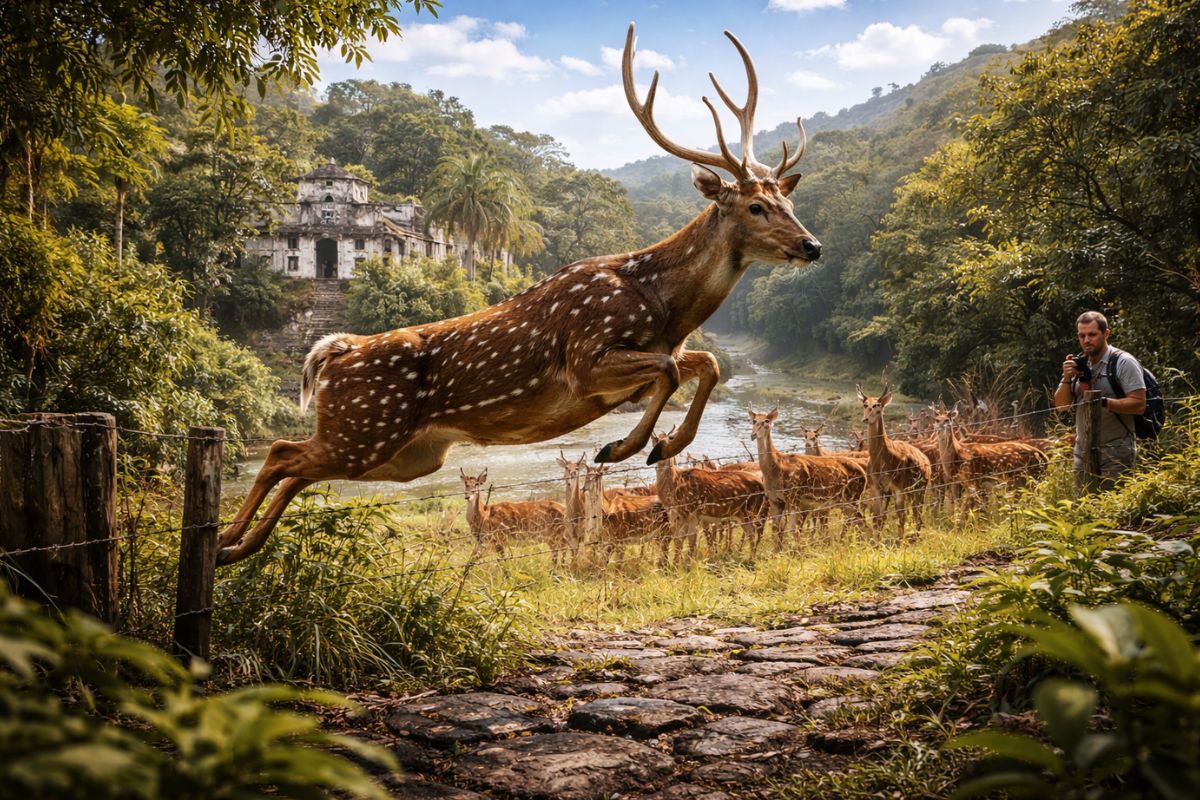


While Pablo Escobar’s Hippos Made Headlines, An Invader Grew In Silence: The Asian Chital Deer Is Already Forming Herds In Doradal, Jumps Up To 3 Meters, And Raises Alerts From Colombian Environmentalists Since 2024
For decades, when talking about Pablo Escobar’s animals, all attention turned to the hippos that escaped from the old Hacienda Nápoles and multiplied uncontrollably. They became a global symbol of an invasive species, led to million-dollar management operations, and dominated the environmental debate. Meanwhile, an invader grew silently in the forests and pastures of Doradal, Antioquia: the chital deer, a medium-sized Asian herbivore with impressive antlers and white spots on its back, almost as photogenic as it is dangerous to local ecosystems.
Only in mid-2024 did cowboys, residents, and environmental technicians start to notice that this invader grew in silence alongside the hippos. Herds of around 30 animals began to be seen more frequently, coming in and out of cattle pastures, crossing patches of teak forest, and behaving as if they had always been part of the landscape. Beautiful, discreet, reminiscent of the “Bambi” from films, but with the potential to cause deep damage to Colombian biodiversity.
From Escobar’s Private Zoo To Doradal Herds
It all started about 40 years ago when Pablo Escobar set up a private collection of exotic animals at Hacienda Nápoles.
-
More than 20,000 positions could be opened, and thousands of technicians are starting to be trained in Brazil, as the expansion of data centers creates an urgent race for professionals to keep the internet, cloud, and artificial intelligence running 24 hours a day.

-
China approves the 15th Five-Year Plan 2026-2030 to become a global power: prioritizes brain implants, 6G with AI, humanoid robots, flying cars, quantum technology, and nuclear fusion, while strengthening defense and the economy.

-
HONOR X80i arrives with a massive 7,000 mAh battery, a 120 Hz AMOLED display with a brightness of 6,500 nits, and the new Dimensity 6500 Elite chip, promising up to 22 hours of video playback and impressive performance in casual gaming.

-
Xiaomi TV Stick HD 2 is announced with Google TV and dual-band Wi-Fi, offering 38% superior performance, HDR10+, Dolby Atmos, a quad-core chip, Mali-G31 GPU, 1 GB RAM, and support for 1080p at 60 Hz.


Among hippos, other African species, and animals from various parts of the world, Asian chital deer were also brought, native to Asia and already known in other countries as a problematic species in environments where they were introduced.
According to local records and reports, some of these deer escaped and found a perfect scenario to adapt in Doradal.
Open pastures, areas of fragmented forest, little regulated hunting, and a favorable climate created ideal conditions for this invader grew in silence, away from the focus that always fell on the hippos.
David Echeverri, head of the biodiversity management office at Cornare, the environmental authority of Antioquia, has been working for years on controlling the hippos.
Among sterilizations and removals to Colombian zoos, he also started receiving reports of “different deer” on the farms.
When he was able to observe the animals calmly, there was no doubt: they were chital deer, the same species that Escobar imported from Asia.
The Cowboy’s Eye Who Saw The Invader Grow In Silence

If technical reports help explain the problem, it’s the daily life of people like Willington Herrera that shows how this invader grew in silence.
At 21 years old, he works on a ranch in Doradal, wakes up at 5 a.m., organizes the corral, milks a cow, and then goes to the pasture, rotating the cattle between different areas so as not to wear out the grass too much.
It was during these back and forths that Willington began to notice deer he had never seen before. According to him, a herd of approximately 30 individuals began to frequently cross the grazing areas, always alert, ears up, reacting to the slightest sound. When startled, they run away and display an impressive skill:
According to the cowboy, these deer can jump between 2 and 3 meters in a single leap, easily overcoming fences and obstacles.
At the same time, they present a gentle image, reminiscent of the Disney deer, which reinforces the residents’ fondness. For many, they “are like cows that only eat grass and don’t harm anyone.”
An Asian Species Adapted To Colonize New Territories


In Colombia, there are five native species of deer, but in the Middle Magdalena region, the local populations disappeared a long time ago, pressured by hunting and deforestation for cattle ranching between 200 and 300 years ago. The ecological void opened the way for a new occupant: the chital deer, also called axis.
The chital is a deer of Asian origin, already introduced in various parts of the world for sport hunting, which has led to recurring problems of biological invasion.
In Colombia, it found a dangerous combination: altered landscape, presence of cattle, fragmented forest, and low risk perception on the part of the population.
This invader grew in silence because it is not as charismatic as the hippos, does not appear in large herds by lakes, does not attack people, and does not attract as much media attention, explains Echeverri.
Its behavior is more sensitive, stealthy, “unpleasant” to those who try to approach, making it more difficult to record and monitor its expansion.
Doradal, The “Little Colombian Africa” With Touches Of Greece And Deer From India
Doradal has already become known as a kind of “little Colombian Africa.” Jaguars share territory with African hippos, Asian deer, cattle, and landscapes designed for tourism, including an entire neighborhood inspired by the Greek archipelago of Santorini.
Streets that look European, the banks of the Magdalena River, and in the background, a mosaic of native and invasive species competing for space.
In the surroundings, the chital deer share the landscape with jaguars, tapirs, capybaras, and other local wildlife, although there are still no detailed studies on the impacts of this coexistence.
In hotels in the region, guests report frequent sightings of deer in water sources and open areas, especially at dawn and dusk.
Meanwhile, residents continue to see the animals in a predominantly positive light. They are considered beautiful, photogenic, “different.”
This friendly perception helps explain why the invader grew in silence, without anyone pressuring for control measures, unlike what happens with the hippos.
Why “Pretty and Harmless” Invaders Also Worry Scientists

At first glance, the deer seems not to pose a direct danger to people, unlike hippos, which can be extremely aggressive and are noted in Africa as one of the leading causes of death from wild animals.
However, this does not mean that the problem is small. Invasive species can profoundly alter the dynamics of ecosystems that have not evolved with them, even when they are herbivores and “apparently harmless.” In the case of chital deer, there are concrete risks:
- Competition for food with native herbivores, such as tapirs and capybaras, which may be displaced from important areas.
- Impact on vegetation regeneration, as constant grazing may inhibit the proper recovery of pastures and regenerating forest areas.
- Imbalance in the food chain, favoring some predators over others and altering behaviors.
The UN itself considers invasive species the second leading cause of biodiversity loss in the world, generating estimated costs of over $423 billion per year.
According to the Ministry of Environment of Colombia, the country already records 1,907 exotic species among animals and plants, many of which have invasive potential.
In this scenario, it is not surprising that another invader has grown in silence until it became a national concern.
What Science Knows, What It Does Not Know, and What Needs To Be Done
If there’s anything that makes the case even more delicate is that the chital deer has hardly been studied in Colombia until now. There are no detailed publications about its ecology in the country, only reports of presence and initial observations.
Cornare has begun to set up a “participatory science” effort, asking residents to report where they see the animals, how often, and in what contexts.
Camera traps have already been installed at some points, and technical teams are trying to map areas of use, activity times, and herd sizes.
Even so, little is still known about the real impact of this invader that grew in silence in the landscapes of Doradal.
With the experience accumulated in controlling hippos, one of the possibilities under discussion is the use of contraceptive methods, applied at a distance with specific darts.
The idea would be to sterilize part of the deer population without directly capturing them, reducing the stress that can lead to the so-called capture myopathy, a situation in which the animal undergoes physiological collapse due to extreme fear.
The challenge, however, is great. Marking each sterilized animal is difficult, there is a risk of applying the treatment more than once to the same individual, and any remote management requires extreme care for animal welfare.
Another alternative that often comes up in these debates is controlled hunting, but in Colombia, sport hunting has been banned since 2020, and similar initiatives aimed at controlling capybaras in Orinoquia have already faced strong resistance.
When The Invader Grew In Silence, But The Time To Decide Is Running Out
In other countries, the chital deer has already shown what can happen when an invader grew in silence for too long.
In Hawaii, the species has been linked to the destruction of native forests and increased erosion. In Texas, where it was introduced for hunting, there are already reports of displacement of the white-tailed deer, a native species.
In Colombia, the script could be similar if nothing is done. Herds grow, resources are depleted in one area, small groups are displaced, and colonize new regions, gradually expanding the distribution of the species.
In the process, tapirs, capybaras, and other herbivores may be pushed out of key areas, changing ecological relationships that have taken thousands of years to establish.
The recent history of hippos themselves shows the cost of delay. Years of inaction have produced an expanding population, difficult to control, surrounded by ethical, political, and legal controversies.
Environmentalists fear that the chital deer will repeat the same curve, only without the visual spectacle that pressures governments to react.
In light of a scenario with almost two thousand exotic species in the country, Colombia is preparing a national plan to control invaders by 2030.
The chital deer, with its “Bambi” appearance and discreet behavior, seems small within this universe, but it is precisely how the invader grew in silence in Doradal and began to reshape the landscape without most people noticing.
And you, do you think a “pretty and harmless” deer, which arrived with Pablo Escobar and whose invader grew in silence for decades, should be controlled with the same firmness as the hippos or do you still have doubts about what to do with this new invasive species?







Mientras no los maltraten, ellos tampoco tienen la culpa de existir
¡Por Dios! Esto que dicen sobre esta especie me parece una gran majederia. Primero: Los primeros Chitales que llegaron a Colombia, no fueron los de Pablo Escobar, hacia los años ochenta del siglo pasado el Jardín Zoológico de Barranquilla llegó a tener más de treinta. Segundo: Todas las introducciones no son malignas; de igual modo llegaron a América, las cabras, las ovejas, las vacas, los caballos etc. Recordemos que nuestro glorioso café también fue un introducido. ¿Que sería de Europa, Asia y África, si América no les hubiera regalado el maíz, el tomate, el cacao, el aguacate etc, etc. No permitamos que los chitales sean víctimas de la obsesión enfermiza de algunos “conservacionistas”. Gracias a estos intercambios, la humanidad ha logrado afrontar con éxito las crueles hambrunas del pasado. Ojalá estos ciervos chitales o gamos, lograrán llenar el espacio que quedo cuando asesinamos, en nuestro Caribe, por ejemplo, el último venado sabanero (Odocoileus virginianus) que lo extinguimos y de esto nadie ha dicho una sola palabra. Es cierto que hay especies invasoras malignas, pero creo que jamás pueda serlo un cérvido, animales que nos prveen de carne leche y pieles y que jamás han constituido una amenaza en ningún lugar de nuestro planeta, solamente cuando el ser humano se empeña insensatamente en multiplicarlos intensivamente por voraces propósitos comerciales.
Texto excessivamente longo e repetitivo. Repete 100 que “cresceu em silêncio”. Chato!