





 Portuguese
  English
  Spanish
  4 min of reading
  0 comments


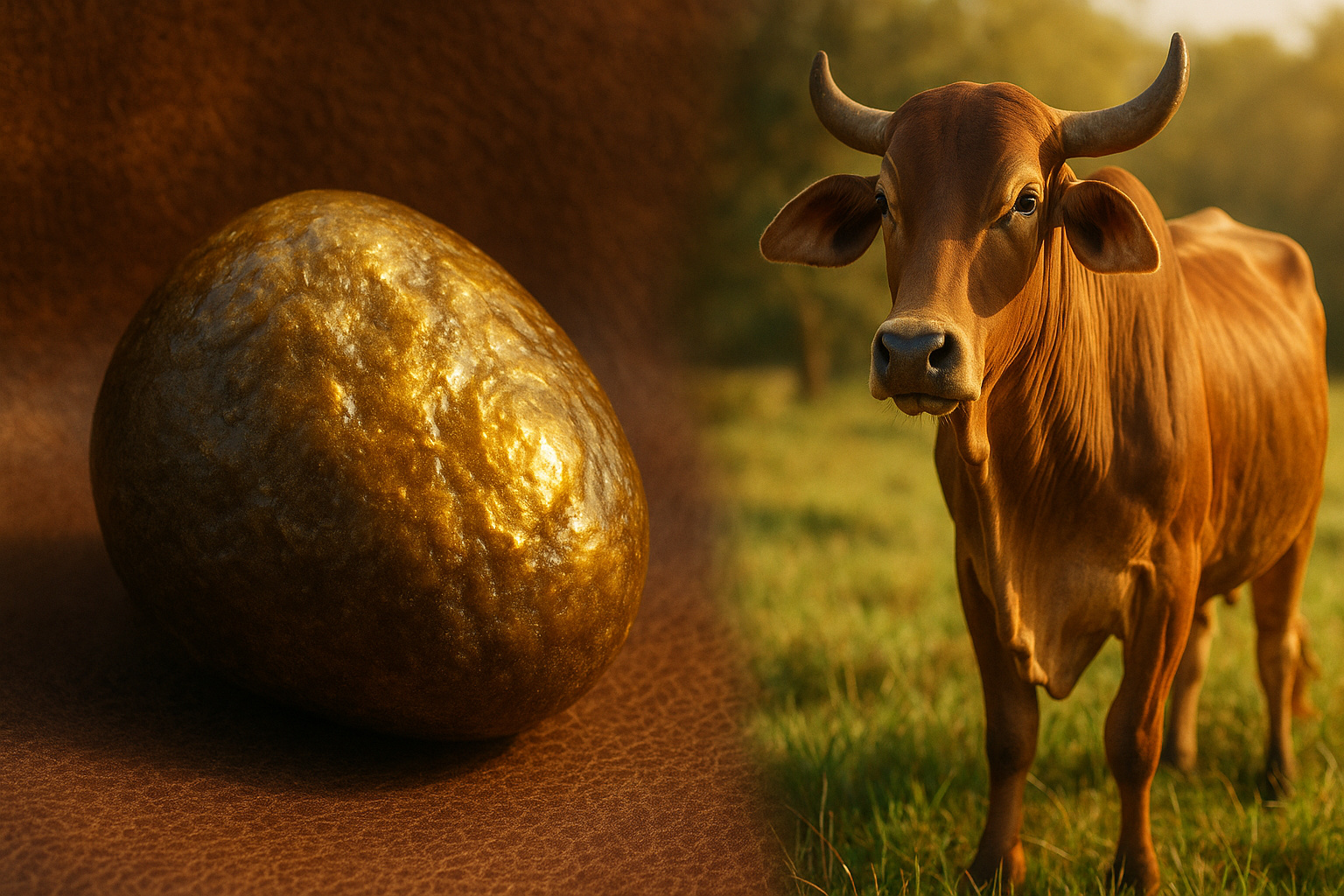
Hidden Wealth in Pasture: Learn How a Rare Physiological Residue Became a Luxury Item in the Asian Market and Moves Fortunes with Clandestine Exports
The so-called “bovine gold” has sparked curiosity and interest in Brazil and abroad. It refers to biliary calculi from cattle, a rare substance formed within the gallbladder of these animals that can surprisingly reach values of up to R$ 300,000 per kilogram. The catchy name is justified by the high market value and scarcity of the product, making it a true treasure in international trade.
According to veterinarian Walter de Oliveira Graça Júnior, an agricultural technician in the region of Itapetininga (SP), these stones are composed of cholesterol, bilirubin, and mineral salts that accumulate in the body over many years. “It is a physiological residue that only appears over time. Older animals, raised extensively, are more likely to develop these calculi,” explains the specialist.


Why Is It So Rare to Find “Bovine Gold”
The rarity of biliary calculi is directly linked to the production model of Brazilian cattle ranching. Due to the high demand for meat, the country has adopted early slaughter, sacrificing young animals with few years of productive life. This drastically reduces the chances of biliary calculus formation, which requires time and specific health conditions for the animal.
-
These living root bridges and ladders are over 700 years old and help indigenous people survive in one of the rainiest regions in the world.

-
From sertanejo star to international investor: Ana Castela invests millions in a mansion in the USA, creates a themed accommodation in Orlando, and shows that the “boiadeira” also wants to grow away from the stage.

-
The 10 most stunning motorhomes in the world: a $3 million trailer with a rooftop nightclub and garage for a Ferrari, “palaces on wheels” with Italian marble, private cinema, and five-star hotel luxury for billionaires.

-
Trump wanted to spend $400 million on the White House, but the courts prohibited the million-dollar construction.

“To meet market demand, cattle are slaughtered increasingly earlier. This prevents biliary calculus from forming,” explains Walter. He adds that only two out of every 100 cows may develop the stone, usually small, measuring between one and five centimeters in diameter.
This scarcity factor makes the product highly valued. In the Asian market, where there is constant demand, the kilogram can range from R$ 100,000 to R$ 300,000, depending on the material’s purity and color. Brazil, according to the specialist, produces about 2,000 kilograms per year, resulting from the slaughter of approximately 2,000 cattle for each kilogram obtained—a figure that highlights how rare and expensive “bovine gold” is.
The information was disclosed by G1, which also highlighted cases of police seizures, such as the one recorded in Iaras (SP), where more than 1.1 kilogram of bovine bile was found, valued at R$ 800,000.

What Is the Gallbladder Stone from Cattle Used For
Bovine biliary calculus has been used traditionally in Chinese medicine for over 2,000 years. The product is used to manufacture natural remedies for neurological disorders, seizures, and fevers, and is also employed as a spiritual amulet in some cultures. In Asia, it is considered a high-energy and medicinal ingredient, keeping the trade bustling.
However, in Brazil, ANVISA (National Health Surveillance Agency) does not recognize therapeutic properties in these substances. Thus, there is no official regulation allowing the medicinal use of the material in national territory. Despite this, international demand keeps the parallel market active, with exports often clandestinely.
A Valuable and Almost Invisible Trade
Although the commercialization is not formally prohibited, it almost always occurs outside official channels, without health supervision and without tax collection. Often, the stones are illegally removed from slaughterhouses, hidden in backpacks or exported by intermediaries linked to international smuggling.
“It is not forbidden to sell, but it is an informal market,” details Walter. “There are people who extract the material in slaughterhouses and sell it without control, even to other countries.”
This parallel market has become so lucrative that it has already attracted the attention of law enforcement agencies. In one of the most recent seizures, the Highway Police found a backpack containing 1.181 kilograms of bovine bile, valued at over R$ 800,000, reinforcing how coveted “bovine gold” is.
Between Myth and Profit: The Fascination That Keeps the Bovine Gold Market Alive
“Bovine gold” is one of the most valuable and controversial curiosities in the Brazilian agribusiness. While for many it is just a physiological residue, for others it represents a biological treasure of high cultural and economic value. Amid the ancient tradition of oriental medicine and the modern clandestine market, the gallbladder stones from cattle continue to evoke fascination—and fortunes—around the world.









-

-

5 pessoas reagiram a isso.