





 Portuguese
  English
  Spanish
  5 min of reading
  0 comments


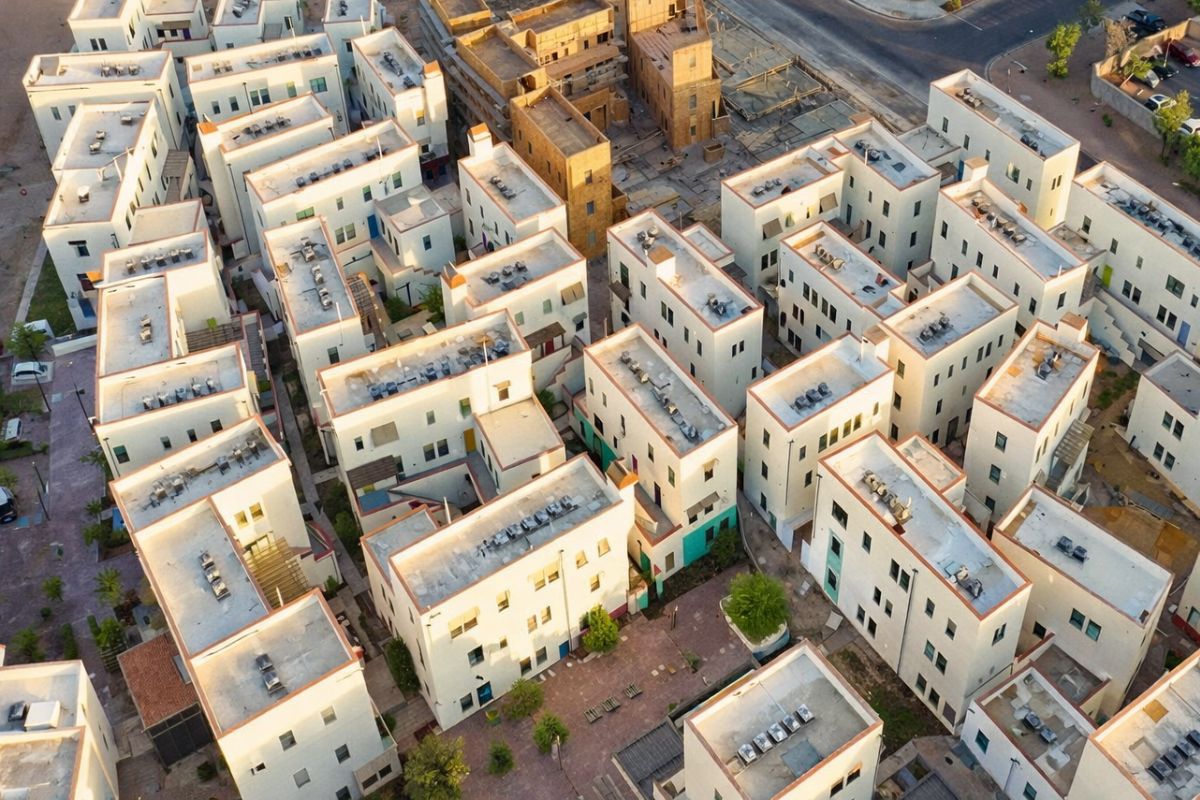
In The Arizona Desert, The Culdesac Project Eliminates Parking, Provides Unlimited Light Rail And Electric Bike Pass, Integrates Waymo, Lyft And On-Demand Car Rental, And Tries To Prove That Housing Plus Transport Costs Less, Reduces Daily Stress And Rebuilds Neighborhood Bonds In American Cities, With A Focus On Urban Quality.
In Arizona, the Culdesac proposal starts from a simple and radical idea: to reorganize urban life so that daily commutes don’t depend on private cars. The neighborhood was planned from scratch in Tempe, next to a light rail station, with housing, services, and mobility concentrated in the same area.
The bet combines logistics and behavior. Instead of parking spaces, the project prioritizes walking, electric bikes, and access to different modes on demand. The central promise is not to “prohibit the car,” but rather to reduce reliance on it, with a direct impact on monthly costs, travel time, mental health, and relations among residents.
What Was Built In Tempe And Why It Draws Attention

Culdesac is born as the first completely car-free neighborhood built from scratch in the United States, in an area of 17 acres in the Arizona desert. The location was not random: the venture was deployed in front of a light rail station, precisely to connect residential daily life to high-frequency public transport.
-
These living root bridges and ladders are over 700 years old and help indigenous people survive in one of the rainiest regions in the world.

-
From sertanejo star to international investor: Ana Castela invests millions in a mansion in the USA, creates a themed accommodation in Orlando, and shows that the “boiadeira” also wants to grow away from the stage.

-
The 10 most stunning motorhomes in the world: a $3 million trailer with a rooftop nightclub and garage for a Ferrari, “palaces on wheels” with Italian marble, private cinema, and five-star hotel luxury for billionaires.
-
Trump wanted to spend $400 million on the White House, but the courts prohibited the million-dollar construction.



In urban design, the logic was to invert traditional priorities. Instead of expanding asphalt for parking, the project allocates 55% of open space for coexistence, circulation, and landscaping. The change appears aesthetic, but it is structural: when the land is no longer dominated by parked cars, it returns to fulfilling the function of a neighborhood.
How Mobility Works Without A Personal Car

The daily operation combines several layers of transport. Residents receive unlimited light rail and electric bike passes, as well as access to services like Waymo, Lyft, and car rentals for specific situations, such as weekend trips or demands outside the immediate area.

This portfolio creates a logic of choosing by occasion, not by ownership. Those who need short commutes use light modes; those who need longer routes activate on-demand transport; those who need a car use one for a limited time. The key point is to swap “mandatory ownership” for “flexible access”.
How Much It Costs To Live In This Logic And Where The Real Economy Is

One of the strongest arguments of the model is financial. The average monthly cost of maintaining a car, including payment, insurance, and maintenance, was presented in the range of US$ 800. When this expense ceases to be fixed, some residents begin to combine light rail and bike, reducing the weight of transportation in the overall household budget.

The project itself emphasizes that the relevant calculation is not just rent but “housing + transport.” There are different profiles coexisting: some save directly, while others use more app services for comfort and convenience. Still, the debate shifts from apartment price to total cost of living in the city, which is the closest indicator to real life.
Commerce, Services And Proximity Routine

On the ground floor and in the immediate surroundings, the neighborhood includes a restaurant, grocery store, bike shop, gym, yoga studio, and micro-businesses such as a vintage clothing store, podcast studio, and home decor shop. This arrangement reduces short trips and transforms dispersed tasks into paths of just a few minutes, often made on foot.
At the same time, the project does not sell the idea of complete self-sufficiency. It integrates with the city to access larger functions such as schools, hospitals, and large shopping centers in Tempe. The proposal is not to isolate residents in an “urban island,” but to shorten basics and better connect to the rest.
Community, Health And Behavioral Adaptation
Residents’ reports indicate increased social interaction and a sense of belonging. Instead of circulation centered around a garage and parking elevator, the routine passes through common areas, local commerce, and gathering spaces. This increases daily contacts and strengthens neighborhood networks, especially in an urban context marked by isolation.
But the transition is not automatic. Those who have lived years driving everywhere need to relearn rhythm, planning, and tolerance for small waits. In return, many report less stress in traffic and more control over their daily time. The model works best when infrastructure and usage culture change together.
Scale, Limits And What Arizona Is Really Testing
The community has already surpassed 100 residents, with plans to reach several hundred in the short term and an estimated capacity of 1,000 people after the second phase. On an urban scale, it is still an experiment, but of sufficient dimension to test operation, behavior, and economic performance under real conditions.
The designers themselves acknowledge that this is not a perfect format nor universal for any territory. What the Arizona case offers is a practical reference: if a neighborhood of this type can operate in the desert, with heat, distances, and a strong car culture, it opens up a concrete discussion for other cities in the United States. The question shifts from ideological to a matter of applicable urban design.
The Tempe experiment shows that living without a car can be less about sacrifice and more about the intelligent reorganization of infrastructure, services, and routine.
If a neighborhood in Arizona managed to reduce automotive dependency without cutting access to the city, what would be, in your reality, the first indispensable element for you to consider a life with less car: cost, time, safety, or neighborhood quality?







-

-

-

6 pessoas reagiram a isso.