





The white dwarf RXJ0528+2838 pushes interstellar gas like the bow of a ship pushes water, but it does not present the accretion disk pointed out as essential to feed this type of structure, and the study published in Nature Astronomy admits not having a complete explanation for the energy involved in the process.
Anyone observing the image captured in the northern Chilean desert sees a red, green, and blue arc drawn in the vacuum, just in front of a star that should be extinguished and inert.
Formed by what remains of a star that has already consumed all its nuclear fuel, this star no longer has fusion occurring within it and, according to accepted models, should not be able to push matter with enough force to draw any structure in the space around it.
According to the European Southern Observatory, responsible for the telescope that recorded the images, the discovery is as enigmatic as it is impressive and challenges the current understanding of how already dead stars interact with the surrounding medium.
-
Growing by 1.3% in the year and marking two consecutive years of increase, Brazil’s construction sector GDP advanced at a more moderate pace than in 2024, even with employment in the sector reaching 2.9 million workers.

-
Producing 29.4 million tons and breaking records, Brazil’s pulp production grew by 6.9% in 2025 and boosted exports, which also reached a historic mark, with 20.7 million tons shipped during the year.
-
Elon Musk reveals when artificial intelligence could surpass humans, explains how Tesla, SpaceX, xAI, humanoid robots, and a million satellites can transform work, drive an era of technological abundance, and change the future of humanity by 2036.

-
Two friends turned a bathroom into a boat, installed a 9 hp engine and a grill, and crossed 18 kilometers on a homemade raft.


White dwarf that should not shine
RXJ0528+2838 is a white dwarf, that is, the dense and hot core that remains of a low-mass star at the end of its life.


Reduced to a body with dimensions close to those of Earth, these stars can concentrate up to 1.4 times the mass of the Sun and emit only residual energy, which has earned them the nickname of zombie stars among astronomers.
By no longer fusing light elements into heavy ones, white dwarfs produce stellar winds considered too weak to generate the shock marks that usually accompany active and massive stars.
Located about 730 light-years from Earth, in the constellation of Auriga, this particular one orbits the center of the Milky Way in the same way as the Sun and the other stars of the galaxy.
A wave like the bow of a ship
As it moves through space, the star pushes the rarefied gas that exists between the stars and compresses this material in front of it.
Called a bow shock, the result is described by researchers as a curved arc of matter, similar to the wave that forms in front of a moving ship.
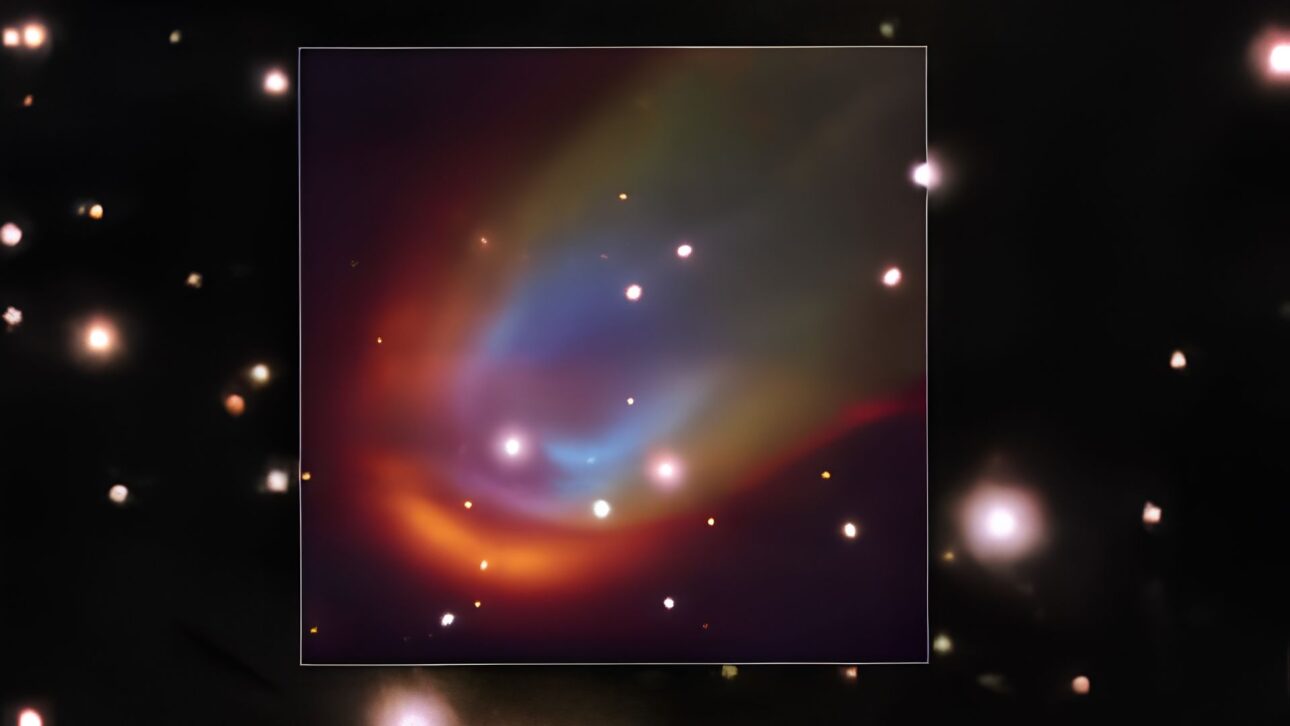
The colors recorded by the telescope are not decorative effects and indicate the chemical composition of the arc, with red corresponding to hydrogen, green to nitrogen, and blue to oxygen.
Similar phenomena had already been documented, but always associated with fast stars that lose mass rapidly or explosive eruptions, situations quite different from what was found now.
Recorded in a system described by the researchers themselves as silent and stable, the arc breaks this pattern by appearing without any recent thermonuclear eruption to justify so much energy concentrated in such a small space.
The disk that simply isn’t there
The star is not alone. It is part of a binary system and has a companion similar to the Sun, from which it pulls material by gravitational attraction.
In pairs like this, the stolen material usually spins before falling, forming a hot and turbulent disk around the white dwarf, and it is from this disk that jets capable of producing a shock wave originate.
The observations, however, found no sign of this disk, and this absence turns the entire visible structure around the star into an open problem for astrophysics.
According to Simone Scaringi, associate professor at Durham University in the United Kingdom, and one of the study’s leaders, the team found something never seen before and, more importantly, completely unexpected.
Magnetic field is the main suspect
In the absence of the disk, researchers began investigating another possible source for the energy sustaining the phenomenon.
The central hypothesis involves the magnetic field of the white dwarf, confirmed by the data as exceptionally strong, capable of capturing the companion’s material and directing it straight to the poles of the dead star.
Channeled in this way, the gas never orbits the star long enough to form a disk, which would explain why the instruments do not detect the structure that models predicted to find there.
As summarized by Krystian Iłkiewicz, researcher at the Nicolaus Copernicus Astronomical Center in Warsaw, Poland, and co-leader of the work, the finding shows that even without a disk, these systems can produce powerful jets through a mechanism that is not yet understood.
A thousand years of activity without complete explanation
The size and shape of the arc allowed the estimation of how long the process has been ongoing, and the number surprised the team.
Calculated from the extent of the nebula, the period indicates that the star has been expelling material continuously for at least a thousand years, which deepens the mystery rather than solving it.
The data itself shows that the current magnetic field would only have the strength to sustain a bow shock for a few hundred years, meaning the main hypothesis explains only part of what astronomers are seeing.
Named by Scaringi as a mysterious engine, this yet unidentified component remains the central gap of the study, and the authors state that many other binary systems will need to be observed before any conclusion.
From the telescope in Spain to the instrument in Chile
The discovery did not begin in Chile. The first clue appeared in images from the Isaac Newton Telescope in Spain, when the team noticed a strange nebulosity around the star.
Once the anomaly was confirmed, the next step was to activate the Very Large Telescope in northern Chile and use the MUSE instrument to map the shock wave in detail and analyze its chemical composition.
According to Iłkiewicz, this step was decisive in confirming that the structure indeed originates from the binary system, and not from a nebula or an unrelated interstellar cloud.
Operated by an organization maintained by sixteen countries, the Very Large Telescope has been observing the southern hemisphere sky since 1998 and is today one of the main instruments used to investigate such phenomena.

After the initial astonishment, the team plans to monitor if the structure changes shape over time and look for similar phenomena in other nearby white dwarfs, which would help determine if the case is an isolated exception or the first example of an entirely unknown class.
How many other processes considered impossible by current science are happening right now in stars that astronomers have classified as dead and stopped observing closely?


