





 Portuguese
  English
  Spanish
  7 min of reading
  0 comments


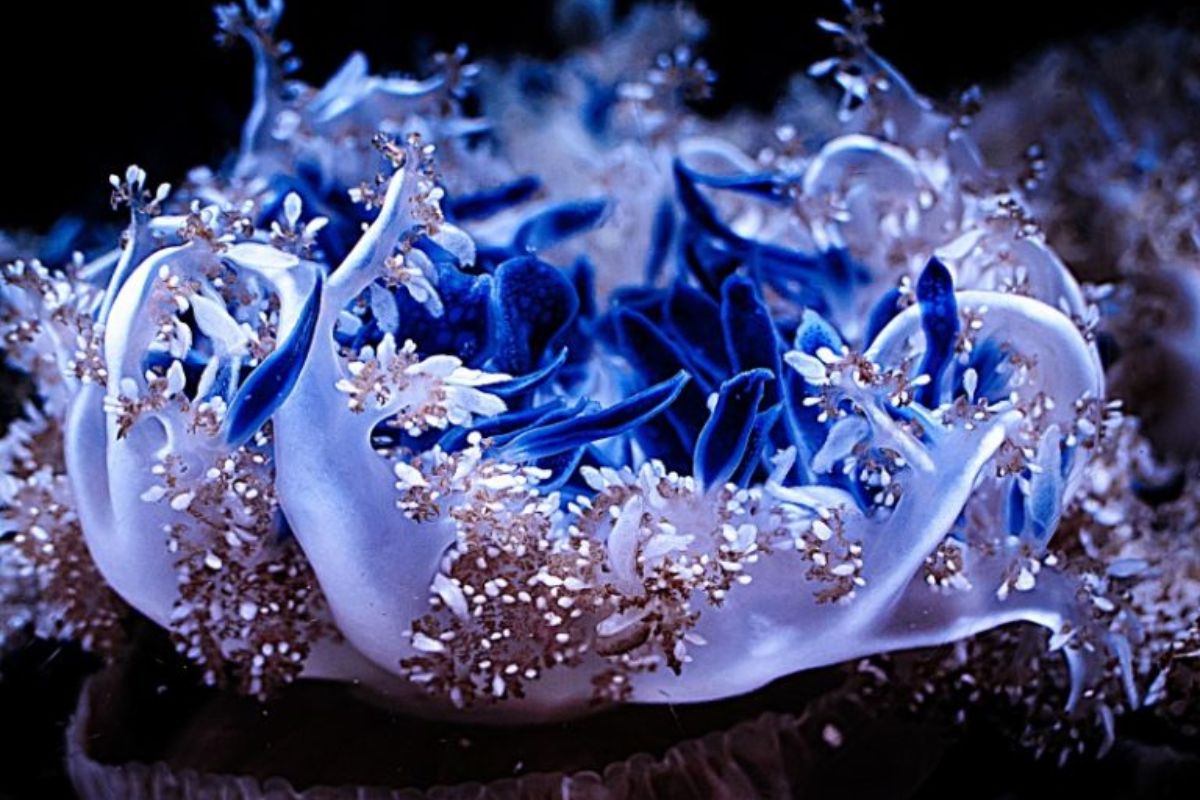
The Jellyfish Cassiopea Andromeda, Invasive Associated with the Red Sea, Was Confirmed Adult on the Brazilian Coast After Genetic Analyses. In Cabo Frio, the Population Exploded in 2008 and 2009, Rising from 2 Thousand Jellyfish in 200 m², Then It Declined and Disappeared, but Polyps Remain Present in Sections of the Coast.
Cassiopea andromeda does not behave like the “typical jellyfish” that many people imagine. It spends a good part of its life fixed upside down in shallow, calm waters, and this choice changes everything: where it can live, how it feeds, and why it can become a problem when it encounters the perfect scenario.
What is frightening is not only the number that has already appeared in Cabo Frio but also the pattern behind it. When an invasive species alternates invisible phases with outbreaks of adult jellyfish, it can “disappear” from radar for years and still maintain the chance of reappearing if conditions become favorable again.
The Jellyfish That Chooses a Place and Does Not Leave

Unlike species that swim in search of food and partners, Cassiopea andromeda tends to seek a specific spot and stay there.
-
An engineer designs a solar plane to fly on Mars at an altitude of 1,000 meters and a speed of 300 km/h, covering 16,000 kilometers in a Martian year, 900 times the distance traveled by the Ingenuity helicopter in three years on the planet before experiencing a rotor failure, and NASA is already funding the feasibility study.

-
A new phenomenon of contactless magnetic friction intrigues scientists and questions a theory that has been valid since the 17th century.

-
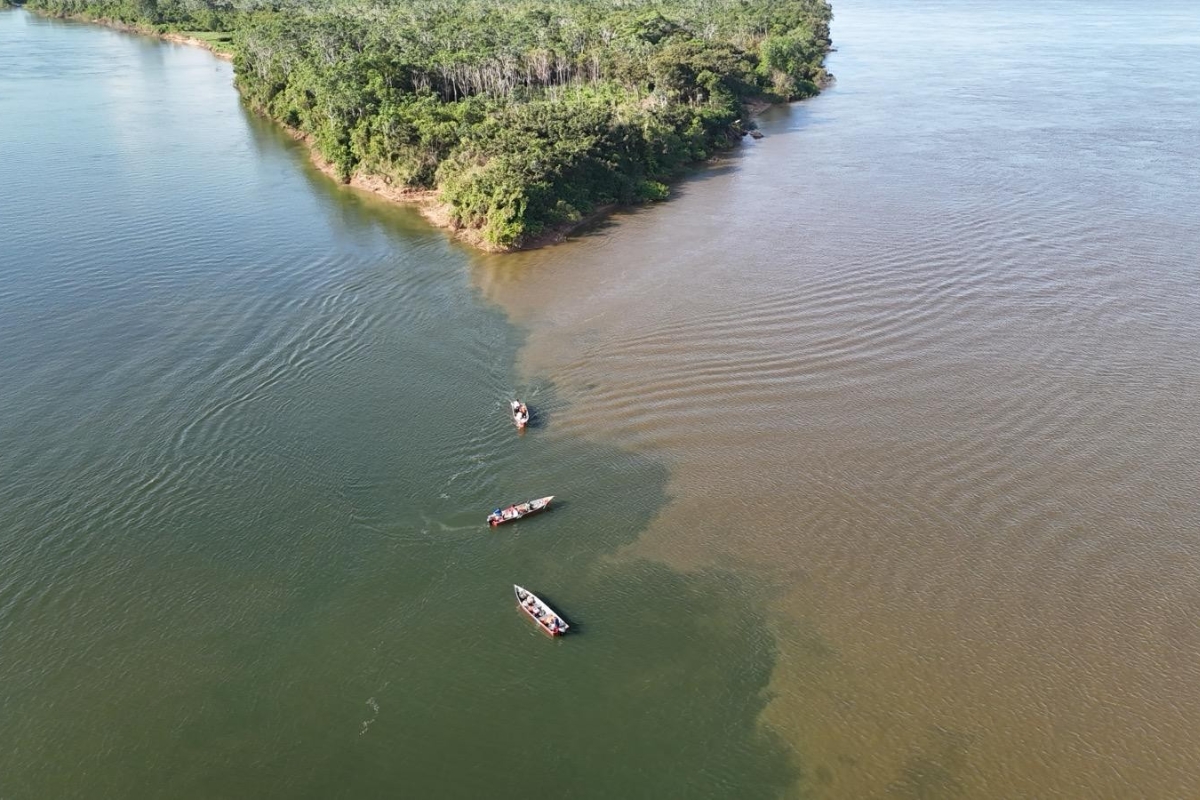
An impressive phenomenon in Northern Brazil causes rivers of different colors to flow side by side, revealing secrets about sediments, currents, and biodiversity.
-
While many schools are still struggling with the basics, a teacher in China went viral for having elementary school students build a two-stage rocket using plastic bottles, water, and pressurized air in a science class that caught the attention of the entire world.


The “ideal address” is quite demanding: calm, shallow, warm, and clear water. This environmental niche is what transforms the species into a specialist of protected, shallow areas, where sunlight and sandy bottoms come into play.
Living upside down is not a whim. It is a strategy for feeding and survival. When it is on the shallow bottom, Cassiopea andromeda can remain discreet while exploring the sediment, raising a cloud of small organisms to capture.
It is a low-noise hunt, done with patience and repetition, perfect for environments where predators and prey rely on quick perception.
From Almost Microscopic Polyp to Pizza-Sized Jellyfish
The life cycle of Cassiopea andromeda has two phases with completely different “personalities”: polyp and jellyfish.
The jellyfish is the adult, visible form, the one that draws attention during population outbreaks. The polyp, on the other hand, is tiny, sessile, and remains fixed on rocks, shells, or other solid structures. This phase can be a maximum of about 5 millimeters, small enough to go unnoticed for a long time.
Reproduction also helps explain the alternation between silence and explosion. In the adult phase, jellyfish reproduce sexually and generate polyps.
The polyps, in turn, can reproduce asexually, creating new genetically identical polyps, or, if the environment is favorable, “bud” and become jellyfish. In the adult stage, Cassiopea andromeda can reach between 30 and 40 centimeters in diameter, a scale that turns a shallow bottom into a showcase when the population grows.
The Dependence on Light and the Invisible Partnership That Feeds the Jellyfish
Part of the requirement for clear, shallow water has a crucial biological explanation: Cassiopea andromeda lives associated with a symbiotic organism, a dinoflagellate protist that performs photosynthesis.
In practice, this partnership creates a kind of shared “energy economy”: the symbiont produces carbon with sunlight and transfers part of this energy to the jellyfish, receiving shelter and protection in return.
This dependence on light redefines the risk map. Murky, deep, or very turbulent waters tend to be disadvantageous for the system, while closed, warm, and transparent locations can become stages for rapid growth.
That is also why Cassiopea andromeda fits so well with certain specific coastal environments and not necessarily with the entire coastline uniformly.
Cabo Frio Became a Laboratory for an Outbreak and a Disappearance
In 2008, the presence of a peculiar population drew attention in the Itajuru Canal, and, over time, the group involved in the identification confirmed, through genetic analyses, that it was indeed Cassiopea andromeda.
The comparison with public databases of genetic sequences indicated identical material to that of animals from the Caribbean and the Red Sea, reinforcing its non-native character and connection to ancient dispersal routes.
The outbreak was intense between 2008 and 2009 and, at its peak, accounted for more than 2,000 individuals in an area of 200 square meters. Then came the opposite of what many expect: the population entered a decline and, between 2012 and 2013, the jellyfish disappeared.
This “go and return” is the kind of behavior that confuses public perception, because it gives the impression that the problem is over when, in reality, it may have just changed phases.
How an Invasive Species Can “Disappear” and Remain on the Coast
The most uncomfortable point of the case is that, despite the disappearance of the jellyfish in Cabo Frio, the polyps remain present and have already been identified in different parts of the Brazilian coastline — including previous records back in 1999 at the Marine Biology Center of the University of São Paulo. This means that the “invisible” phase can remain silent, waiting for a favorable environmental window to return to producing jellyfish.
There are also indications that reinforce the hypothesis of an introduced species: the sudden disappearance and the fact that, in that population of Cabo Frio, all individuals were male.
In biological invasions, anomalous patterns of population composition and abrupt fluctuations can serve as clues that the species is not integrated into the local balance. In this sense, Cassiopea andromeda seems capable of alternating between discreet presence and localized explosions.
Where It Came From and Why the Route May Have Been Ancient
Genetic analyses suggest that the presence of Cassiopea andromeda in Brazilian waters is older than it seemed. A hypothesis raised is that the species arrived in the Americas during the age of exploration, with initial installation in Florida and the Caribbean, and later reached Hawaii and the South American coastline.
The logic is simple: the ocean connects what seems distant, and the historical traffic of vessels creates repeated opportunities for involuntary transport.
The proposed mechanism for this journey is the polyp phase: Sérgio Nascimento Stampar from the São Paulo State University (campus of Assis) described the possibility that the polyp may have attached itself to ancient vessels and thus reached Brazil.
When the most durable stage is also the most discreet, the introduction is easy to underestimate, because no one is looking for something that measures in millimeters.
Ecological Risk: What Can Happen if It Returns to Spread
Invasive species are a global concern because, without natural predators and equivalent competitors, they can dominate specific areas and compromise the survival of local species, generating ecological imbalance.
In some parts of the world, such as Japan, population explosions of jellyfish are treated as a serious problem: they can affect fish and other marine organisms, impacting aquaculture and fishing.
In the case of Cassiopea andromeda, the cited risk is more plausible in enclosed environments, such as bays and lagoons, where calm water, shallowness, and transparency create the perfect scenario.
At the same time, there is a more cautious assessment: due to its reduced mobility, the species is unlikely to disperse over large distances on its own, and the direct impact on humans tends to be limited.
The central point is the scale: it may not be “a widespread disaster,” but it can be “a local imbalance”, and that is already enough to concern those who depend on healthy coastal ecosystems.
What to Observe in Shallow Waters and Why Silence Is Not a Sign of Safety
If Cassiopea andromeda prefers calm, shallow, warm, and clear water, intuitive monitoring begins with the type of environment, not the “size of the coastline.”
Sheltered areas, channels, coves, and shallow bottoms with good light are natural candidates to host jellyfish when the adult phase reappears. And, if there are no jellyfish, this does not guarantee absence: there may be polyps out of common sight.
The second attention is ecological: outbreaks change the routine of small sediment organisms and can alter local interactions. Even without “panic,” the message is practical: observe patterns, record occurrences, and understand that biological invasions are not linear. Cassiopea andromeda may seem “solved” when it disappears, but the life cycle allows it to be just waiting for the “right” environment.
Cassiopea andromeda has become a symbol of a coastal paradox: a species that appears quiet and fixed can create rapid explosions when conditions align.
The story in Cabo Frio shows how an invasive species can alternate between invisible phases and jellyfish outbreaks, leaving doubts sabout what causes the decline and what might trigger a return. And, with polyps still present, the most disturbing question is not “if it exists,” but “when and where it will return to appear.”
I want to hear from you about something very specific: have you ever seen a jellyfish in a canal, lagoon, or bay and thought it was “normal” for that place? If you lived near a shallow, enclosed spot,





-

-

-

-

11 pessoas reagiram a isso.