





 Portuguese
  English
  Spanish
  5 min of reading
  0 comments



Wooden Buildings Are Springing Up Around The World, Replacing Steel And Concrete. Find Out Why This Sustainable Trend Is Gaining Momentum And How It Can Transform The Construction Industry!
At University of Toronto, a new building is coming to life, but what stands out is not just its strategic location near the soccer stadium or its imposing height of 14 stories. The difference of this building lies in how it is being erected — using large beams, columns, and panels made from manufactured wood boards. This construction process is part of a technological innovation called mass timber.
The concept behind mass timber goes beyond simply using wood in constructions; it involves the manufacturing of massive wood elements capable of replacing concrete and steel at various stages of construction.
As the wooden pieces arrive at the construction site, a crane positions them while workers fasten them with metal connectors, gradually transforming the project into an immense structure, reminiscent of assembling flat-pack furniture.
-
A megaproject worth R$ 89 billion is advancing in Iraq and promises to change the game in global trade by creating a new corridor between Asia and Europe, reducing traditional routes and repositioning the country as a logistics powerhouse.

-
Goodbye bedside table: floating shelves become a trend in 2026 by freeing up space in the bedroom, improving circulation, bringing visual lightness, and integrating technology without taking up floor space.

-
Israel, Greece, and Cyprus signed an agreement in 2020 to transport gas from the Mediterranean to Europe via a 1,872 km pipeline, but Turkey claimed sovereignty over part of the maritime route, and the project never materialized.

-
Israel, Greece, and Cyprus signed an agreement in 2020 to transport gas from the Mediterranean to Europe via a 1,872 km pipeline, but Turkey claimed sovereignty over part of the maritime route, and the project never materialized.

The Growth Of Mass Timber Usage
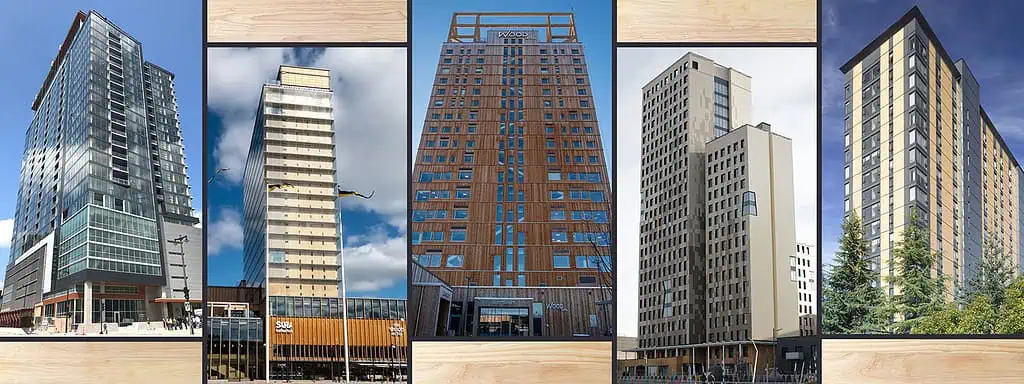
Although it is still relatively new, mass timber is becoming increasingly popular and has gradually appeared in urban landscapes around the world.
The tallest building made with this technique is currently Ascent, a 25-story skyscraper in Milwaukee, completed in 2022. According to the Council on Tall Buildings and Urban Habitat, in 2022 there were already 84 mass timber buildings with eight stories or more, either built or under construction, and another 55 in the proposal stage.
The majority of these constructions are concentrated in Europe, with approximately 70% of the projects, while 20% are in North America and the remaining in Australia and Asia.
In the United States, for example, over 1,700 mass timber buildings had been constructed by 2023. This type of construction offers an attractive alternative to concrete and steel, materials that together are responsible for almost 15% of global carbon dioxide emissions.
Although experts still debate the role of mass timber in combating climate change, many believe this technology to be more sustainable than traditional construction methods.
The Beauty And Efficiency Of Mass Timber Buildings
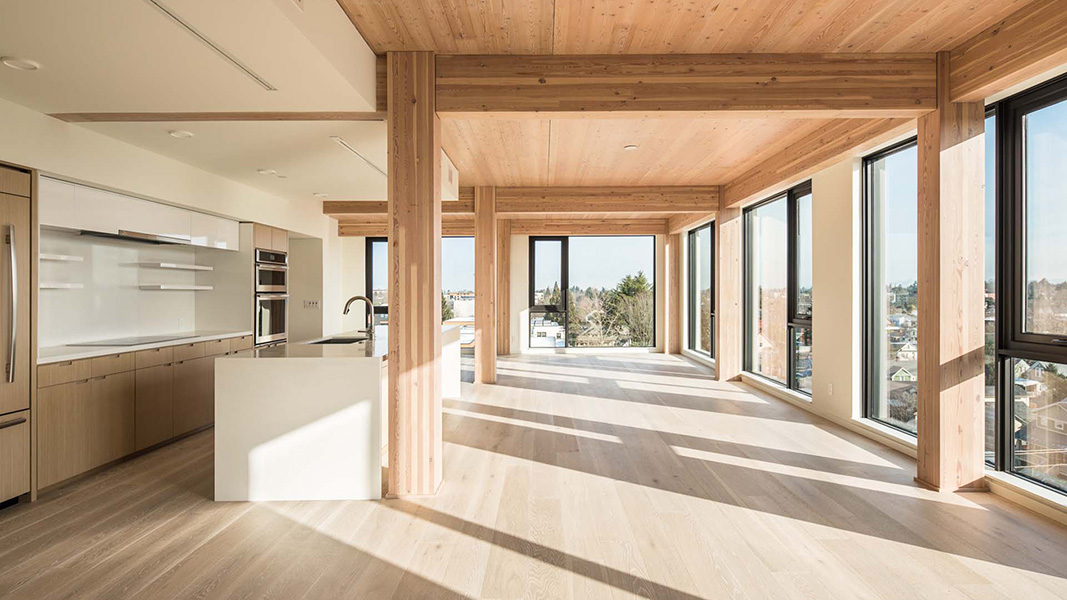
In addition to environmental benefits, mass timber offers an aesthetic appeal that distinguishes buildings constructed with this material. The warm and inviting appearance of wood, with its natural variations, can be more pleasing to the eye than steel and concrete.
As Ted Kesik, a building scientist at the University of Toronto, points out, “people get tired of steel and concrete,” but the look of wood can provide a more enjoyable experience.
It is important to highlight that the use of wood in large constructions is not new. During the 18th and 19th centuries, many factories and warehouses were built with wood beam structures and brick exterior walls.
However, with the evolution of architecture and the demand for taller buildings, wood gave way to concrete and steel.
This changed about 30 years ago when engineers and architects in Germany and Austria began experimenting with techniques to create massive wood elements from smaller pieces, without the need to fell large trees.
How Mass Timber Construction Works
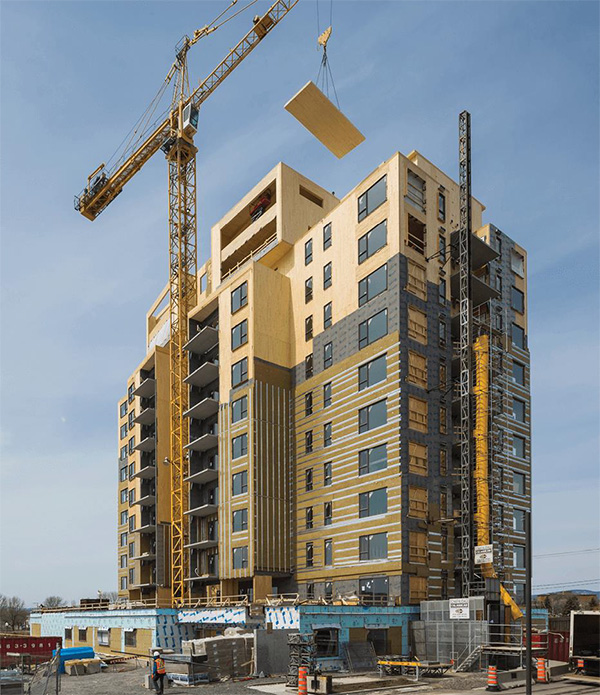
In practice, mass timber works similarly to plywood, but on a much larger scale. Smaller pieces of wood are glued and pressed together to form solid and durable masses.
Today, wooden beams of up to 50 meters in length, made with the so-called glulam (glue-laminated timber), can replace steel elements, while panels up to 50 centimeters thick, usually made of CLT (cross-laminated timber), can replace concrete in walls and floors.
These wood composites can be surprisingly strong, often more resilient than steel by weight. However, the taller the building, the thicker the wooden beams and supports need to be, which limits the exclusive use of this material in skyscrapers. For these projects, as in the case of Ascent, a combination of wood, steel, and concrete is often necessary to ensure structural stability.
Fire Safety And Other Concerns
One of the main concerns with the use of wood in tall buildings has always been fire safety. Until recently, many building codes limited the use of wood in low-rise buildings.
However, rigorous testing in gas chambers and fire simulations on mass timber models has shown that these materials can withstand fire long enough for firefighters to contain the flames and for occupants to evacuate the building.
These tests have convinced regulators and consumers that mass timber can be just as safe as other materials, especially because, in many cases, a layer of charcoal forms on the surface of the wood when exposed to fire, insulating the interior of the piece and slowing the spread of flames.
Aside from fire, moisture is another major challenge for this type of construction. Wet wood is susceptible to deterioration caused by fungi and insects, such as termites. Therefore, it is crucial to control moisture, both during transport and construction.
Moisture management techniques include proper ventilation systems and, in some cases, treating the wood with pesticides or physical barriers against insects.
Potential Benefits Of Mass Timber
One of the main reasons mass timber is attractive is its ability to combat global warming. The construction sector is responsible for 39% of global greenhouse gas emissions.
Diana Ürge-Vorsatz, an environmental scientist at the Central European University in Vienna, states that mass timber could be an important part of efforts to reduce these emissions. A 2020 study, for example, revealed that the 18-story Brock Commons building prevented the emission of 2,432 metric tons of CO2 compared to a similar concrete and steel construction.
However, the environmental benefits of mass timber depend on several assumptions, such as replanting trees after wood extraction and the disposal of construction waste. Not all the wood from a tree ends up in the building, and the material that is unused can release carbon if burned or disposed of improperly.
Still, mass timber is leading a new construction model called integrated design. In this model, construction planning involves all professionals from the outset, allowing for better control over the building’s components and speeding up the construction process, which can be up to 40% faster than conventional methods.
The Future Of Sustainable Construction
With the growing popularity of mass timber, the future of sustainable construction looks promising. Although challenges remain to be overcome, such as issues related to moisture and durability, mass timber represents a viable and environmentally friendly alternative to concrete and steel.
As technology advances and more research is conducted, this type of construction is likely to continue expanding, offering not only environmental benefits but also new aesthetic and functional possibilities for architecture.






Seja o primeiro a reagir!