





 Portuguese
  English
  Spanish
  3 min of reading
  0 comments


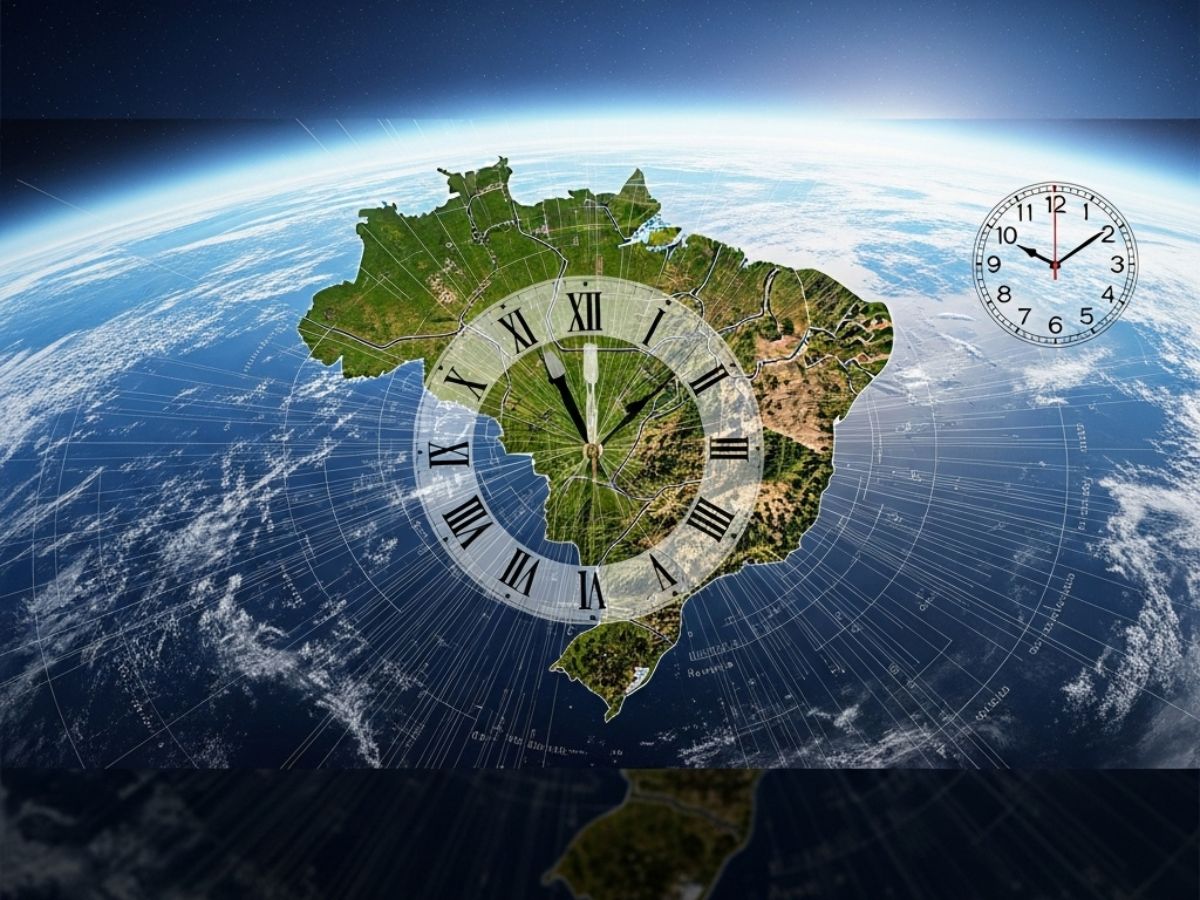
Understand How the Immense East-West Extension of Brazil Makes It the Only Country in South America with Four Official Time Zones, a Unique Characteristic on the Continent
Understand the geographical and historical foundations that make Brazil the only country in South America with four time zones. We will analyze each time zone, its legal evolution, and how this uniqueness impacts life in the country.
The Brazil, a nation of continental proportions, has a geotemporal characteristic that distinguishes it in South America: the adoption of four official time zones. This complex organization of time is a direct consequence of its vast territorial extension, especially in the east-west direction.
Knowing the Official Time Zones and Their Scope
The Brazilian temporal organization is defined by four time zones, all referenced to Coordinated Universal Time (UTC):
-
The United States has a serious problem with its F-35s: China is already producing fighters at a pace that exceeds American capacity and could manufacture up to 300 aircraft per year before the end of the decade, shifting the global military balance.
-
A retired IT professional built a 22-meter boat in his backyard in Oklahoma with a school bus engine, light pole masts, and handmade watertight doors to become the redneck version of Jacques Cousteau.

-
China is building a city in Brazil: a complex with an investment of R$ 5.5 billion comes to light, but allegations involving workers draw attention.
-
While Argentina buys old war equipment, Brazil is keeping an eye open and joins the select group of nations with advanced military technology by investing $5.2 billion, producing 36 Gripen fighters in the country, and reducing operational costs.


UTC-2: Covers the Brazilian oceanic islands, such as Fernando de Noronha, São Pedro and São Paulo Archipelago, Rocas Atoll, and Trindade Island.
UTC-3 (Brasília Time): This is Brazil’s official time zone and the most well-known. It covers all states in the South, Southeast, and Northeast regions, the Federal District, and the states of Goiás, Tocantins, Pará, and Amapá.
UTC-4: Includes Mato Grosso, Mato Grosso do Sul, Rondônia, Roraima, and most of the state of Amazonas.
UTC-5: Comprises the state of Acre and the westernmost portion of Amazonas.
The Brasília Time (UTC-3) acts as the main national synchronizer due to the population and economic concentration in the areas it covers.
Why Is Brazil the Only Country in South America with Four Time Zones? The Geographical Explanation and Longitudinal Extension
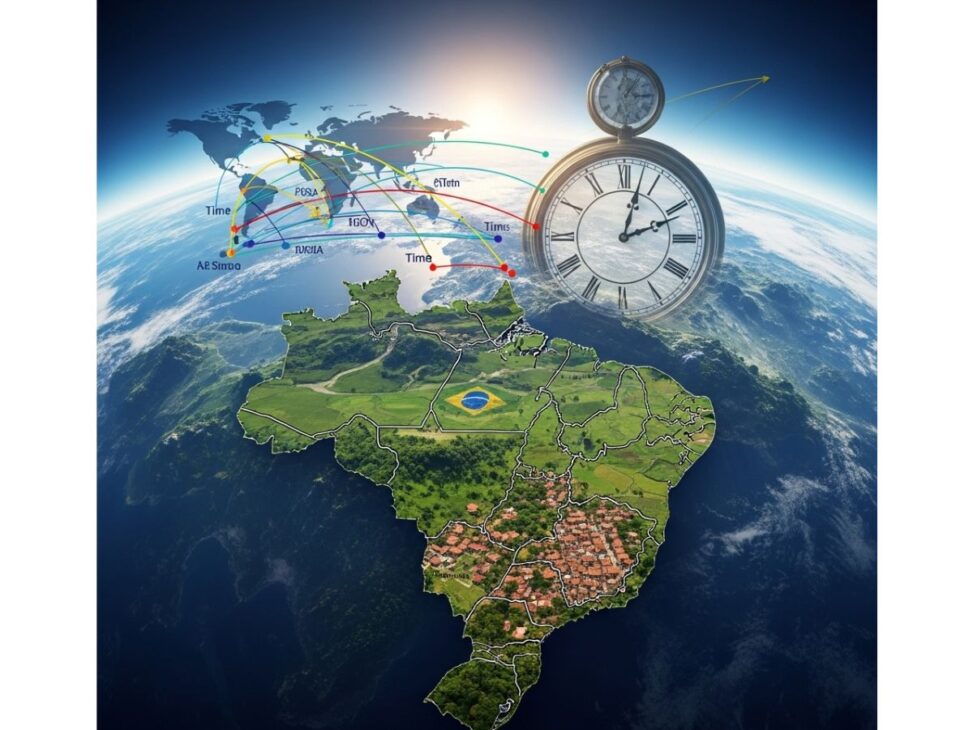
The need for multiple time zones in Brazil is dictated by its geography. With an area of 8,515,767.049 km², its east-west extension is 4,319.4 km. This longitudinal range of approximately 39.2 degrees results in a solar time difference of about 2 hours and 37 minutes between the eastern and western extremes of the continental country.
A system of four time zones (with a total variation of three hours in the official time) accommodates this natural variation, seeking to align legal time with local solar time.
The History and Evolution of Brazilian Legal Time
Legal time in Brazil was formally established by Decree No. 2,784 of 1913, which set four time zones based on studies by engineer Henrique Morize from the National Observatory. The National Observatory (ON) has been the guardian of Brazilian Legal Time (HLB) ever since.
For almost a century, this system remained unchanged. In 2008, Law No. 11,662 reduced the number of time zones to three, eliminating UTC-5 and unifying Pará under UTC-3. However, after a referendum in Acre in 2010 where the population rejected the change, Law No. 12,876 of 2013 reestablished the fourth time zone (UTC-5) for Acre and western Amazonas, a configuration that remains in effect today.
A Temporal Singularity on the Continent and Its Comparisons
Compared to other South American countries, Brazil is indeed unique in its temporal organization. Countries like Argentina adopt a single time zone (UTC-3). Chile has a complex situation with multiple UTC offsets due to daylight saving time and distant island territories like Easter Island, but it does not maintain four distinct and simultaneous standard time zones in its main continental mass like Brazil. Continental Ecuador uses UTC-5, with a different time zone for Galápagos (UTC-6).
Thus, the assertion that Brazil is the only country in South America with four distinct official time zones covering its main territory and nearby islands holds true.
Challenges and Meanings of Living in a Country with Multiple Times
The management of four time zones poses challenges for national coordination in areas such as media broadcasting, banking operations, transportation logistics, and even electoral processes. However, this temporal diversity also reflects a respect for regional variations in solar time.
The time zone system of Brazil is yet another layer of the complex tapestry that defines the nation. It mirrors the immense diversity of the country’s geography, environment, and culture, a multifaceted giant both in the space it occupies and the time that governs it. Understanding this “geotemporality” is essential to comprehend the particularities of Brazil.







Seja o primeiro a reagir!