





 Portuguese
  English
  Spanish
  6 min of reading
  0 comments


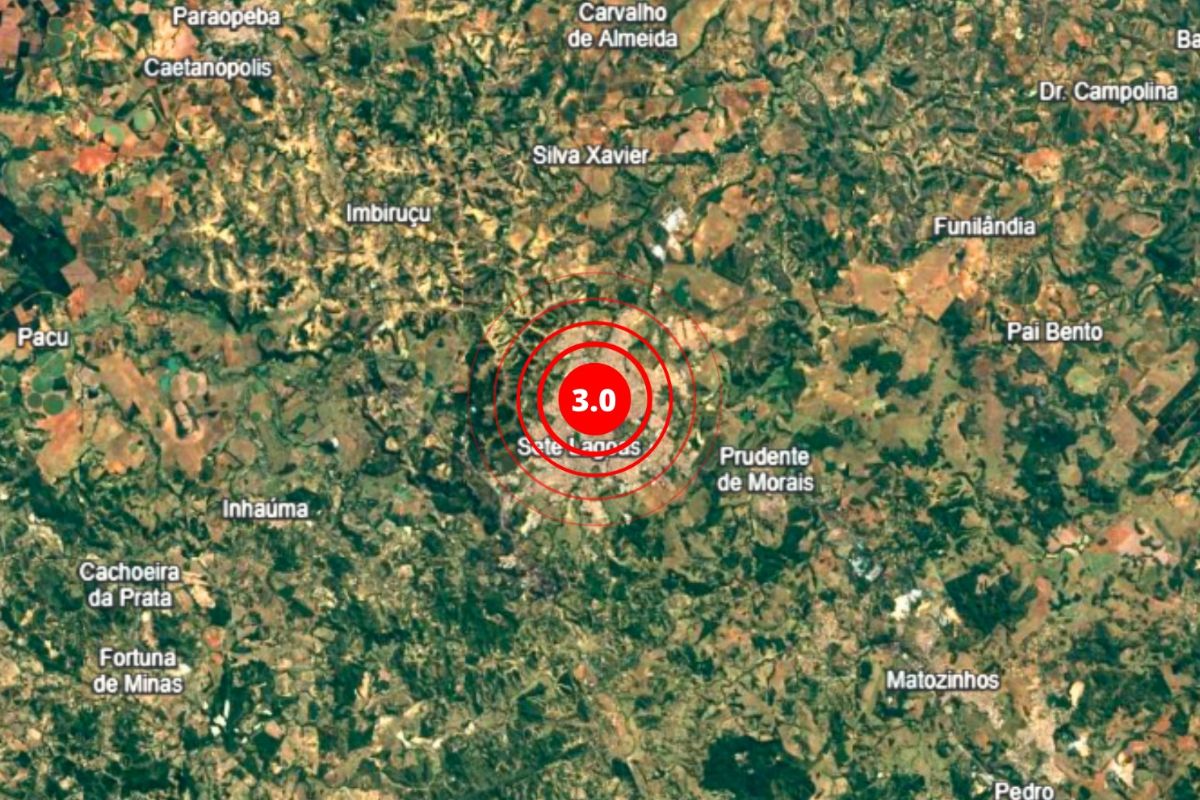
In A Week, Minas Gerais Registered Quakes In Three Regions, With Magnitudes 2.4, 2.9, And 3.0, Including An Earthquake Felt In Sete Lagoas At 14:35. The RSBR Confirmed The Events, Analyzed By The University Of São Paulo. Without Injuries, The Series Reignites Questions About Why The State Leads Records In The Country.
The quakes that hit a Brazilian state in just seven days changed the atmosphere in cities across different regions: residents reported scares, curiosity, and that hard-to-describe feeling when the ground “sends a message” and everything seems out of place for a few seconds. The most recent episode, with a magnitude of 3.0, reinforced the alert and placed urban routine at the center of the quakes map.
Even when there is no damage, the repetition of quakes in a short span affects the perception of safety. And this is precisely where the topic becomes public debate: why does this happen there, why do some cities feel it more, why does the region appear so often in the news, and what really changes for those living near the epicenter.
What Happened In Sete Lagoas And Why The Quake Became A Reference
The most recent record of the quakes occurred on Friday afternoon (30), around 14:35, and was felt by residents for a few seconds.
-
Mercado Livre “opens the vault” and announces a record investment of R$ 57 billion in Brazil in 2026, a value 50% higher than the previous year, with an expansion plan that includes 14 new logistics centers, totaling 42 units in the country and hiring an additional 10,000 employees.

-
How investment in technology can revolutionize the national economy and enhance industrial gains, according to a study that highlights the direct impact on productivity, innovation, and wealth retention within Brazil.

-
The largest food company on the planet, JBS, has just opened a 4,000 square meter laboratory in Florianópolis to develop customized proteins that modulate muscle mass gain, immune response, and metabolic performance.

-
After nearly 30 bids and competition among industry giants, a Spanish company purchases one of the largest airports in Brazil for almost R$ 3 billion and takes over the management of Galeão in a concession that will last until 2039.


The magnitude was 3.0, classified as small, but sufficiently noticeable to provoke reports mainly in quiet environments, people at rest, and often on higher floors, where the vibration may seem more evident.
One point that draws attention is that this event matches the historical record of the municipality recorded in April of last year, consolidating the perception of recurring quakes in the urban area. When the epicenter appears “within the city,” the experience of the quake stops being abstract: it is not “far away,” but in the neighborhood, on the street, in the immediate surroundings, which amplifies the collective feeling.
The Week Of Quakes And The Pattern Of Occurrences In The State
The sequence of quakes closed a cycle that began on Tuesday (27), with different municipalities registering events of varying magnitudes.
There were three points in distinct regions, reinforcing that the phenomenon was not confined to a single geographic corridor, although the everyday experience of those who feel it may seem like “a concentrated attack” due to the short interval.
In the list of occurrences were Riacho dos Machados (magnitude 2.4), Frutal (magnitude 2.9), and Sete Lagoas (magnitude 3.0), with mentions of the North, the Triângulo Mineiro, and the Central region. It is the combination of territorial dispersion and temporal repetition that makes the quakes “seem more serious” than the isolated number would suggest.
Why Minas Gerais Appears So Often When It Comes To Quakes
Minas Gerais is often pointed out as the state with the highest number of recorded quakes in Brazil, and there is a geological explanation for this: pressures acting on the Earth’s crust can generate intraplate seismic activity, meaning events that do not depend on being at the edge of tectonic plates to occur. Brazil is not “free” from quakes; it only tends to have smaller and more dispersed tremors.
Sismologist Bruno Collaço, mentioned in the context, summarizes the logic with a straightforward sentence: small quakes in Minas Gerais are not uncommon and are related to significant geological pressures in the Earth’s crust.
In practice, this means that the region can register repeated quakes without a “fault line” opening up.
Energy accumulates, releases in small events, and depending on where the epicenter occurs, the population feels it more or almost does not perceive it.
What Does Magnitude 3.0 Mean And Why Is There Not Always Damage
On the Richter Scale, quakes between 3.0 and 3.9 are considered small. They can be felt, especially by those at rest or on higher floors of buildings, but rarely cause significant structural damage. This does not invalidate the scare: a small quake can be very memorable when it occurs nearby and in an urban area.
The difference between “feeling strong” and “causing damage” depends on factors such as the depth of the event, distance to the epicenter, soil characteristics, and even the type of construction around.
In some cities, a small quake can “shake” more because the source is usually close and often within the urban perimeter, creating a scenario where the body perceives it before the mind understands what is happening.
Why An Urban Epicenter Increases Perception And What To Observe Afterwards
When the epicenter forms within the urban area, the perception broadens for a simple reason: there are more people around, more buildings, more simultaneous reports, and a social network ready to spread accounts in seconds.
The quakes gain “volume” in the public eye because they occur where life is concentrated, not necessarily because they are stronger than in less populated areas.
After the event, the recommendation is to observe signs of structural risk in the environment, such as new cracks, unusual noises, or gas smells.
The focus is on caution, not panic: perceiving what has changed and acting with logic. If there is any indication of danger, the recommendation is not to stay in the building and to contact the relevant authorities, as small quakes rarely cause collapse, but may reveal pre-existing weaknesses.
How To Act During Quakes At Home, On The Street, And In Traffic
The Civil Defense emphasizes that calm is the best ally. In enclosed spaces, the guideline is to stay in place, move away from windows, glass, and objects that might fall, protect your head and neck, and avoid using elevators. The goal is to reduce secondary risk: falling objects, shattering, and chaotic rushing.
On the street, the recommendation is to seek open areas, away from facades, poles, and wiring. Drivers should reduce speed and stop in a safe location, away from bridges and overpasses. After the quakes, it is advisable to resume routine only after checking the surroundings: if something seems out of the ordinary, cracks, persistent noises, strong gas smells, the priority is to leave the location and seek technical support.
What Changes When Quakes Recur In Short Intervals
The repetition of quakes in a few days does not automatically mean that “something bigger” is about to happen, but it changes social dynamics: increases attention, accelerates rumors, and raises the search for simple explanations for a technical phenomenon. In this scenario, official information and practical guidance are worth more than any alarmist chain.
For authorities and technical teams, the repetition reinforces the importance of monitoring and clear communication: confirming events, recording data, guiding the population, and keeping contact channels prepared for questions and occurrences.
For residents, it changes the daily mindset: knowing how to recognize real risks, understanding what is common in small quakes, and having a “mental plan” of what to do at home, work, and on the street when the quakes return.
Three quakes in seven days triggered an alert not because they represent a catastrophe by themselves, but because they expose a central point: the region records quakes frequently, some occurring close to urban areas, and this amplifies the feeling of vulnerability.
When the ground shakes more than once in the same week, the debate stops being curiosity and becomes a routine of prevention.









-

Uma pessoa reagiu a isso.