





 Portuguese
  English
  Spanish
  4 min of reading
  4 comments


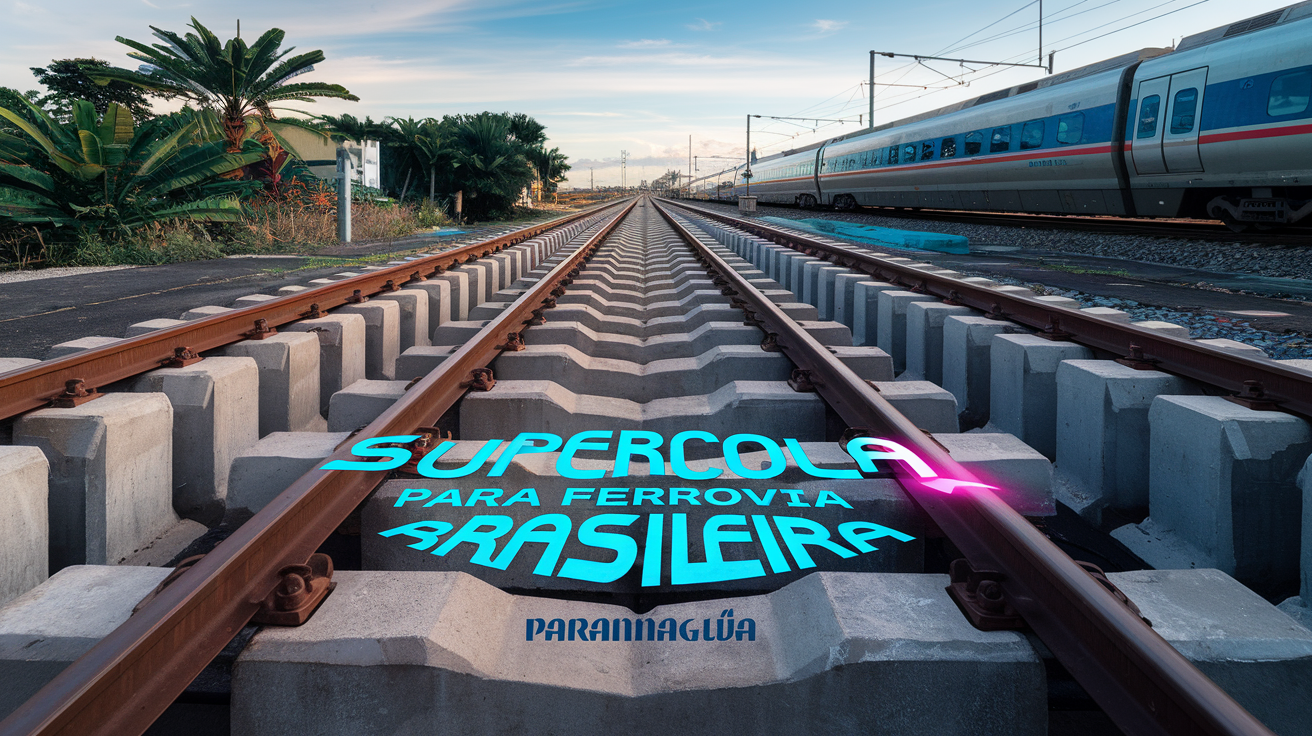


Railway Modernization Has Arrived in Brazil! A Dutch Technique Replaces Sleepers with High-Strength Super Glue. The Innovation Is Already Improving Safety and Efficiency and Can Transform Rail Transport in the Country.
A simple yet powerful innovation promises to transform rail transport in Brazil.
Forget traditional wooden or concrete sleepers. A revolutionary technique imported directly from the Netherlands is being tested on Brazilian railways.
The idea is bold: to use a high-strength super glue to secure tracks to precast blocks.
-
Larger than entire cities in Brazil: BYD is building a 4.6 km² complex in Bahia with a capacity for 600,000 vehicles per year, but the discovery of 163 workers in conditions analogous to slavery has shaken the entire project.

-
With an investment of R$ 612 million, a capacity to process 1.2 million liters of milk per day, Piracanjuba inaugurates a mega cheese factory that increases national production, reduces dependence on imports, and repositions Brazil on the global dairy map.

-
Brazilian city gains industrial hub for 85 companies that is equivalent to 55 football fields.

-
Peugeot and Citroën factory in Argentina cuts production by half and opens a layoff program for more than 2,000 employees after Brazil drastically reduced purchases of Argentine vehicles.


This technology is already widely used in countries like Germany, Switzerland, and Belgium, where the railways stand out for their safety and efficiency.
Now, this solution is being implemented by Rumo, Brazil’s largest railway operator, at level crossings (PNs) in the city of Paranaguá, Paraná.
But how does this technique work, which promises to solve historical problems of Brazilian railways?
How Super Glue Transforms Railways
The main change brought by the technology lies in the replacement of traditional methods for securing the tracks.
Until now, railways used wooden or concrete sleepers with cured in situ methods to secure the tracks.
These materials, despite being robust, showed flaws over time due to natural wear, causing unevenness, gauge widening, and other structural issues.
Now, the technique employs precast concrete blocks with post-tensioned reinforcement, measuring 6x2x0.4 meters and weighing an impressive 12.16 tons each.
The tracks are secured directly to these blocks using a super glue imported from the Netherlands, developed to withstand high pressures and constant impacts.
This innovation eliminates the use of traditional sleepers, which were vulnerable to problems such as rotting and degradation due to weather, significantly reducing the need for frequent maintenance.
Initial Results and Benefits
The initial results of applying super glue at eight PNs in Paranaguá are promising. Rodrigo Taflick, Permanent Way Coordinator at Rumo, highlighted the effectiveness of the technique:
“This solution has positively surprised us. In addition to eliminating chronic problems, such as sleeper wear, it provides greater stability and safety for the tracks. This prevents serious accidents, such as derailments.”
Another highlight is the speed of application and maintenance. While traditional methods require days of work, the super glue technique allows completion in up to 20 hours.
This drastically reduces interruptions in rail and road traffic, especially in busy areas like port regions.
Additionally, drivers using these level crossings also benefit.
With a more stable and level structure, vehicles can cross the tracks at higher speeds and with greater safety, reducing the risk of collisions—accidents where vehicles collide with trains at crossings.
Paranaguá as a Pioneer
The choice of Paranaguá to implement the technique was not by chance. The city is an important logistics hub, connecting agricultural production from inland Paraná to ports for export.
The application of this technology in a high-traffic area is a crucial test to verify its viability in other railway sections across Brazil.
The expectation is that the eight PNs in the city will be fully equipped with the new structure by the end of the first quarter of 2025.
Comparison with the European Model
The super glue technique is already widely used in the most modern railways in Europe. Countries like Germany, Switzerland, and Belgium have adopted this solution to increase the durability of the tracks and reduce operational costs.
In Europe, these railways are recognized for their efficiency, safety, and ability to support high traffic volumes.
The introduction of this technology in Brazil aligns the country with the best international practices, signaling a significant advancement in the railway sector.
The Impact on the Future of Brazilian Railways
The adoption of this innovative technique represents more than a practical solution to structural problems.
It marks an important step in modernizing Brazilian rail transport, which has historically faced challenges such as high maintenance costs, infrastructure failures, and a lack of competitiveness compared to other transport modes.
With this innovation, a reduction in maintenance costs and greater operational efficiency is expected, which can attract new investments to the sector.
Furthermore, the durability of the method contributes to increased safety, reducing accidents and interruptions in operations.
In the long run, the expectation is that this technology will be expanded to other strategic railways in Brazil, strengthening national logistics and bringing the country closer to international railway transport standards.
Could this technology be the first step toward transforming Brazilian rail transport and making it a global example?



Quero investir em ferrovia internacional
Investir em ferrovia internacional é uma escolha estratégica, mas implica uma abordagem cuidadosa e considerada. No Brasil, a modernização da infraestrutura ferroviária tem sido um objetivo principal, devido ao seu potencial no transporte de piso duto e aos benefícios para a logística nacional. Recentemente, uma tecnologia revolucionária vem ganhando destaque. A Rumo, maior operadora de ferrovias no Brasil, começa a explorar uma técnica importada da Holanda que utiliza uma supercola de alta resistência para fixar trilhos em blocos pré-moldados. Esse método promete solucionar problemas históricos das ferrovias nacionais, como o desgaste natural dos dormentes e a necessidade de manutenções frequentes. A técnica em questão não é nova, e a Rumo não é a primeira a adotá-la. Países europeus como Alemanha, Suíça e Bélgica já a utilizam para melhorar a eficiência e segurança de suas ferrovias. Agora, a Rumo testa essa tecnologia em passagens de nível (PNs) da cidade de Paranaguá, no Paraná. Esse projeto abre novas perspectivas para o transporte ferroviário no país. Inicialmente, a supercola promete fornecer maior estabilidade e segurança para os trilhos, reduzindo o risco de acidentes graves. Além disso, a rápida aplicação e manutenção-wrapper reduzem interrupções no tráfego ferroviário, que é fundamental para áreas logísticas movimentadas.
O transporte de cargas e passageiros por ferrovias , deveria ter sido implementada desde o começo dos tempos , interesses políticos e corruptos , elegeram , se venderam ao petróleo , escolhendo as rodovias e seus problemas , que não enfrentam os países civilizados , que fundaram seus transportes na ferrovia , o brasil é o único país que nunca investiu em redes ferroviárias , e hj temos esse caos , no trânsito , e perda de competitividade , nas exportações .
Já passou do tempo de investir em ferrovia , o que já resolveria os problemas com transporte via carretas , e nem precisaria tantos , projetos , que em sua maioria não sai do papel e nas falácias de políticos , para resolver os prejuízos e custos com transporte do agronegócio.
Como a revolta em relação ao transporte de cargas e passageiros por ferrovias no Brasil se abriga , nos momentos de trajetória navigada nos pontos tramados na construção de rolem Cegas esta s Hipóteses devem Humanizar a Situação multissêntrica num Caos.