





 Portuguese
  English
  Spanish
  4 min of reading
  0 comments


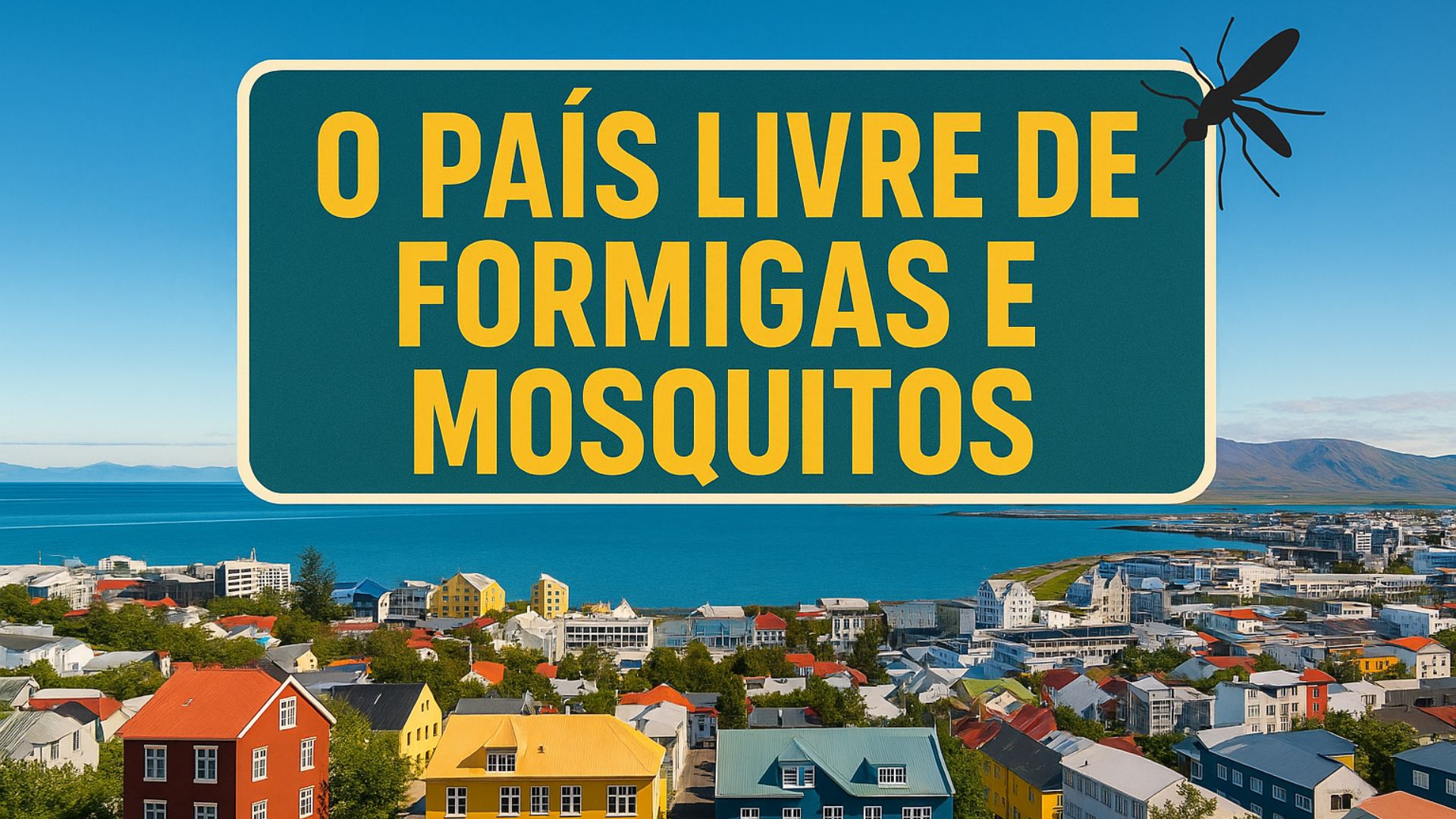
Country Known For The Absence Of Mosquitoes And Ants Sparks Worldwide Curiosity By Gathering Extreme Climate, Volcanic Soil And Geographical Isolation Able To Prevent The Survival And Proliferation Of These Insects In Its Territory.
Iceland occupies a curious position on the planet’s biological map: it is the only country known where mosquitoes and ants simply have not established themselves.
The harsh climate, combined with the isolated geography and predominantly volcanic soil, creates an environment where these species cannot complete their life cycles.
For residents and visitors, this peculiarity transforms daily life into something rare in the rest of the world, marked by the absence of bites, buzzing, and home invasions.
-
He started running at 66 years old, broke records at 82, and is now a subject of study for having a metabolic age comparable to that of a 20-year-old, in a case that is intriguing scientists and inspiring the world.

-
Oldest tree on the planet reappears after 130 years of searches: Wattieza, 385 million years old, was 10 meters tall and had no leaves or seeds; Gilboa fossils in New York solved the mystery in 2007.

-
A 48-square-meter house assembled in hours with 4,000 bricks made of recycled plastic that does not absorb moisture, has natural thermal insulation, and costs less than 90,000 reais in a complete kit.

-
Luciano Hang revealed that Havan’s air fleet has already accumulated more than 20,000 landings, 10,000 flight hours, and 6 million kilometers traveled, and he says that without the planes, the company would never have grown so quickly.


Icelandic Climate And Absence Of Mosquitoes
The phenomenon begins with the climate. The island spends a good part of the year under low temperatures, even during the summer, when the average hardly exceeds 10 °C.
As winter approaches, thermometers quickly drop to negative levels.
This intense alternation between cold and less cold prevents mosquitoes from surviving the early stages of development.
Eggs and larvae, which in other countries develop in moist and relatively stable environments, do not withstand the recurring freezing.
Without completing the life cycle, the species does not advance and does not create permanent populations.

Moreover, the country possesses a climatic characteristic that further complicates the existence of these insects: abrupt changes over short periods.
While in other regions summer provides long windows of heat, in Iceland the temperature can drop rapidly over a few days, interrupting any attempt at reproduction.
Researchers highlight that this instability is one of the determining factors for the island to remain free of mosquitoes, even in areas naturally favorable, such as lakes and swampy zones.
Volcanic Soil And Impossibility Of Ant Colonies
The absence of ants follows a similar logic, but with additional elements.
The Icelandic soil is dominated by volcanic formations, composed of newly formed rocks, layers of solidified lava, and sediments constantly disturbed by geological activity.
Ant colonies depend on stable, dry, and organic-rich terrains to build their nests and sustain the castes that form the insect’s society.
In Iceland, these conditions almost never come together.
The ground is unstable, cold, and often poor in shelter for underground colonies.
As a consequence, no species has managed to adapt over the centuries of human occupation.
Even in regions where the climate would allow some progress, the constant wind acts as a natural barrier.
The combination of cool breezes and persistent gusts makes both movement and the initial survival of newly introduced insects difficult.

It is an environment without rest, which does not favor the stabilization of species fragile to the cold.
Another important point is that the country maintains strict biosafety controls.
Authorities monitor the entry of foreign organisms to prevent environmental imbalances.
This means that, in addition to the adverse natural conditions, there is human vigilance to prevent invasive insects from finding gaps.
The measure is necessary because the introduction of pests can cause significant damage to isolated ecosystems, like the Icelandic one, which have evolved with little presence of certain species.
How This Absence Affects The Experience Of Visitors
For those visiting the island, the result of this combination of factors is noticeable right from the first walks.
On trails near lakes, rivers, or swampy areas — scenarios that, in other countries, would be swarming with mosquitoes — the air remains clean and silent.
There is no need for repellents, skin protectors, or strategies to avoid bites.
There are also no reports of kitchens invaded by ants, nor the common discomfort of encountering long lines of these insects searching for food.
The experience of walking among lava fields, glaciers, mountains, and craters without any discomfort caused by insects makes Iceland even more unique.
In many times of the year, nature presents itself in an almost pure form, without interruptions or noise typical of regions with high insect density.

For those engaged in photographing landscapes, birdwatching, hiking, or simply contemplating the environment, this absence creates a particularly comfortable setting.
Iceland As A Unique Destination In The World
In addition to being free of mosquitoes and ants, the country already attracts attention for other reasons.
The presence of active volcanoes, recurring geysers, giant glaciers, and long periods of light in summer shape a destination that seems to challenge standards.
With just over 370,000 inhabitants, Iceland combines modernity with an isolated territory that is at the same time extremely organized.
The feeling of safety, combined with the almost untouched landscape, creates an environment that many consider different from any other in international travel.
Although the absence of these insects is a widely discussed curiosity, it also offers reflections on how climate, soil, and isolation shape ecosystems.
On an increasingly connected planet under pressure from climate change, characteristics like this serve as a reminder of the extreme diversity present in nature.
The question that arises is inevitable: to what extent can other regions of the world preserve their singularities in the face of accelerated environmental transformations?







-

-

-

3 pessoas reagiram a isso.