





 Portuguese
  English
  Spanish
  3 min of reading
  4 comments


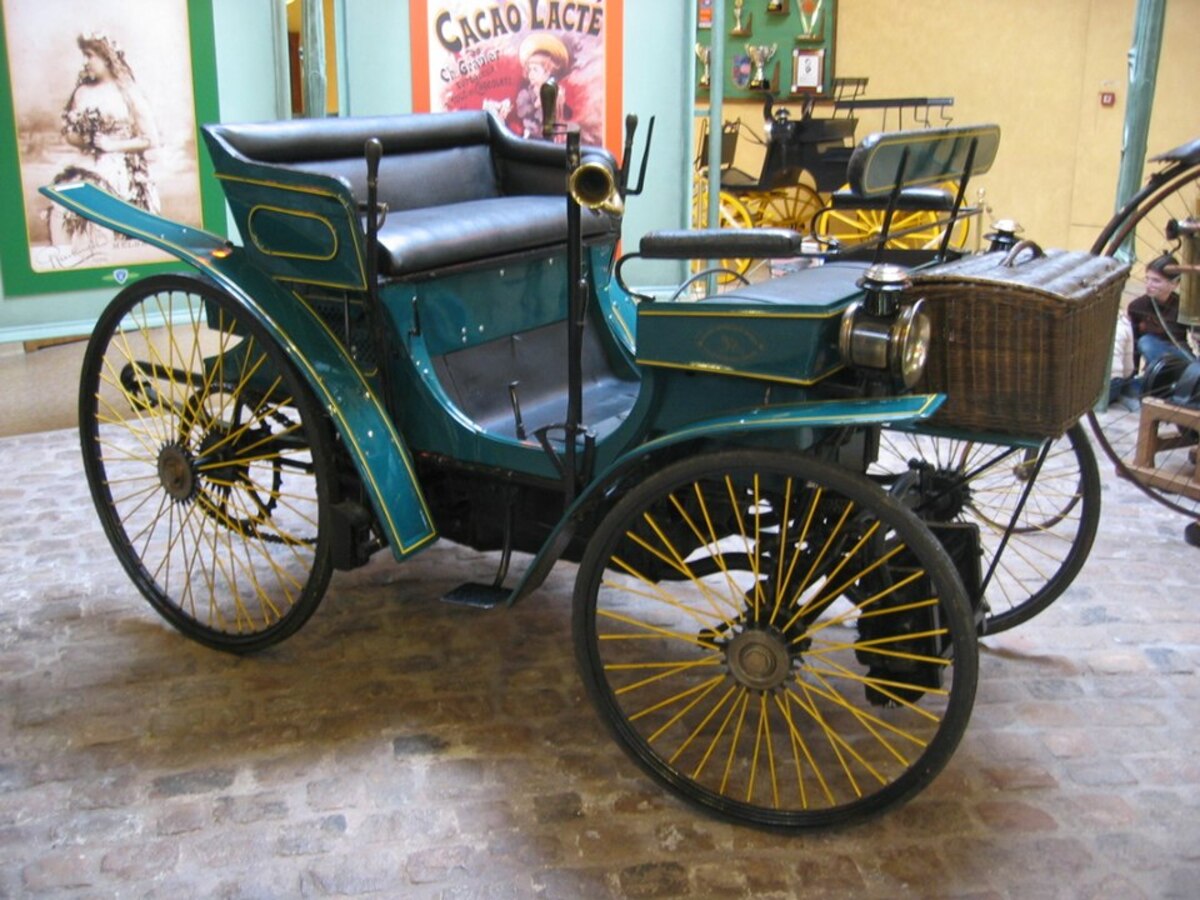

Before Conquering The Skies, Santos Dumont Was Already Exploring The Streets With A Pioneering Car That Would Change The History Of Transportation In Brazil
Amid the celebrations for the 150th anniversary of Alberto Santos Dumont’s birth, a little-known curiosity has once again gained prominence. Besides being the father of aviation, the Brazilian inventor was also passionate about cars. It was his family that brought the first automobile to circulate in Brazil.
The First Car In The Country
The year was 1891. The Santos Dumont family imported a Peugeot Type 3, a French model powered by gasoline. The car, with four seats and a 2-horsepower Daimler engine, was an absolute innovation in Brazilian lands. While the country was still using horse-drawn carts, the vehicle drew attention wherever it went.
Santos Dumont was not just a user. He was interested in the structure and operation of the automobile. He studied its parts, dismantled the engine, and observed everything closely.
-
While restoring a historic mansion from 1910, a brick structure with an old turbine that generated energy from the Rio do Testo emerged, along with a hidden door and a rare floor concealed under layers of wax.

-
Italian researchers have detected what appears to be a second Sphinx buried under the sands of Egypt, and satellite scans reveal a gigantic underground megastructure hidden beneath the Giza Plateau for over 3,000 years.

-
There are 4,223 drums and 1,343 metal boxes concreted with 50-centimeter walls that store the radioactive waste from Cesium-137 in the worst radiological accident in Brazil, just 23 kilometers from Goiânia, with environmental monitoring every three months.

-
Giant Roman treasure found at the bottom of Lake Neuchâtel in Switzerland reveals an advanced trade system, circulation of goods, and armed escort in the Roman Empire about two thousand years ago.


This knowledge was essential in the development of his airship and airplane projects. For Dumont, understanding machines was part of the creative process.
The Dispute For The First License Plate
Although it was the first car to run in Brazil, the Dumont family’s Peugeot was not the first to receive an official license plate. That distinction belongs to the industrialist Francisco Matarazzo. In 1903, São Paulo began to require vehicle registration. Matarazzo was the first to register his.
Tax And Protest
Shortly before that, at the end of the year 1900, the city hall of São Paulo created a tax similar to the IPVA. Henrique, Santos Dumont’s brother, decided to protest. He sent a petition requesting an exemption from the charge.
In the letter, Henrique argued that the city’s streets were in terrible condition. The paving damaged the car tires and required constant repairs. Therefore, he considered the tax unfair.
The Peugeot Type 3 In History
The Peugeot Type 3 had limited production. Manufactured between 1891 and 1894, only 64 units were built. It was the first car from the brand delivered to a private customer on October 2, 1891. The model had a V2 engine with 565 cm³, 2-horsepower, and four gears.
In an attempt to promote the new vehicle, Armand Peugeot decided to showcase the car during the Paris-Brest-Paris cycling race. The automobile traveled over 2,000 km at an average speed of 14.7 km/h, attracting public attention. Shortly thereafter, the model would also make history in Brazil.
A Curious Repetition
More than a hundred years later, some of the complaints remain. Today, there is still criticism of the IPVA and the problems of Brazilian roads. The machines have evolved, but some obstacles remain the same.
Santos Dumont’s car has become a museum piece. But its story shows how the Brazilian inventor was always ahead of his time — even on four wheels.
With information from AutoPapo.








Faltou dizer onde o veículo se encontra hoje.
Se hoje ainda temos problema com a bateria imagine naquela época! Não seja ingênuo.
Se tivesse continuado haveria muito mais evolução, será tão difícil entender o joao prado disse?
Século 19 já tinha carros elétricos que tinham autonomia de 100 kms e velocidade de 90 kms por HR mas diziam que era carro de mulher eram limpos,se tivessem continuado hoje seriam super adiantados e o clima estaria normal equilibrado em ppm parte por milhão em CO2.