





 Portuguese
  English
  Spanish
  5 min of reading
  0 comments



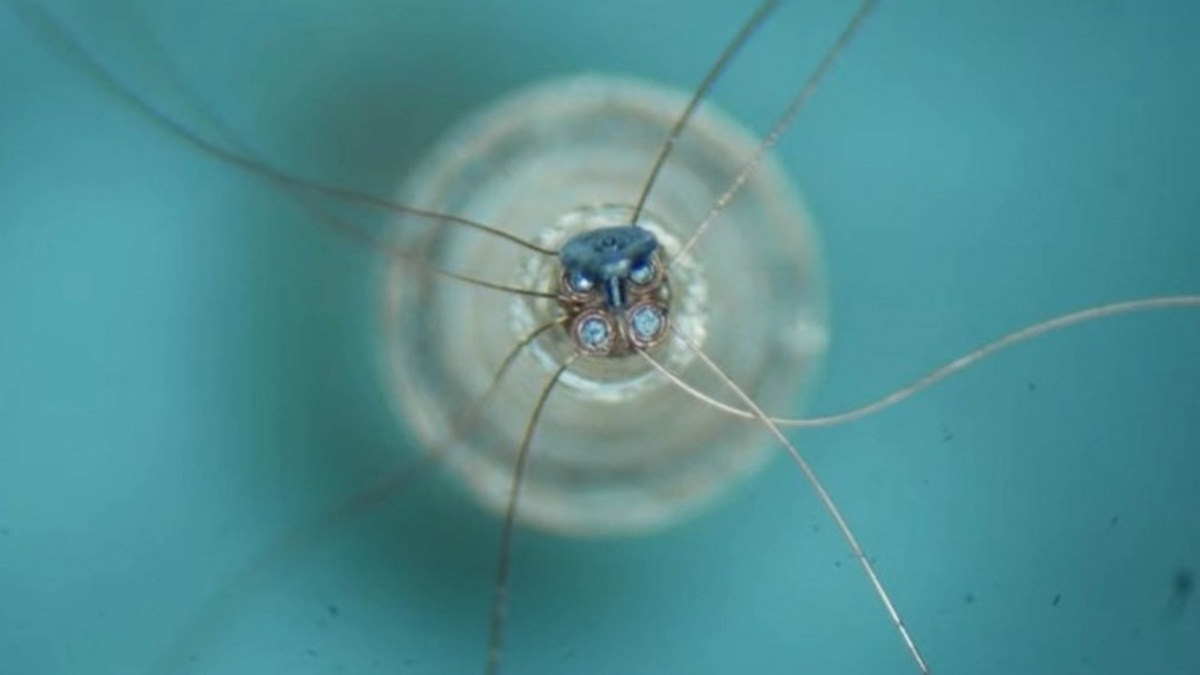
A microscopic electric motor, with a volume smaller than a grain of sand and a thickness similar to a hair, was created by engineers at Chromonova Engineering. Manually assembled under a microscope, the device uses classical principles of electromagnetism and already displays functional movement, despite its fragility.
A group of engineers from Chromonova Engineering developed a microscopic electric motor that surprises with its size and precision.
With only 0.4 cubic millimeters of volume and a thickness comparable to that of a human hair, the device represents a remarkable advance in technological miniaturization.
Assembly Under the Microscope
The most important thing is that the motor was assembled manually, piece by piece, using a high-precision microscope. This task required extreme delicacy.
-
The gigantic steel shell built to contain Chernobyl for a century has been pierced by a drone, exposing a critical system and creating a hole that could cost over 500 million euros to repair.

-
Brazilian Navy reaches a new level by taking over an airport with a 1,600-meter runway used by 1,800 military personnel and autonomous attack drone testing.

-
The Himalayas continue to grow to this day, with tectonic plates advancing 5 cm per year, mountains rising up to 10 mm annually, and the 2015 earthquake that killed 9,000 people may have increased the risk of an even larger seismic mega-event.

-
At an altitude of 400 km by astronauts from the International Space Station, Paris transforms at night into a golden mesh so precise that it reveals the outline of the Seine River, avenues, and entire neighborhoods like a luminous map drawn over the Earth.


Any breath or vibration could compromise the work. To minimize friction, the engineers placed the rotor on a thin film of oil between two glass plates.
During assembly, several rotors were lost due to the fragility of the components. Even so, the team managed to assemble a functional prototype.
The rotor responds to electrical activation of the coils and performs oscillatory movements when receiving current pulses.
It does not yet achieve continuous rotation like larger motors, but basic functionality has already been proven.
How the Motor Works
The principle behind the design is the same as that of a common brushless motor, but on a micro scale.
When current passes through the ultrathin coils wound manually, it creates magnetic fields that interact with the magnetized rotor. This generates force and causes movement.
Therefore, the motor does not employ new physical effects, such as piezoelectricity or ionic propulsion. It is based on classical laws of electromagnetism, such as the Lorentz force.
The innovation lies in applying these principles at an extremely small scale, with components assembled by hand.
The device includes a small control circuit, a support base, and four coils around the rotor.
All elements were constructed with conventional ferromagnetic materials, such as the AlNiCo alloy, and joined by means of microscopic welds.
Comparison with Other Technologies
This is not the only microscopic motor in development worldwide. The Japanese company Orbray, for example, has already created brushless motors with a diameter of 0.6 millimeters, used in medical and optical devices.
On the other hand, researchers at the University of Texas have developed even smaller nanomotors, measuring less than 1 micrometer, capable of spinning at tens of thousands of revolutions per minute.
These models are used at the cellular level for mixing or drug delivery, but have different functionality and structure.
Additionally, ionic motors, like those used in spacecraft probes, accelerate ions to generate propulsion, without involving moving parts. In contrast, the motor from Chromonova has a real rotating shaft, albeit limited.
The most relevant aspect in this case is that Chromonova’s project combines a traditional approach with unprecedented scale. This makes it unique in its category and raises exciting possibilities for various fields.
Potential Applications in the Future
Although still an experimental prototype, the invisible motor already points to promising paths for sectors such as medicine, robotics, and the aerospace industry.
Extreme miniaturization allows for scenarios previously restricted to science fiction.
In nanorobotics, for example, motors of this scale could drive robots capable of circulating through blood vessels and performing internal diagnostics.
They would also be useful for administering drugs directly to specific areas of the body.
The smaller the motor, the easier it will be to insert these machines into human tissues.
In medicine, this type of motor could enable new types of implantable devices. It would be possible to build micro-drug pumps, micro-injection systems, and actuators for minimally invasive surgical procedures, all with greater precision and less impact on the patient.
In lightweight robotics, the trend is to use smaller and smaller motors in miniature drones, manipulators, and autonomous mechanisms. A more robust and reliable version of the Chromonova motor could allow robots the size of a coin or smaller to have specific functions.
In the space sector, one could imagine applications in cubesats and small satellites. These motors could move antennas, position solar panels, or act in guidance systems. Currently, many of these devices rely on large mechanisms or ionic propulsion. A physical motor that small would open new options.
Finally, even in household consumption, electronics could benefit. Wearable devices with tiny moving parts, sensors with automatic adjustment, or precision mechanisms in industrial systems could become a reality. Everything will depend on the evolution of control and mass production.
Limits of Current Technology
Despite the advances, there are considerable challenges ahead. The presented motor is handcrafted. This means it cannot be produced at scale with current techniques. To become commercially viable, methods such as advanced lithography or automation with microrobots would need to be adopted.
Another obstacle is control. The prototype still relies on basic sequential activation of the coils. For complex movements, a more sophisticated control system would need to be developed, which involves equally miniaturized microprocessors.
Nanoscale friction also poses a problem. While the use of oil between the glass plates has reduced friction, this solution is not ideal for real environments. In medical implants, for example, conventional lubricants may be unfeasible.
Moreover, heat dissipation, wear of parts, and standardization of ultra-small components are still in the early stages of study. Precision engineering faces the limits of what is possible with traditional tools.
A Symbolic Achievement
The project from Chromonova also holds important symbolic value. It meets the challenge posed in 1959 by Richard Feynman, the Nobel Prize-winning physicist who proposed the construction of a motor the size of a pinhead.
The proposal at the time seemed more like an exercise of imagination. Now, more than six decades later, it has become a reality.
According to the creators themselves, the prototype is a “claim of a 65-year-old challenge” and shows how precision engineering can achieve extraordinary feats even without large structures or multimillion-dollar laboratories.
What is most surprising is that everything was handmade, with extreme patience and care. In one of the images of the process, one can see a small punch being used on a piece the size of the tip of a toothpick.
Path to the Next Generation
Now, the engineers plan to develop a second version of the motor, with structural improvements and more durable materials. The goal is to ensure continuous functionality, avoid losses during assembly, and create more reliable control mechanisms.
If these goals are achieved, the motor could pave the way for a new generation of real nanomachines. The trend of miniaturization continues to grow, with brushless motors of 0.6 millimeters already on the market and DNA nanomotors being tested in laboratories.
Therefore, even though the motor from Chromonova is not yet ready for commercial use, it marks an essential step towards technologies that could change the way we interact with the world — both inside and outside the human body.








Seja o primeiro a reagir!