





 Portuguese
  English
  Spanish
  5 min of reading
  1 comment


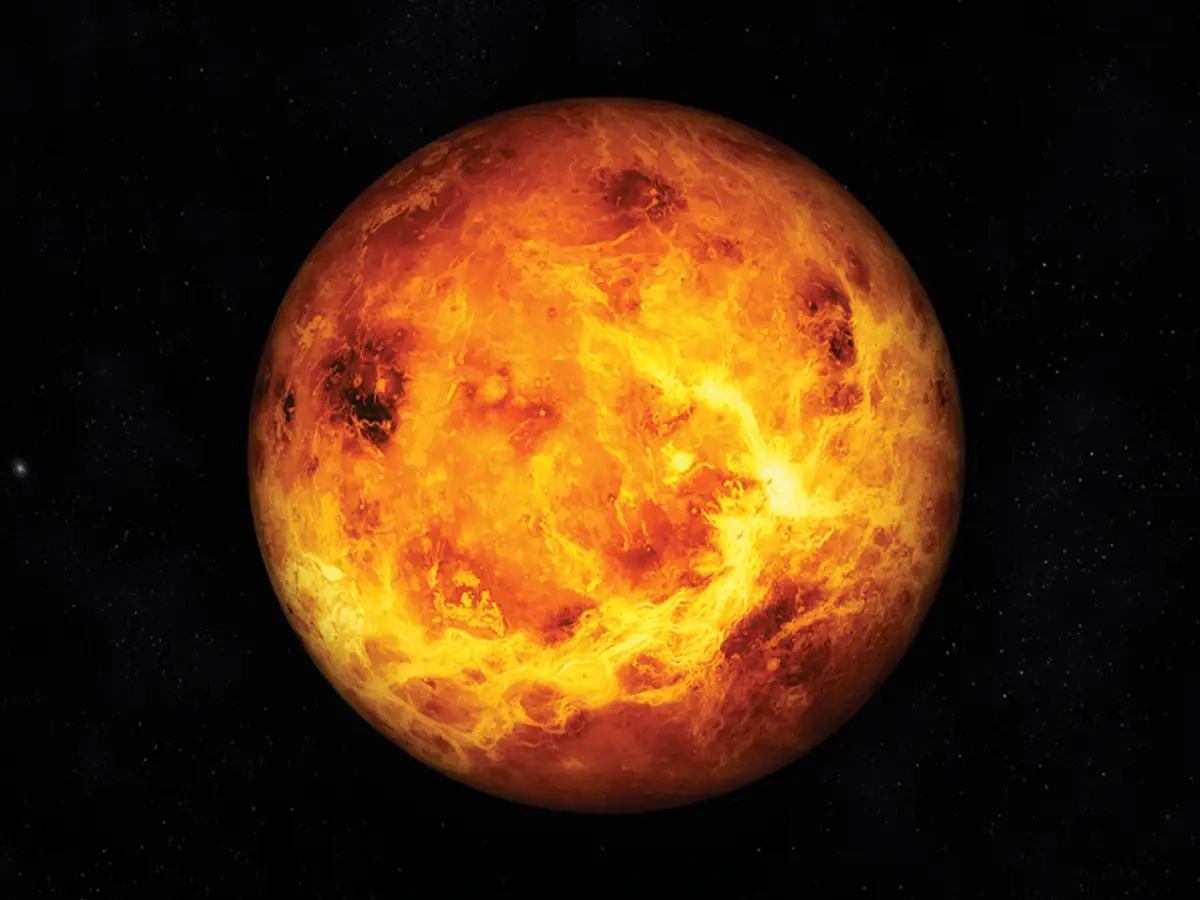


Discover Why This Fiery Planet of the Solar System, With Active Volcanoes and Geological Secrets, Is the New Target of NASA’s Space Exploration
Imagine a planet so hot it melts metal, covered by toxic clouds, yet still holds hot secrets, literally! Venus, our neighbor in the Solar System, is back in the spotlight of NASA’s space exploration. Far from being a dead world, new discoveries show that it is geologically active, with bubbling volcanoes and crustal deformations. This is leaving scientists stunned and reigniting curiosity about how this planet evolved. Let’s dive into this hot story and find out why Venus is the new favorite of planetary science!
Why Is Venus Stealing the Spotlight?
For decades, Venus was seen as an uninhabitable planet, with temperatures of 460°C and a suffocating atmosphere. But recent studies are turning this story on its head. Data from missions like NASA’s Magellan shows that the planet is not a geological desert. On the contrary, it is very much alive, with signs of volcanism and internal movements shaping its surface. “Venus is not a static world. It surprises us with signs of activity that challenge what we thought about rocky planets,” says Dr. Suzanne Smrekar, the principal investigator of the VERITAS mission, in an interview with NASA.
This turnaround is exciting scientists and paving the way for new space exploration missions. After all, understanding Venus can help us decipher not only the past of the Solar System but also the future of other rocky planets.
-
Woman arrested after receiving $1.2 million due to banking error and not returning the amount.

-
Beneath Mexico City lies an entire buried Aztec capital, and it all began when workers discovered a 3.25-meter stone disk featuring a dismembered goddess, revealing temples, skulls, and palaces beneath 22 million people.
-
How to build a 35,000-liter cistern with 60 by 50 cm panels and rainwater for drinking and cooking without relying on water trucks or the city hall.
-
A woman went out for a regular walk and ended up finding a treasure buried for over 900 years, with more than 2,000 medieval silver coins compared by archaeologists to a lottery prize and considered one of the most significant finds in recent years in the country.


Coronae: The Hot Scars of Venus
One of the most impressive discoveries is the so-called coronae, giant circular structures on the surface of Venus. These formations, with diameters of up to 2,000 km, are marks of heat plumes rising from the interior of the planet. Unlike Earth, which has tectonic plates, Venus deforms its crust with these plumes, creating these geological “scars.” According to a study published in Nature Geoscience, more than 70 coronae have been identified, suggesting that the internal heat is still active.
“These coronae are like fingerprints of the interior of Venus. They show that the planet is alive and constantly changing,” explains planetary geologist Dr. Paul Byrne from North Carolina State University, in an article from Scientific American. These discoveries challenge the idea that Venus is geologically inert, reigniting interest in the exploration of the planet.
Volcanoes in Action: Fresh Magma on the Surface
Another sign that Venus is quite active is its volcanoes. Recent data from the Magellan mission, analyzed with modern techniques, revealed changes in a volcanic vent near Mount Maat. In just a few months, the opening of this volcano has grown, suggesting that fresh magma is reaching the surface. “Finding evidence of recent volcanism is like catching Venus in the act. It is telling us that it still has the energy to change,” states Dr. Robert Herrick from the University of Alaska, in an interview with the BBC.
These signs of volcanism show that Venus is not a planet frozen in time. On the contrary, it continues to transform, raising questions about how its geological activity influences its hellish atmosphere.
How the Magellan Mission Changed the Game?
Between 1990 and 1994, the Magellan spacecraft mapped 98% of Venus‘ surface using radar, as the dense clouds of the planet block visible light. This map revealed a landscape full of surprises: volcanoes, coronae, and areas where the crust is deforming due to internal heat. More recent analyses, with advanced technology, confirmed that these changes are recent. For example, a 2023 study published in Science identified signs of active volcanic eruptions in several regions.
This data is rewriting what we know about Venus. Once seen as a plain planet, it is now a living laboratory for understanding the geology of the Solar System.
What’s Next in the Exploration of Venus?
The space exploration of Venus is about to take a leap. The VERITAS mission, scheduled for 2031, promises radar maps with ten times better resolution than those from Magellan. Additionally, it will measure gravitational variations to detect internal movements and monitor volcanoes and coronae. “With VERITAS, we will see Venus like never before. It will be a revolution in our understanding of the planet,” says Smrekar in a statement from NASA.
Another exciting mission is DAVINCI, which will dive into Venus‘ atmosphere to collect chemical and geological data. These missions will help us understand how Venus evolved from a potentially habitable planet to the furnace it is today.
What Can Venus Teach Us About Earth?
Venus and Earth are like siblings with different destinies. Both have similar sizes and compositions, but while Earth became an oasis, Venus transformed into a hell. Studying the geological activity of Venus is like opening a book on primitive Earth. “Comparing Venus with Earth helps us understand why our planet became habitable and what can go wrong on other worlds,” explains Dr. Ellen Stofan, former chief scientist of NASA, in an article from National Geographic.
The mantle plumes and volcanism of Venus also provide clues about the formation of atmospheres on rocky planets, even outside the Solar System. This may help us identify exoplanets with potential for life.
Venus in the Spotlight: New Missions Promise Cosmic Revelations
As space exploration advances, Venus is becoming a priority target. New technologies and missions like VERITAS and DAVINCI promise to reveal more about this fascinating planet. Each discovery brings us closer to answers about how Venus evolved and what that means for the Solar System and beyond. “We are just beginning to scratch the surface of Venus. The future of exploration will surprise us,” says Byrne.
What do you think of this new view on Venus? Leave your comment or share this article to spread the Venusian fever!








Como homem de ciência, católico, que acredita na existência de um Deus cuja inteligência nos deixa em uma posição bastante distante da Dele, mais uma vez constato a sabedoria divina quando Ele colocou a Terra justamente nessa posição celestial. Um pouco mais distante do nossa estrela mais próxima e todo o planeta estaria coberto de gelo e um pouco mais próximo a água seria evaporada e com ela, a vida nesse planeta tal como a conhecemos.
O Observatório do Vaticano foi fundado em 1572 e a Pontifícia Academia das Ciências em 1603, tendo Galileu Galilei como um de seus membros.
Na verdade a Igreja desde o século XIV tenta encontrar no espaço traços da presença de Deus em outros mundos, sendo que a mera observação e comparação dos planetas do nosso pequeno sistema solar nos revela essa existência, não é preciso se debruçar sobre galáxias distantes.
Sem Deus somos todos animais destinados à extinção, senão de nossos corpos mortais, mas também de nossas almas.