





 Portuguese
  English
  Spanish
  4 min of reading
  0 comments


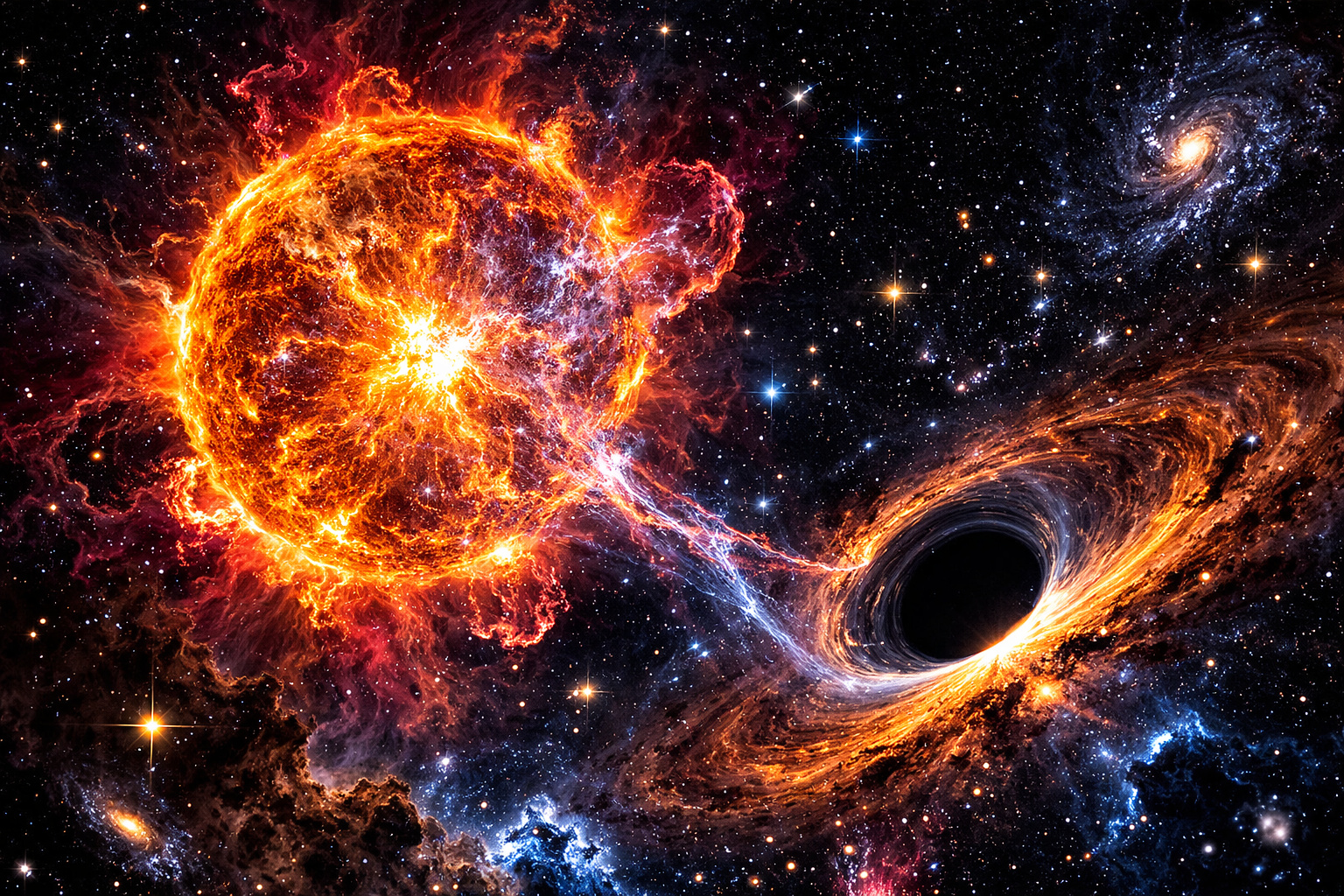
Indirect Observations Made by the James Webb Space Telescope Indicate the Existence of Giant Stars That Lived Briefly in the Early Universe and Left Chemical Traces and Black Holes
A recent scientific investigation has brought new evidence about one of the oldest periods in the history of the universe.
Researchers reported evidence of the existence of extremely massive stars that emerged shortly after the Big Bang, which occurred approximately 13.8 billion years ago.
The study was published in the scientific journal The Astrophysical Journal Letters, one of the international publications focused on astrophysics research.
According to the analysis, the data were obtained through indirect observations made with the James Webb Space Telescope (JWST), a scientific mission launched by NASA in 2021 to investigate the first galaxies of the cosmos.
These stars were nicknamed “dinosaur stars” because, just like the prehistoric giants of Earth, they would have been enormous, rare, and restricted to a very ancient phase of the universe.
-
NASA has set a date for the beginning of the end of Earth, and it won’t be an asteroid or an explosion: the planet will slowly lose its oxygen over the course of 1 billion years because the Sun is getting hotter every day.

-
Archaeologists have discovered a colossal submerged wall in the Atlantic, dating back 7,000 years and weighing 3,300 tons, regarded as the largest prehistoric submerged structure ever found in France.

-
Scientists have discovered a gigantic magnetic anomaly hidden beneath the soil of Australia that mirrors the shape of the entire continent and holds geological records of two and a half billion years that could change what we know about the Earth.
-
The heatwave that has been affecting Brazil in recent weeks is coming to an end: a cyclonic vortex is moving in during Holy Week with heavy rains, and a cold air mass is already threatening to lower temperatures in the South starting in April.

Giant Stars That Existed in the Primordial Universe
Researchers estimate that these stars could reach masses between one thousand and ten thousand times greater than that of the Sun.
This extraordinary size would make these celestial bodies some of the most massive stellar objects ever proposed in cosmological models.
However, despite their impressive size, these stars would have lived for an extremely short period in cosmic terms.
For this reason, they disappeared rapidly after their formation and are currently no longer present in the observable universe.
Just as happened with the dinosaurs in Earth’s history, these giant stars would have dominated a specific period of cosmic evolution and then become extinct.
Evidence Revealed by the James Webb Telescope
The evidence emerged when scientists analyzed unusual chemical signatures in an ancient galaxy observed by the James Webb telescope.
This chemical composition showed anomalous levels of certain elements, indicating a stellar origin different from currently known stars.
Among the identified signals, there is a notable excess production of nitrogen, which is not easily explained by traditional stellar evolution models.
Therefore, researchers proposed that these chemical characteristics could have been produced by giant and rare stars of the primordial universe.
Theoretical Models Explain the Formation of These Stars
To interpret the observational data, scientists used theoretical models of stellar evolution.
These models suggest that extremely massive stars could produce large amounts of nitrogen during their brief existence.
Moreover, the behavior of these stars helps explain the origin of the unusual chemical signatures detected in the studied galaxy.
Thus, even without direct observation of these stars, the chemical traces serve as indirect evidence of their existence in cosmic history.
Stellar Collapse May Have Created Primordial Black Holes
Another relevant point of the study is related to the fate of these giant stars.
Models indicate that the direct collapse of these supermassive stars may have favored the early emergence of black holes.
This process would have occurred shortly after the end of the brief life of these celestial bodies.
Thus, although these stars disappeared billions of years ago, the black holes formed from them may still persist in the universe today.
These dense objects represent one of the main traces left by the so-called “dinosaur stars” of the primordial universe.
Traces of an Ancient Phase in the History of the Cosmos
The hypothesis of supermassive stars reinforces the idea that the primitive universe may have been very different from the current cosmos.
Scientists continue to analyze the data obtained by the James Webb telescope to better understand this early period.
Each new observation helps reconstruct the processes that shaped the first galaxies and structures of the universe.
Thus, even though these stars are now extinct, the signals they left continue to offer important clues for cosmology.
How many more traces of these giant stars may still be hidden in the first galaxies of the universe?







-

Uma pessoa reagiu a isso.