






 Portuguese
  Spanish


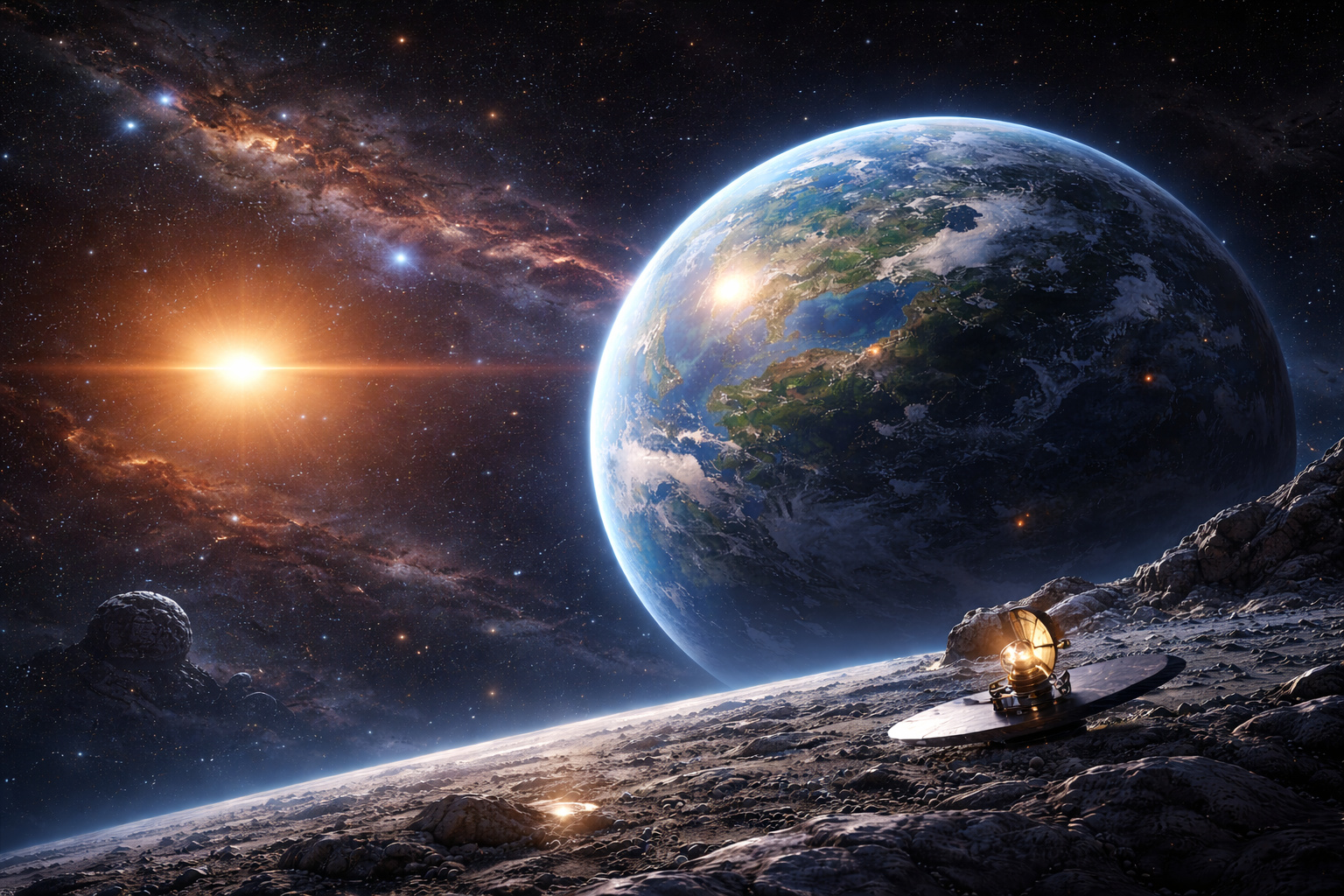


Rocky Planet with 355 Days of Orbit, Sun-Like Star, and Position in the Habitable Zone Rekindles Scientific Debate About Earth-Like Worlds
A significant astronomical discovery was recently presented to the international community.
The planet, located about 146 light-years from Earth, was described in a study published in 2024 in The Astrophysical Journal Letters.
According to the researchers, it orbits a sun-like star and has estimated dimensions of only 6% larger than Earth.
-
Man Transforms Desert Ranch into Forest by Harvesting Rainwater, Captures 15,000 Gallons in One Downpour, Builds 100 Dams with 6 Volunteers

-
16 kWh Solar Battery Powers Entire Home Off-Grid, Lasts Over 22 Years with 8,000 Cycles, Delivers 10,000 Watts for Appliances
-
Drones Can Now Detect Underwater Mines Hidden by Sand and Algae Using Aerial Images, Special Light, and AI

-
Helicopters Drop “Green Rain” of Seeds Over Remote U.S. Forests to Reforest 19 Hard-to-Reach Areas in Minnesota, Reviving Pine Trees Where Ground Teams Struggle to Access



Furthermore, the calculated orbital period is 355 days, which is just ten days shorter than a terrestrial year.
This combination of characteristics places the object among the most interesting candidates ever identified among the more than 6,000 exoplanets known today.
Technical Investigation Details Orbital and Thermal Characteristics
The study was conducted by an international team led by Alexander Venner, then affiliated with Southern Queensland University and currently at the Max Planck Institute for Astronomy in Germany.
According to the data presented, the central star of the system is approximately 1,000 degrees cooler than the Sun and significantly less luminous.
As a direct consequence, the planet receives less than one-third of the energy that Earth receives from the Sun.
For this reason, models estimate surface temperatures between -68 °C and -70 °C, values closer to Martian conditions than to a typically habitable environment.
Icy World on the Edge of the Habitable Zone
Despite this, the planet is located at the outer limit of the so-called habitable zone, a region where liquid water could exist under certain conditions.
However, in the current orbital configuration, the surface likely remains completely frozen.
Still, climate models indicate an alternative scenario.
If the planet has a thick atmosphere with a high concentration of carbon dioxide, an intense greenhouse effect could significantly raise the temperature.
Under these specific circumstances, the temporary presence of liquid water is not ruled out by the researchers.
Discovery Starts with Citizen Science
Interestingly, the first clues did not come from a large ground-based observatory.
They emerged from the citizen science project Planet Hunters, which analyzes public data in search of planetary signals.
The project utilizes records from the Kepler space telescope, especially from the K2 mission, which monitored over 500,000 stars between 2009 and 2018.
In the case of this system, only one transit was recorded in 2017, when the star exhibited a slight reduction in brightness for about ten hours.
Normally, multiple transits are needed for unequivocal confirmation.
Still, the team was able to estimate the size and orbital period based on the duration and depth of the observed signal.
So far, the object remains officially classified as a candidate planet, awaiting further observations.
Scientific Potential and Future Challenges
Currently, most known exoplanets are gas giants or extremely hot worlds.
Thus, rocky planets similar to Earth around sun-like stars are considered rare.
Moreover, many are too distant for detailed atmospheric studies.
In this context, the relatively close distance of the planet, on a galactic scale, makes it a promising target.
In future analyses, gases such as oxygen or methane may be investigated as possible relevant chemical indicators.
However, new transits need to be observed, and since the orbital period is nearly a year, these events are infrequent.
As astrophysicist Sara Webb from Swinburne University stated to The Guardian, the planet is relatively close in galactic terms.
Still, even with current technology, a trip there would take tens of thousands or hundreds of thousands of years.
In light of this scenario, the planet represents a significant and carefully analyzed scientific case.
Definitive confirmation and future observations will determine its true potential in the study of Earth-like worlds.
Do you believe that future technologies will allow us to study, in detail, worlds like this still in this century?





Tá, mas, cadê o Nome do Planeta? fazendo o Favor.
Só otários que acreditam numa terra **** d’água girando a 1.600km/h no próprio eixo e ao mesmo tempo rodopiando a mais de 107.000km/h ao redor do sol, sendo que não tem como nada passar por detrás dele e mesmo assim, nessa velocidade absurda, não jorrar uma gota de água para o espaço. Mais absurdo ainda, é essa invenção de outro planeta parecido com o que não existe.
Ja falei pra fazer uma cidade perto da órbita da terra de estudar pra fazer naves que **** na velocidade da luz quem tem o poder pode fazer acontecer cidade mãe do planeta azul