





 English
  Francês
  Alemão
  Italiano
  Japonês
  Norueguês
  Portuguese
  Spanish
  3 min of reading


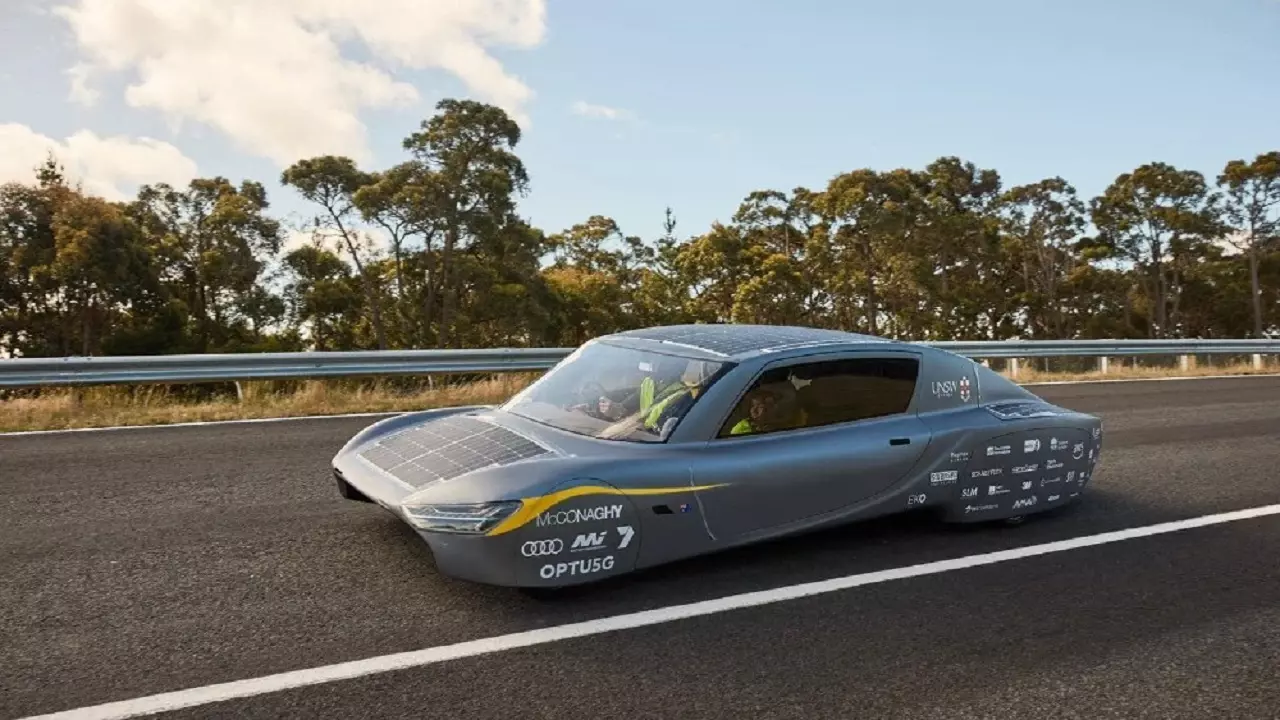
Entitled Sunswift 7, Students Set New Record With Their Solar Powered Car That Has A Range Of 1,000 Km On A Single Charge.
A group of students has developed the most efficient electric car in the world, called Sunswift 7. This solar electric vehicle, which has set several new records, features a futuristic design covered in solar panels, and has entered the Guinness World Records after traveling 1,000 km in 11 hours and 52 minutes. All of this was achieved on just a single charge without needing to recharge along the way.
Sunswift 7 Weighs Approximately A Quarter Of A Tesla Model S


This achievement is nothing short of astounding, especially considering that the solar electric vehicle was designed and built by students from the University of New South Wales (UNSW) in Sydney, Australia, at Sunswift Racing, the university’s solar electric racing team.
The question now is what to do with this solar-powered car, the latest in a series of solar electrics produced since 1996 by Sunswift Racing, to achieve such a high range. It’s not just a simple matter, but rather a blend of factors.
-
350-year mystery may have been solved: remains of a soldier who inspired the hero of The Three Musketeers found beneath a church in the Netherlands.

-
NASA photographed a nearly perfect square with 3 km sides on Mars, 13 times larger than the Great Pyramid of Giza, but the official explanation is natural erosion; still, no one has explained why the four sides have almost identical lengths.

-
Starlink breaks the barrier of 10,000 satellites in orbit and takes its expansion to an unprecedented level, with a direct impact on global internet, technological competition, and the race for space.

-
Japan finds an alternative to oil amid rising prices by transforming ocean balance into electricity with a new technology that maintains efficiency even when the sea changes.

One of the essential points is the weight of the solar electric vehicle. Weighing only half a ton, the Sunswift 7 is about a quarter of a Tesla Model S. To achieve this, some elements are not included in the solar-powered car.
Air conditioning, ABS, airbags, and windshield wipers were considered unnecessary extras in the development of the solar vehicle and are not present in the model. To reach 1,000 km on a single charge, it was absolutely necessary to ensure maximum aerodynamics, something that was carefully considered during the shaping of the model. The unique design aims for this objective and guarantees a drag coefficient of 0.095, while the Model S features a coefficient of 0.208, for example.
Solar Electric Vehicle Cannot Be Marketed
According to the team behind the project, the battery and solar panels used are perfectly common. One of the secrets to such high range focuses on the low rolling resistance of the wheels, allowing the solar-powered car to keep moving even without pressing the accelerator.
It’s important to remember that the model cannot be purchased; despite the technology being available for anyone to use, it is impossible to mass-produce the Sunswift 7 prototype developed by the students for commercial sale.
This is because it is not a safe vehicle for the road as developed. The lack of essential safety features, such as airbags, windshield wipers, or ABS, in order to make it lighter, prohibits it from being on the streets.
The development of the solar-powered car is an exercise, a study of what is possible. For now, there will not be solar electric vehicles weighing 500 kg on the roads. However, this possibility cannot be ruled out in the coming years.
Automotive Giants Are Embracing The Use Of Solar Panels
In December of last year, Toyota unveiled the fifth generation of its hybrid car, the Prius. The new version of the model comes with a fresh exterior design and new interior features. This model is equipped with an innovative system that includes a solar panel that promises to extend the range by up to 1,250 annually.
According to the Japanese automaker, the system in the model uses the solar panel to generate energy for the car’s batteries while it is parked. The vehicle’s design has not changed much since 2015, and some design features that have become iconic to the model are still present in this version.







-

Uma pessoa reagiu a isso.