





 Portuguese
  English
  Spanish
  6 min of reading
  0 comments


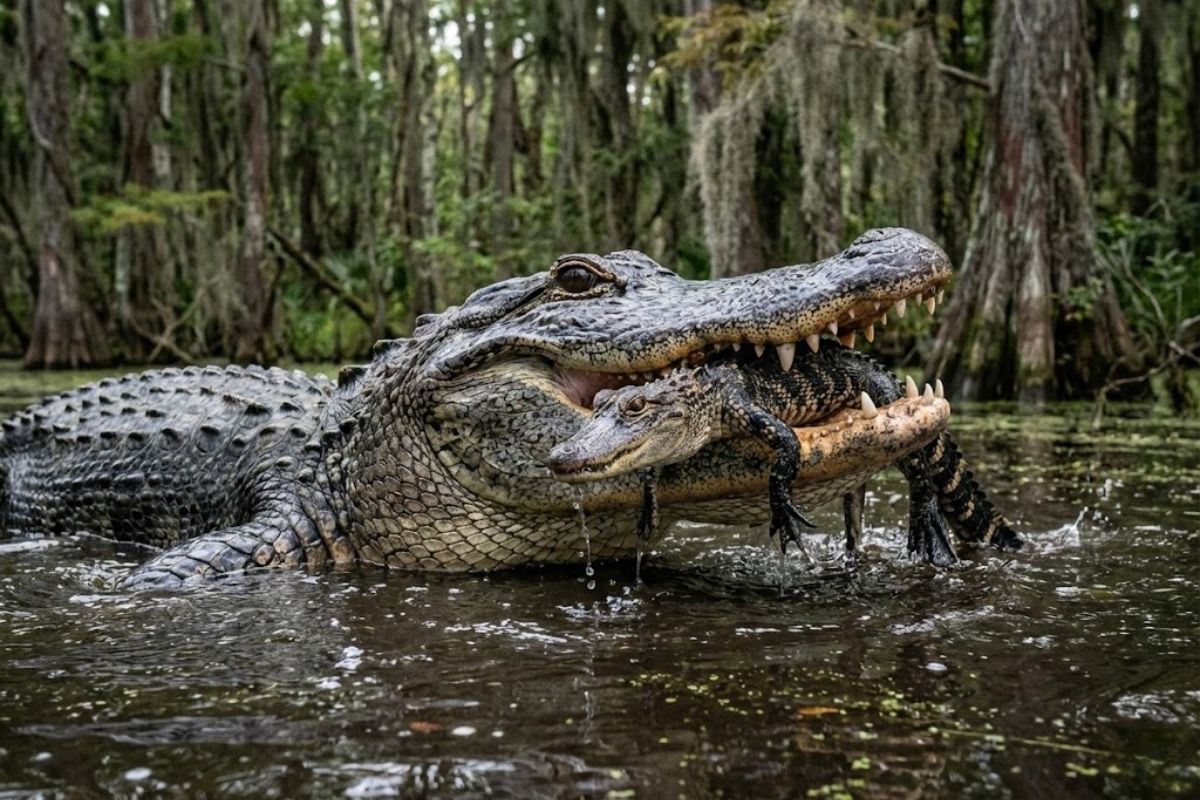
In Orange Lake, Florida, Tags of Hatchlings Appeared in 12% of the Stomachs of Slaughtered Alligators, Suggesting Relevant Cannibalism. Models Estimated 6%–7% Per Year, with Adults, 26% of the Population, Accounted for 97% of the Cases. Tags Can Stay in the Stomach for Over 10 Years, and This Alters How Mortality is Interpreted.
Alligators are often portrayed as top predators, threatened by environmental changes and human actions. However, in a specific slice of the American swamps, one conclusion shifts the focus of risk: the adult alligators themselves may be the primary cause of death for juvenile alligators, in a dynamic where cannibalism stops being an “exception” and becomes part of population functioning.
The detail that makes this story less intuitive is the path taken to view the phenomenon. It was not necessary to find bones or recognizable remains in the stomach to suggest predation. Instead, tags swallowed along with the hatchlings became traces, allowing estimates of “how much” cannibalism weighs, “where” it appears, and “why” it may be favored in certain environments.
When the “Killer” is Already in the Same Swamp

The change in perspective begins with a simple observation: in alligator habitats, the threat to hatchlings is not always a snake, bird, or opportunistic mammal. In part of the swamps, the most consistent pressure may come from larger alligators, with the capacity to capture juveniles without significant risk of injury.
-
After decades of failed attempts, Brazil is once again looking to space with an orbital rocket measuring 12 meters, weighing 12 tons, costing R$ 189 million, and scheduled for launch in 2026, in a new race to finally achieve autonomous access to orbit.

-
The Earth will plunge into a few minutes of darkness in broad daylight in August 2026, when a total solar eclipse transforms the sky into one of the most impressive astronomical phenomena in recent years.

-
How the terraforming of Mars can transform the planet: artificial aerosols can increase the temperature by up to 35°C in 15 years, creating conditions for liquid water.

-
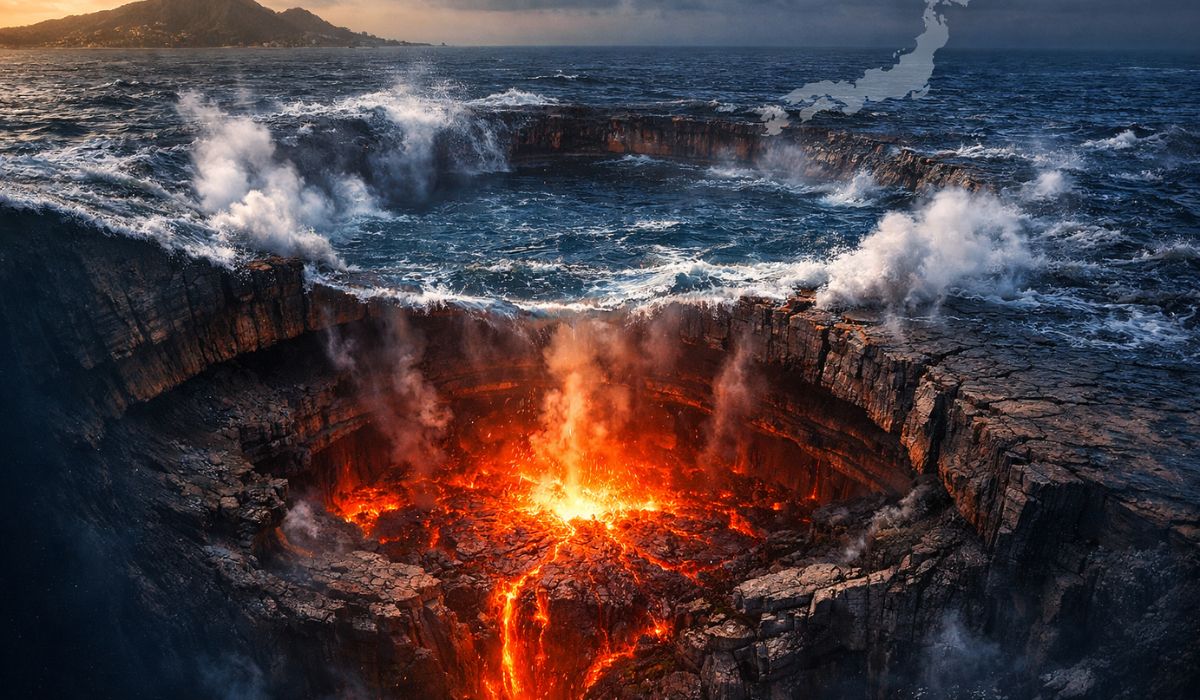
Scientists drilled nearly 8,000 meters into the ocean floor above the fault that caused the 2011 tsunami in Japan and discovered that a layer of clay 130 million years old was responsible for making the wave much worse than any model had predicted.


In Orange Lake, Florida, this hypothesis gained traction based on an objective data point: 56 tags were found in 33 stomachs, representing 12% of the examined stomachs among alligators slaughtered by hunters during the analyzed period.
In the most direct study it was found that there is sufficient intraspecific consumption to leave measurable traces, even when the food “disappears” quickly during digestion.
The Proof That Doesn’t Appear: Tags, Stomachs, and the Time That Distorts Everything

The methodological heart of the study was to treat the tag as evidence of ingestion, not the rest of the hatchling’s body. This matters because digestion can erase almost everything, but the metal tag persists.
In the analyzed set, the retrieved tags were linked to small juveniles: available records indicated individuals from 26 to 140 cm at the last release, with an average of 43.7 cm; for 91% of them, the total length was up to 85 cm, associated with a maximum age of three years.
However, there is a statistical trap: if the tag gets stuck in the stomach for a long time, it “counts” a cannibalism event from months or years ago as if it were recent.
That’s why there was a captive experiment to measure retention: ten alligators were monitored through X-rays over long intervals, and after 588 days, 38 tags (76%) were still in nine stomachs.
In the best fit, the estimated median retention exceeded 10 years, which completely changes the interpretation of how many tags represent cannibalism “in the last year.”
How Much Cannibalism Weighs: From Small Percentages to Big Effects
When probability and survival models come into play, the question ceases to be “whether there is cannibalism” and becomes “what is the likely annual rate.”
The weighted average estimate indicated something between 6% and 7% per year for juvenile mortality attributed to cannibalism, with intervals that, in different sets of assumptions, were approximately between 2% and 11%. This may seem low at first glance, but it is not necessarily small in population terms, because mortality in early stages often influences the entire age pyramid.
Comparisons with areas in Louisiana help to understand the magnitude of possible variation. In one study area there, it was estimated that cannibalism accounted for at least half of the total annual mortality; in another modeling approach, it was predicted to range from 2% to 6% per year.
The central point is that there is no “universal number”: rates change with density, refuge availability, food, and habitat structure.
Who Devours Whom: Size, Age, and the Moment the Hatchling Becomes Exposed
A pattern emerges strongly: size difference is decisive. In Orange Lake, the analysis focused on adult alligators (generally over 183 cm), because subadults rarely showed evidence of cannibalism.
And there is a striking contrast: adults made up about 26% of the estimated population but accounted for 97% of the cases. This suggests that it is not “everyone doing everything,” but rather a strong asymmetry, typical of intraspecific predation.
Vulnerability also has a window. The data supports the idea that juveniles remain exposed until reaching about 140 cm, something associated with several years of life. In this interval, the ecology of the hatchling changes: as they grow, they tend to disperse from areas associated with the nest and move through transitional zones between swamp and open water, where encounters with larger alligators become more likely. In other words, it is not just “being small”; it is being in the wrong place at the wrong time, when habitat protection decreases and contact increases.
Why This Happens: Food, Density, Refuge, and an Internal “Brake”
Cannibalism in generalist predators tends to increase when there is pressure for resources. In alligators, this can occur due to lower prey availability, concentration of individuals, and environmental conditions that compress the usable space, such as lower water levels during hot periods.
When the environment pushes alligators into smaller areas, the chance of encounters between size classes increases, and intraspecific predation can become an energetically “acceptable” pathway for adults.
There is also a regulatory effect: by removing juveniles, adult alligators reduce future competition and “thin out” the population base, which can stabilize the system in high-density scenarios. This does not make cannibalism “good” or “bad” in moral terms but positions the behavior as part of an ecological mechanism.
In many swamps, balance may depend more on interactions between alligators than on external enemies, especially when the habitat offers unequal refuge.
Hunting, Repopulation, and the Mathematics of Risk
When cannibalism becomes a relevant part of juvenile mortality, some management decisions gain another layer. Strategies that remove a large portion of annual hatchling production, for instance, are often justified by high juvenile mortality.
If part of that mortality is caused by adult alligators, the estimate of “excess” hatchlings may be more linked to internal dynamics than to outside predators.
Additionally, the study highlights a caution in interpretation: if the presence of tags can increase encounters (for example, due to how human management alters release and movement patterns), there is a risk of overestimating cannibalism in certain models.
Still, even rates that seem moderate can be decisive, as mortality in hatchlings and juveniles is the bottleneck that determines who reaches adulthood, impacting any capture, conservation, or repopulation plan.
The picture that emerges is uncomfortable precisely because it is plausible: in certain swamps, adult alligators may be the most lethal factor for young alligators, and this is not a detail of “rare” behavior, but a cog that helps regulate density, age structure, and habitat use.
By following traces that remain in the stomach for years, the research also shows how nature can hide important events and how the method of measurement completely changes what seems to be happening.
Should cannibalism among alligators influence management and population control decisions, or is it a “natural” process that shouldn’t be counted? And have you seen, in videos or field reports, situations where adult alligators attack juveniles or does that still seem too counterintuitive to believe?







-

-

-

-

-

28 pessoas reagiram a isso.