





 Portuguese
  English
  Spanish
  6 min of reading
  9 comments


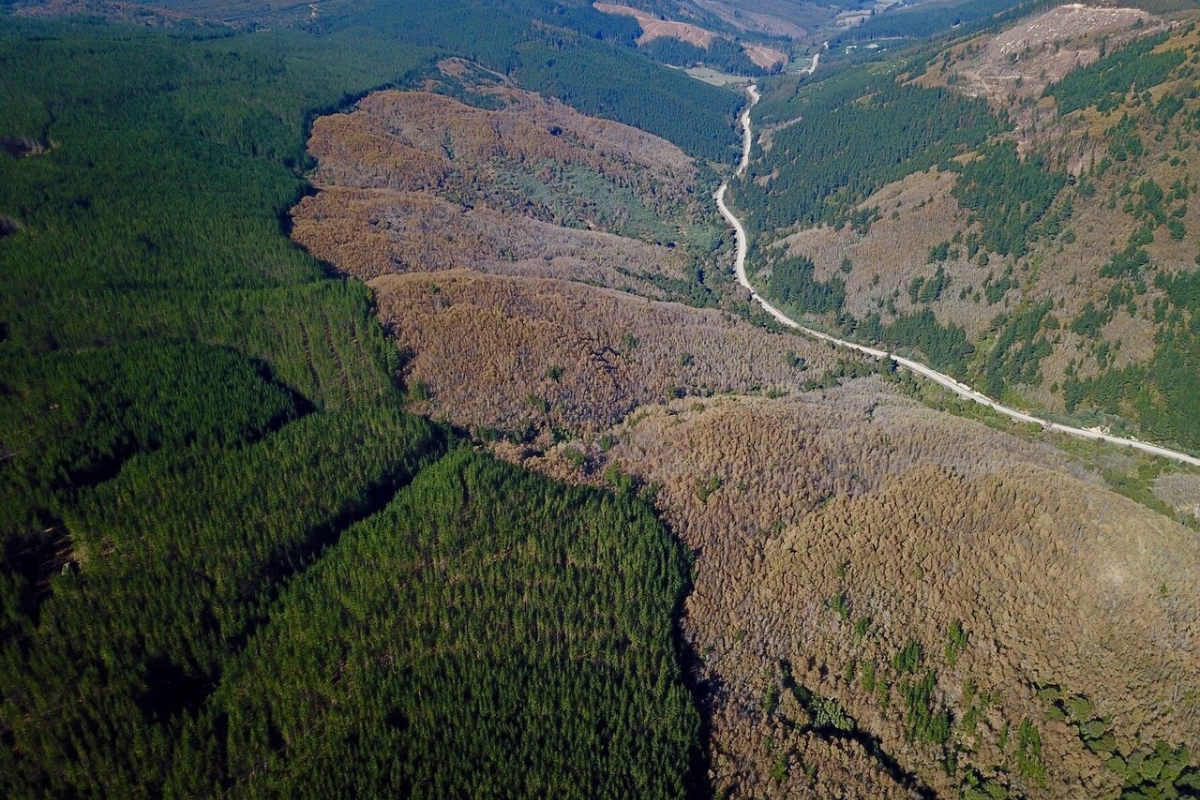


Researchers Show That Restoring Is Not About Aligning Trees in Rows, but Allowing Natural Regeneration, Using Diverse Native Species, and Planning the Landscape Beyond the Boundaries of a Plantation
A study by researchers from Stanford University showed that massive tree planting campaigns can generate the opposite effect from what is intended. Monocultures of trees can reduce biodiversity, alter water cycles, and compete with native ecosystems, causing more harm than good when not carefully planned.
The Myth of “The More Trees, the Better”
In recent years, planting trees has become an almost unassailable symbol of environmental responsibility. Governments, companies, and philanthropic organizations have announced goals to plant billions and even trillions of trees, presenting these campaigns as a quick solution to the climate crisis. The idea is simple and seductive: more trees mean more carbon captured from the atmosphere.
However, the Stanford study demonstrates that this logic is dangerous when it ignores the real ecology of the places where trees are planted. By analyzing large global restoration commitments, the researchers found that most goals do not focus on recovering native forests. Instead, they prioritize fast-growing commercial plantations, typically with just one or a few species.
-
Something is happening around the Earth: Inside the huge explosion of fireballs in 2026

-
A hot air bubble coming from Argentina expands over Brazil, causing thermometers to exceed 38 degrees with a thermal sensation of 40 degrees in late March, affecting 6 states at once.

-
The radish leaf that almost everyone throws away has more polyphenols, flavonoids, and fiber than the consumed root, and a 2025 study showed that the leaf contains compounds that protect the intestine, combat inflammation, and may inhibit the growth of cancer cells.

-
A planet that seemed to defy the laws of physics has intrigued scientists for decades, until the James Webb revealed what is really affecting Saturn’s rotation.



When Reforesting Means Losing Forest
Scientists evaluated tree planting subsidy programs implemented over decades in a country that has become a benchmark for large-scale reforestation. The policy seemed exemplary: the government funded most of the planting and maintenance costs, encouraging landowners to cover degraded areas with trees.
In practice, however, design and oversight failures led to an unexpected outcome. Many landowners deforested native forests to replace them with plantations of exotic or commercially valuable trees. By comparing the real scenario with simulated scenarios without subsidies and with well-designed subsidies, the researchers found a clear pattern: the area “with trees” increased, but the area of native forest decreased.
Native forests store more carbon and support a much greater biodiversity than homogeneous plantations. This means that, despite good intentions, the program ultimately reduced the total carbon stock and pushed native species even closer to extinction.
Monocultures: Trees That Silence the Forest
A monoculture plantation is not a forest. In a true forest, the diversity of species, sizes, ages, and ecological functions creates a complex network of interactions. It is this complexity that provides resilience against pests, diseases, climate change, and extreme events.
Industrial plantations, such as those of eucalyptus or pine on a large scale, tend to exhibit:
- Very few species of trees, almost always exotics.
- Poor understory, with few plants and less variety of animals.
- Few niches for birds, mammals, insects, and fungi.
- Short cutting cycles that prevent the formation of a mature forest structure.
Additionally, the conversion of native ecosystems into homogeneous plantations is often accompanied by intensive use of herbicides, pesticides, and fertilizers. This degrades the soil, contaminates watercourses, and affects local human communities that depend on these resources.

Trees That Dry Rivers
Another critical point highlighted by researchers is the impact on water cycles. Fast-growing trees, when planted over large areas, can consume immense amounts of water. When these plantations are established in areas that would naturally be open fields, savannas, or low vegetation formations, the effect on local hydrology can be drastic.
Among the impacts observed in different regions of the world are:
- Reduction of river and stream flow.
- Drop in the level of underground aquifers.
- Drying of springs and wetlands.
- Changes in rainfall patterns, especially when large areas are converted into monocultures.
In other words, the same tree that, in an appropriate context, could help protect soil and water, in another context becomes a silent “firefighter” that pulls water from the ground until it exhausts the reserves.
Planting Trees Where There Never Were Forests
A common mistake in planting campaigns is to assume that any “tree-less” area is degraded and needs to be forested. However, the planet’s ecosystems are not all forested. Many are naturally open: fields, prairies, steppes, savannas, and other types of non-tree vegetation.
When these environments are covered with trees:
- Species adapted to open environments lose space.
- The dynamics of fire, light, and water change completely.
- The landscape loses its original ecological identity.
From a carbon point of view, there is also no guarantee of gain. In several cases, the carbon accumulated in intact prairie soils is as high or even higher than that of many planted forests. Replacing these ecosystems with trees can release carbon stored in the soil and, at the same time, reduce biodiversity.
Why So Much Emphasis on Planting?
There are economic and political reasons that explain the popularity of massive tree planting programs. Planting is a visible action, easy to communicate and account for. It is simple to announce goals of “millions of seedlings,” take photos of planting ceremonies, and disseminate impressive numbers in reports.
Moreover, timber, cellulose, oil, rubber, or fruit plantations generate profit. When these initiatives are integrated into climate policies, there is a risk of confusing legitimate commercial interest with ecological restoration, as if they were the same thing.
The Stanford study shows that this confusion is dangerous. Programs aimed at combating climate change and biodiversity loss end up, in practice, financing the expansion of monocultures that aggravate these problems.

What Works: Restoring Ecosystems, Not Just Planting Trees
The researchers’ work is not an attack on the idea of planting trees per se, but on simplistic ways of doing it. The main message is that serious reforestation requires ecological planning, not just seedling numbers.
Some central principles emerge from the evidence:
- Do Not Replace Native Ecosystems with plantations, whether they are forests, savannas, fields, or others.
- Prioritize Natural Regeneration, whenever possible, allowing vegetation to recover from seed banks, roots, and remaining fragments.
- Use Diverse Native Species, avoiding extensive monocultures of a single species.
- Plan on a Landscape Scale, considering watersheds, ecological corridors, and already fragmented areas.
- Include Local Communities and Indigenous Peoples in decision-making, respecting territorialities and traditional knowledge.
These paths are slower and more complex than simply planting millions of seedlings of a fast-growing species. But they are also the only ones capable of actually recovering the ecological functionality of a territory.
Rewilding: Letting Nature Return
A concept that has been gaining traction is “rewilding.” Instead of trying to control every tree, this approach seeks to restore ecological processes: allowing seeds to circulate, herbivores and predators to return to their roles, rivers to reclaim their natural courses, and the mosaic of habitats to recompose.
In practice, this can mean:
- Removing barriers to natural regeneration.
- Protecting remaining fragments as dispersal cores.
- Reintroducing locally extinct species that play key roles in the ecosystem.
- Reducing pressures from deforestation, hunting, and predatory exploitation.
This way, trees continue to emerge, but as part of a dynamic system, rather than as perfectly aligned rows of an industrial plantation.
More Than Counting Trees: What This Alert Changes
The Stanford study presents a direct challenge to governments, companies, and organizations that rely on planting numbers as proof of their environmental action. It is not enough to announce goals of billions of trees if they are planted in the wrong places, with the wrong species, replacing ecosystems that are already valuable.
What starts to matter is not how many trees are planted, but:
- Which ecosystems are being helped to recover.
- How much carbon will actually be stored, in the long run.
- Which species will benefit or disappear.
- How the water cycle will be affected.
- Which human communities will be impacted.
Planting trees remains a powerful tool against the climate crisis and biodiversity loss. But, as the Stanford alert shows, it is a tool that can cut both ways. Used carelessly, it destroys what it promises to save. Used with ecological knowledge and responsibility, it can help rebuild entire landscapes, not just fill reports with pretty numbers.
Sources consulted include Stanford Report, BBC News, Earth.org, academic releases from the University of Concepción and UCSB, in addition to the study published in the journal Nature Sustainability on forest subsidies in Chile.







Research today is conducted to arrive at a predetermined outcome in support of a narrative. It makes perfect sense that the outcomes are negative when you base actions on faulty assertion.
Essa matéria é um desserviço à sociedade! O estudo de Standford sequer cita eucalipto! Olha o plantio em mosaico, compromissos ambientais assumidos pelas empresas, publicações de biodiversidade circulando entre os plantios e por aí vai. Me ajuda a te ajudar Noel Budeguer! Tanta informação nova e bacana sobre o tema! O errado (e ilegal) é desmatar para esse fim o que hoje é inexistente nas grandes empresas do setor. É normal em garimpos e empresas que atuam fora da legalidade.
O bom manejo florestal é o que garante a perpetuidade do negócio. E qualquer empresa que tenha o mínimo de noção, quer a perpetuidade do negócio. Manejo é baseado em ciência, em estudo científico + prático…
Maybe stop fukn with sh*t