





 Portuguese
  English
  Spanish
  3 min of reading
  0 comments


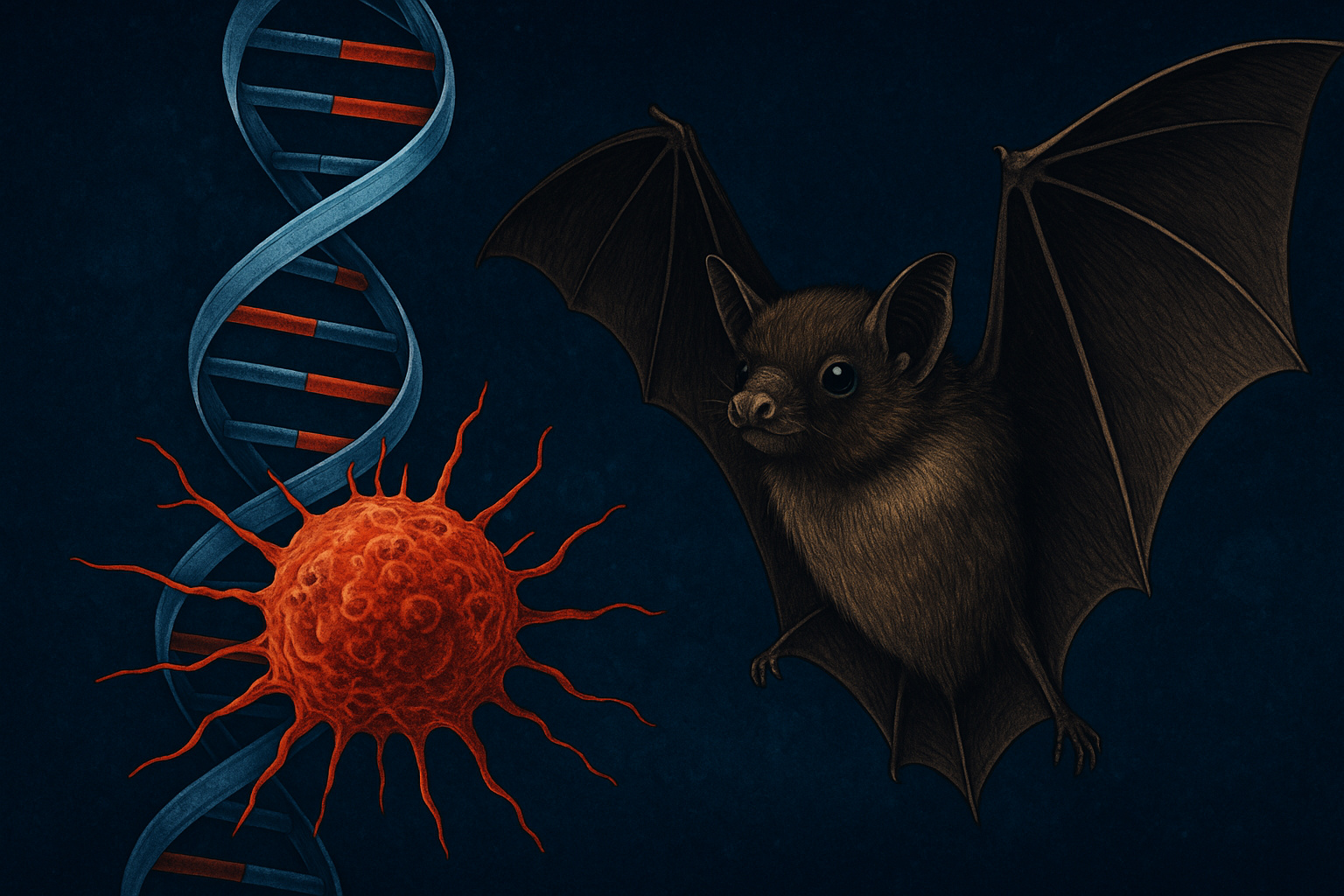
Researchers From The University Of Rochester Show How Bats Avoid Cancer With Powerful Genes, Silent Immunity, And Rare Cell Balance
In the forests of northern New York, small brown bats live for decades, hanging upside down in caves. One of them has been found to be over 30 years old. That is equivalent to 180 human years. Even so, these animals almost never develop cancer.
Now, scientists at the University of Rochester may have discovered why. The findings were published in the journal Nature Communications. The study provides a new insight into bat biology and offers clues for future cancer treatments in humans.
Cancer With Only Two Hits
Typically, for cancer to occur, a cell needs to undergo several mutations. In humans, between three and eight. In mice, just two. And bats? They also only need two.
-
An impressive phenomenon in Northern Brazil causes rivers of different colors to flow side by side, revealing secrets about sediments, currents, and biodiversity.

-
While many schools are still struggling with the basics, a teacher in China went viral for having elementary school students build a two-stage rocket using plastic bottles, water, and pressurized air in a science class that caught the attention of the entire world.

-
10 million robots per year in unprecedented industrial scale place China at the forefront of automated production and raise the question of how far machines can manufacture other machines.

-
Researchers in Malaysia buried sensors at 15 and 30 cm and can now predict soil moisture with 95.49% accuracy, helping the field to irrigate only at the right time and reduce water waste.

The researchers analyzed cells from three species of bats. In the lab, only two changes were needed to turn these cells into cancerous ones: the activation of an oncogene and the deactivation of genes that should prevent tumors.
This contradicts what was expected. If bats have such fragile cells in the lab, why don’t they develop cancer in nature?
The Power Of Gene p53
The answer may lie in the p53 gene. This gene acts as a guardian. It detects DNA damage and can signal the cell to die, preventing it from turning cancerous. In humans, half of cancers involve failures in this gene.
In bats, p53 is especially powerful. One of the species studied, Myotis lucifugus, has two complete copies of this gene. This is also the case with elephants, another cancer-resistant animal.
Moreover, bats manage to maintain the perfect balance. Not too much, not too little. If p53 is underactive, cancer develops. If it is overactive, it destroys even good cells. Bats possess this rare balance.
They also produce high levels of two molecules that help p53 function properly: MDM2 and WRAP53. And they do so in a stable manner, even when exposed to radiation. In humans and mice, this pattern is not observed.
Active And Silent Immunity
Another factor that helps bats is their immune system. They coexist with dangerous viruses like Ebola and SARS without falling ill. This makes them good carriers but also reveals that their bodies are always on alert.
This vigilant system may be an ally against cancer. The study suggests that they have more CD8+ T cells and natural killer cells, which are responsible for eliminating tumors. It is a silent and efficient defense.
Additionally, bats age without inflammation. Their cells produce fewer inflammatory substances. Meanwhile, human cells, over time, become “zombie” cells, promoting inflammation that favors cancer.
Telomerase Active For Life
One last detail caught attention. Bats keep the telomerase enzyme active into old age. This enzyme protects chromosomes. In other animals, it becomes inactive over time. Without it, tissues degrade, and aging accelerates.
In bats, this does not happen. They continue producing telomerase. This could be a risk, but p53 steps in and removes suspicious cells. Thus, the balance is maintained.
According to researcher Vera Gorbunova, this complex system helps bats avoid age-related diseases and viruses. She is one of the authors of the study from the University of Rochester.
A New Path To Treat Humans
The discovery may inspire future treatments for cancer in humans. Many medications are already trying to activate p53. This study could help improve these therapies.
There is also interest in safely controlling telomerase. If this is possible, some of these findings could be applied in the treatment of people.
The research is part of comparative oncology, which studies cancer resistance in other species, such as elephants, whales, and mole rats. Now, bats join this group.
They live much longer than expected for their size. And they rarely develop tumors. This was already impressive. Now, it begins to make sense.
With information from ZME Science.







Seja o primeiro a reagir!