





 Portuguese
  English
  Spanish
  5 min of reading
  0 comments


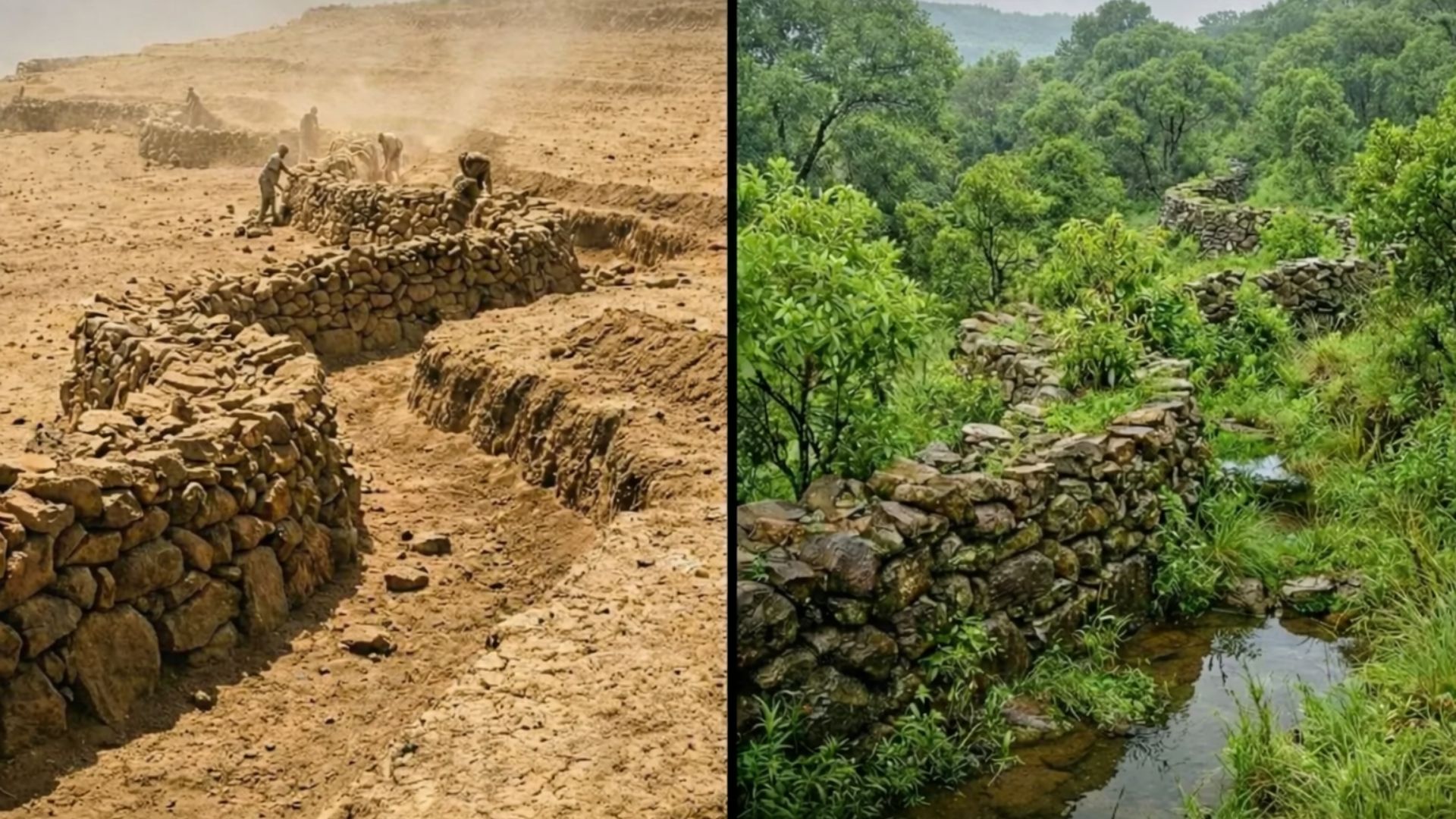
Ecological Restoration In The Highlands Of Ethiopia Shows That Soil Engineering And Water Retention Can Precede Traditional Reforestation. Community Project Transformed Degraded Slopes By Prioritizing Rain Infiltration, Natural Regeneration And Grazing Management Before Large-Scale Planting.
In Northern Ethiopia, the restoration of the Desa’a Forest strayed far from the more well-known formula in reforestation campaigns.
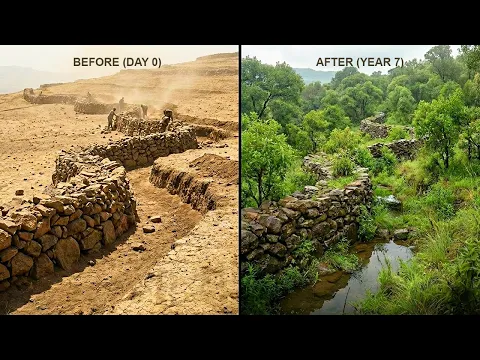
Instead of starting with rows of seedlings, local communities and technicians focused the first years on soil and water conservation works, with trenches, micro-basins and stone walls to slow erosion, retain rainwater, and create the minimum conditions for vegetation to regrow.
The strategy, conducted since 2018, has already amounted to 23,000 hectares in restoration, with more than 22.5 million trees planted or regenerated and a survival rate of over 90%, according to WeForest.
-
How 5,000 Indian dabbawalas manage to deliver around 200,000 lunchboxes a day in Mumbai for over 130 years using bicycles, crowded trains, and a manual system that continues to operate with impressive accuracy.

-
While restoring a historic mansion from 1910, a brick structure with an old turbine that generated energy from the Rio do Testo emerged, along with a hidden door and a rare floor concealed under layers of wax.

-
Italian researchers have detected what appears to be a second Sphinx buried under the sands of Egypt, and satellite scans reveal a gigantic underground megastructure hidden beneath the Giza Plateau for over 3,000 years.

-
There are 4,223 drums and 1,343 metal boxes concreted with 50-centimeter walls that store the radioactive waste from Cesium-137 in the worst radiological accident in Brazil, just 23 kilometers from Goiânia, with environmental monitoring every three months.

The Desa’a area, in the regional state of Tigray, is described by studies and restoration organizations as one of the oldest remnants of dry afromontane forest in the country.
Before the recent intervention, the scenario was one of significant degradation: 74% of the original cover had vanished, while the remaining area was under pressure from deforestation, agricultural expansion, firewood collection, and grazing.
In this context, insisting solely on planting seedlings meant repeating a historical difficulty of the region: little water infiltrated the soil, high evaporation, and low survival of young trees.
Soil Engineering Changed The Logic Of Reforestation

The project’s logic was to invert the traditional order. First, it was necessary to keep rain on the slope for longer.
To achieve this, communities opened 20,480 deep trenches, implemented almost 38,000 shallow retention structures, excavated 3.8 million micro-basins, and built 439 kilometers of stone barriers, used to slow down surface runoff and increase water infiltration.
The result reported by WeForest is the annual capture of 1.7 million cubic meters of rainwater, now retained in the system instead of being quickly lost downhill.
These interventions address an old problem of the Ethiopian highlands.
Erosion removes fertile soil on a massive scale in the country, with academic estimates indicating losses exceeding 1.5 billion tons of topsoil per year.
On degraded slopes, rain tends to run off over the compacted surface, carrying nutrients and sediments away.
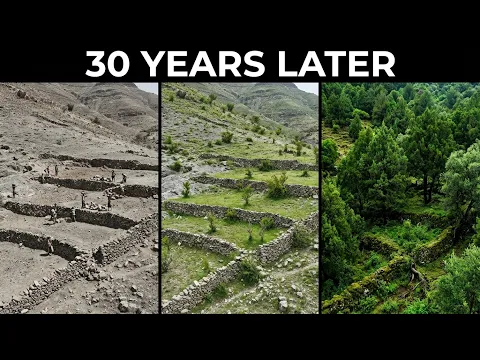
By fragmenting the terrain with trenches, basins, and barriers, the project reduced the energy of runoff, increased subsurface moisture, and supported the gradual return of vegetation cover.
Natural Regeneration Helped Forest Reappear
Another central axis was assisted natural regeneration.
In Desa’a, restoration did not rely solely on nursery seedlings, but also on the ability of native trees to sprout from existing structures in the terrain.
In areas with intermediate cover, the project combined planting with assisted regeneration of species such as Juniperus procera and Olea europaea subsp. cuspidata, native to the dry afromontane forest.
Instead of treating the entire landscape as empty soil, the initiative divided the area into management zones and adapted the intervention to the degree of degradation of each section.
Protection against free grazing was another decisive point.
Local rules began to restrict activities in restoration areas, updating community standards in seven municipalities.
This social arrangement was considered relevant because land management depends, in practice, on local agreements regarding forest use, grazing, agricultural areas, and protected zones.
Without this control, the progress of regeneration would be compromised by the consumption of sprouts and soil compaction.
Environmental Conservation Became A Source Of Local Income
The restoration in Desa’a was also designed to reduce economic pressure on the forest.
Socioeconomic assessments indicate that many families lived on very low annual incomes and depended heavily on the extraction of forest resources for cooking, feeding animals, and supplementing their livelihoods.
Therefore, the project incorporated productive alternatives such as beekeeping, raising small animals, small-scale irrigation, and planting fruit trees.
Training focused on food security and income diversification was also provided.
This combination helped transform conservation into a local economic asset, not just a restriction.
Operational updates show that nurseries, water capture structures, and activities such as pruning, monitoring, and seedling production continued to be executed with broad community participation.
In 2022, the organization reported that more than 75% of participants in the planting program were women.
Project Continued Active Even During The War In Tigray
The war in Tigray, which began in November 2020 and was formally concluded with the ceasefire agreement on November 2, 2022, disrupted supply chains, hindered movement, and severely impacted the region.
Still, independent assessments indicate that the initiative in Desa’a maintained continuity even during the conflict.
Capacity-building actions, supply of materials, and support for communities continued to take place.
This point is noted as evidence that restoration gained enough local foundation not to rely solely on the external presence of funders and technical teams.
The measured environmental effects reinforce the weight of this choice.
In addition to the 23,000 hectares restored, the initiative claims that the work has already protected over 500,000 tons of soil from erosion.
Meanwhile, independent checks record that the project occupies more than 38,000 hectares in total, combining ecological restoration with livelihood strengthening strategies.
The forest plays an important role in aquifer recharge, protecting springs, and reducing degradation in a region threatened by desertification.
The experience gained prominence precisely for countering the logic of quick actions aimed solely at planting.
Recent reports highlight the importance of water retention structures and land preparation before vegetation expansion.
The contrast is often made with massive planting campaigns without adequate maintenance, such as mobilizations that prioritize immediate scale over long-term survival.
In Desa’a, the progress was not presented as a miracle or a simple tree-planting campaign.
What appears in the most recent reports is a gradual process based on landscape engineering, community management, and phased restoration.
First came water retention. Then, soil stabilization. Next, regeneration and planting with native species.
Finally, the consolidation of local rules and income sources that reduced pressure on the restored area.
This sequence helps explain why green has begun to emerge where isolated planting had previously failed.







-

-

-

7 pessoas reagiram a isso.