





 Portuguese
  English
  Spanish
  11 min of reading
  13 comments


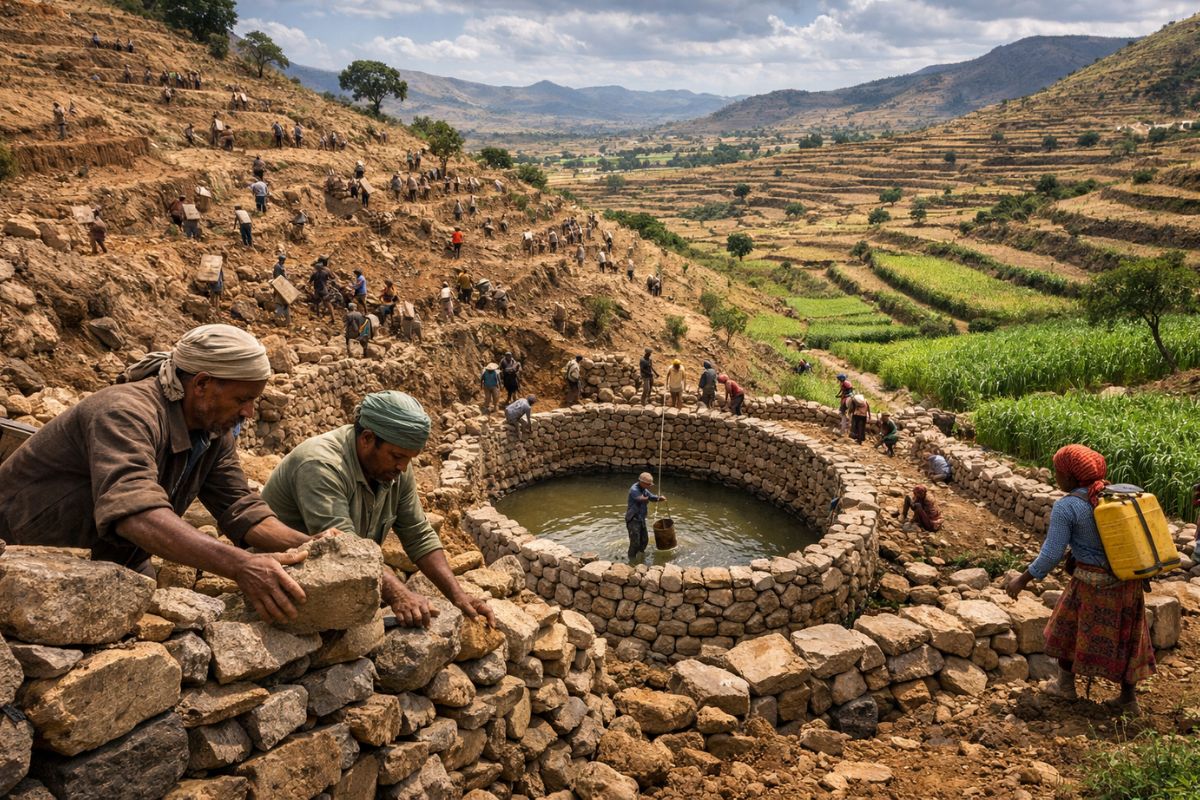


In Ethiopia, the drought and erosion crisis led to hunger and migration, but ancestral techniques without machines slowed down floods, increased infiltration up to twenty times, raised thousands of bunds and millions of water pits, created reservoirs, reduced dust, resurrected wells, and inspired global programs with annual mobilization of millions of volunteers.
Ethiopia faced decades of a scenario that seemed definitive: cracked soil like broken glass, slopes turning to dust, water running off without infiltrating, and entire villages depending on wells so deep that they no longer delivered anything but hope. At its peak, the land was so degraded that a hoe barely penetrated a few centimeters, and the rain, instead of nourishing crops, turned into floods that carried away what little remained of the ground.
It was at this limit that Ethiopia became a living laboratory by doing the opposite of what expensive projects tried to impose: instead of betting everything on concrete and machines, it rescued simple, precise techniques adapted to the terrain. Millions dug retention holes, built low walls of stone and earth, and reconstructed infiltration drop by drop, until wells considered dead for decades began to flow with water again.
The Environmental Collapse That Transformed Hectares Into Dust

By the late 1970s and early 1980s, Ethiopia plunged into a sequence of droughts and soil degradation that could not be explained only by climate.
-
In a flooded well, archaeologists found a 1,700-year-old Roman egg that still contains clear and yolk intact inside the very thin shell.

-
Something is happening around the Earth: Inside the huge explosion of fireballs in 2026

-
A hot air bubble coming from Argentina expands over Brazil, causing thermometers to exceed 38 degrees with a thermal sensation of 40 degrees in late March, affecting 6 states at once.

-
The radish leaf that almost everyone throws away has more polyphenols, flavonoids, and fiber than the consumed root, and a 2025 study showed that the leaf contains compounds that protect the intestine, combat inflammation, and may inhibit the growth of cancer cells.

There were decades of deforestation, intensive livestock farming, soil impoverishment, and total loss of the capacity to retain water.
The result was physical, visible, and brutal: the hardened surface cracked, and agricultural land turned into a mixture of stone and dust.
In some regions, erosion reached levels of between 200 and 300 tons of soil per hectare per year, carried away by the wind.
The dust didn’t just stay “over there”: there were records of particles leaving Ethiopia and reaching the shores of the Arabian Peninsula thousands of kilometers away.
In areas like Tigray and Amhara, there were years when 90% of the rain flowed over the surface, infiltrating practically nothing, because the soil no longer had the structure to absorb water.
The level of degradation was so extreme that, in Tigray, 100% of the seedlings died during three consecutive seasons, and the hoe could not penetrate more than about 5 cm.
The cracks in the ground reached 30 to 50 cm wide and exceeded 2 m deep, large enough to swallow a cow’s leg.
Many villages dug “dead wells” with 20 to 30 m deep, not to seek real water, but to try to find a still moist layer, any sign of life beneath the crust.
Hunger, Absent Water, and a Country Pushed Into Mass Migrations
When the land loses trees, infiltration, and structure, agriculture disappears along with it. Between 1984 and 1985, Ethiopia experienced a devastating famine that killed between 400,000 and 1 million people, with the population suffering simultaneously from lack of food and lack of water.
Millions were forced to walk hundreds of kilometers in search of humanitarian aid. The realization was direct: without structural change, the cycle of drought, hunger, and migration would repeat.
In this context, Ethiopia received external help to modernize water storage.
There were projects with concrete dams financed by international partners, sending specialists and machinery, irrigation channels, reservoirs, and catchment models inspired by European experiences.
The problem was not intention. It was territory.
Why Modern Dams Failed in Ethiopian Terrain
Ethiopia is not flat, and that changes everything. Steep slopes make water flow down rapidly, with pressure beyond what was envisioned in standardized projects.
The superficial layer of soil in many areas is only a few millimeters or a few centimeters, being washed away as soon as it rains.
In several places, the bedrock is exposed, preventing deep and stable excavations.
In some years, in just five weeks, it rained the equivalent of six entire months. On a mountain, a drop does not flow slowly.
It shoots down the slope.
The result was a recurring pattern: expensive works failing one after another. In a typical set of five small dams, there were cases where two completely collapsed, two operated with less than 30% capacity, and one was abandoned.
Some failures became local memories. There was a dam that broke after 21 days. There was the case of the Cobo dam: in the first rainy season, it reached 60% of the projected capacity, but a single nighttime storm caused infiltration behind the structure in a way that the team had not predicted.
The water opened an internal erosion tunnel. In just three hours, the dam broke, the water violently flowed to downstream areas, and the project was deemed a failure.
In practice, Ethiopia had to accept that “modernizing” without adapting to the terrain was insisting on a mistake.
The Turning Point When Ethiopia Sought Answers in Its Own Past
When modern solutions failed, communities turned to ancestral techniques of reading the land.
Instead of trying to block the water, the idea was to reduce speed and give time back to infiltration. That is how low stone and earth walls gained scale, built transversely on slopes and aligned with the contours.
These walls are simple and repeatable: 30 to 50 cm high, with lengths ranging from dozens to hundreds of meters, following the contours of the terrain.
They don’t use cement or steel. They use stones collected from the fields, clay mixed with straw and earth compacted with feet. The secret is in precision: the walls are built with inclination of 3 to 7 degrees, allowing water to pass without destroying the structure and, at the same time, reducing its force.
At this point, many outsiders were surprised. On a slope, missing the contour by a few degrees can cause rain to destroy everything.
Even so, communities managed to position the structures accurately because the knowledge came from generations observing how water flows and where it tears the land.
The Simple Tools That Became an Advantage in Extreme Terrain
The method did not rely on heavy machinery, and that was precisely the advantage in the type of terrain in Ethiopia. Tools with local names were used to break the thin hardened surface layer and open space where exposed rock dominated. In areas where machines couldn’t dig more than a few centimeters, people with hand tools could “read” the ground’s resistance and work point by point.
The logic was practical: instead of trying to dominate the slope, it was necessary to learn from it. Mark the correct alignment, break the crust, open holes with stable shapes, compact the soil in the right way, and protect the structure so it could withstand the rainy season without giving way.
Water Pits: Holes That Work as Mini Water Batteries
Ethiopia did not dig holes to plant trees. It dug to capture rain and return infiltration to the soil. The water pits were opened following a pattern: circular or cone-shaped, sloping walls between 60 and 70 degrees, and a wide mouth to capture water.
Then, the soil was compacted with wooden sticks, firm enough not to collapse, but without excess to prevent cracking. On top, straw helped retain moisture and stimulate microbial life.
The execution time says a lot about why this scaled. One person took 20 to 40 minutes to dig a hole.
A group of 10 people could complete between 150 and 200 holes per day. In Ethiopian conditions, this surpassed the real efficiency of excavators, which faced exposed rock, steep slopes, and thin surface soil.
Microrreservoirs: When Holes and Walls Start to Talk
After the walls and holes began to work together, a second level of retention emerged: small microrreservoirs, from 8 to 15 m³, which captured water slowed down by the walls above. Everything was manual: excavation, transporting earth in baskets, stacking stone, compacting.
What seemed “small” changed the entire system, because multiplied by thousands and millions, it became infrastructure spread throughout the landscape.
The change in dynamics was objective. Before, the water flowed at 3 to 4 m per second and disappeared in minutes. Upon meeting the walls, the flow dropped to less than 0.5 m per second.
This reduction in speed made infiltration increase by 10 to 20 times. Instead of flooding, the rain became a recharge for the soil.
When the Soil Began to Retain Water, Dead Wells Resurrected
After one or two rainy seasons, the landscape began to change. The surface stopped cracking like before.
Humidity increased. Between the second and third season, water pockets formed between the walls and expanded, turning into seasonal lagoons. Some puddles began to connect, forming small streams.
The most impressive milestone was the return of water in wells considered lost. After about 5 to 7 years, many wells classified as dead for over 40 years began to flow with water again.
The explanation is a simple and powerful cycle: retained water nourishes plants, roots hold soil, soil retains more water, and self-recovery begins to work.
Ethiopia Turns Restoration Into a National Mission
When the result appeared, Ethiopia understood that it was not a local action, it was a survival strategy. Starting in 1994, restoration became a national mission with annual mobilizations.
For 20 to 30 days, millions pause their activities to dig holes, build walls, and open reservoirs.
The numbers grew over time. In 2009, 4.3 million participated. In 2016, the total rose to 8 million. In 2019, it reached nearly 11 million.
In a single region of Tigray, there were years when 1 million people dug reservoirs in one season. And the strongest detail: no one is paid. The work is voluntary because crops improve, water returns, and the land cannot die again.
The Role of Women and the Physical Routine of a Nation in Volunteering
One of the elements that drew attention was the female presence. There are records of women representing between 40% and 50% of the workforce in building walls, digging reservoirs, and transporting soil and stones. They arrive early and leave late, with bamboo baskets on their backs and hands covered in dust.
The typical routine starts around 5:30 am, with a meeting at the site and the traditional coffee prepared right there. At 6 am, the rhythm starts and the slope turns into the sound of hoes, stones hitting, and groups carrying soil.
There is a short break around 9 am for simple food, and work continues until noon. In the afternoon, they reinforce structures, finish holes, and, near 5:30 pm, they return to measure inclination and mark the section for the next day.
On average, each person completes 15 to 25 holes per day, or builds 5 to 10 meters of wall. A team can achieve 200 holes or 100 meters before sunset.
When this is repeated for decades, the impossible becomes statistics.
The Scale That Seems Unbelievable: Reservoirs, Holes, and Kilometers of Walls
After more than 20 years, the numbers become difficult to visualize. There were over 600,000 microrreservoirs, which together would equal a surface area of about 6,000 football fields.
There were more than 1 million retention holes. There were tens of thousands of kilometers of walls crossing slopes like veins.
The total area restored surpassed 2 million hectares, larger than the entire territory of Israel or Slovenia.
Instead of a centralized work, Ethiopia created a distributed infrastructure, point by point, hole by hole, wall by wall.
Failures Also Existed and Almost Brought It All Down
Nothing was linear. There were episodes when the program nearly collapsed. One case became known as the goat rebellion, between 1992 and 1993: herds invaded newly recovered areas, trampled young plants and knocked down still fragile barriers.
The country needed to react with rules: fines for damage, prohibition of grazing in areas for 3 to 5 years, and even children receiving the task of watching over herds to prevent invasion.
Before that, in 1988, an exceptionally heavy rain swept away hundreds of meters of newly built walls and destroyed holes dug with weeks of effort. The difference is that, the next morning, the village returned and rebuilt brick by brick.
In 1999, there was a large-scale reservoir campaign with technical errors. 35% of the first reservoirs had leaks.
More than 20% had collapsed walls. Many holes were dug to incorrect depths and did not retain water.
Instead of giving up, elders organized intensive courses to teach proper compaction, durable stacking, and precise positioning on the contours. What was once an error became a national standard.
Later, the conflict in Tigray between 2020 and 2022 brought destruction: walls broken by vehicles and explosions, abandoned reservoirs, and burned recovery areas.
Even so, when the fighting decreased, there were villages that, in 48 hours, mobilized 3,000 people to rebuild damaged structures. The recovery was not just technical. It was cultural and collective.
When Water Returned, Life Returned Too and the Effects Were Cascade
With structures retaining water for longer, Ethiopia realized that it was not just about “stopping runoff”. It was about changing the rhythm of the territory.
The first sign was not a tree, it was sound: frogs at night in villages that had been silent for decades.
Then came waterfowl, insects, and even fish appearing in the small reservoirs. Eggs can arrive with the rainwater or get stuck in birds’ feet. A moist environment is all it takes for them to hatch.
In recovered areas, erosion that blew dust over long distances fell by up to 70%. Vegetation cover increased between 200% and 300% in a few years, creating shade, reducing hot winds, and helping the soil retain moisture.
There were records of surface temperature drops of 1 to 3 degrees in areas with more intensive recovery, something rare in semi-arid ecosystems.
The recovery also touched economic daily life. With vegetation and water distributed, wildlife stopped invading villages in search of water, reducing conflicts. Bees returned, and local beekeeping was revitalized as a source of income.
And the return of water in wells after 5 to 7 years placed Ethiopia in a position that few imagined decades earlier: a global reference in manual land restoration.
Ethiopia Becomes a Reference and the Method Spreads to Other Countries
What began in Tigray became a global model and inspired more than 15 programs around the world. There was application in Niger with increased production of millet and sorghum in some cases.
In Kenya, regions built walls along slopes, and the effect was the creation of tens of thousands of small reservoirs, ensuring water in areas previously dependent on water trucks.
The model also reached Sudan, Mexico in severely eroded areas, and India in Rajasthan, where hundreds of thousands of structures were built following the principle of aligning contours and slowing down runoff.
Even countries with large budgets sought to observe how Ethiopia made the basics work in real terrain, incorporating the logic of walls and retention into terrace designs and erosion control actions.
What Ethiopia Proved, In Practice, About Environmental Restoration
Ethiopia proved that, in certain territories, the challenge is not “lack of rain”, but rather the lack of infiltration time. When water flows too fast, it leads to destruction.
When you slow it down, it becomes recharge. And when the recharge comes back, everything reorganizes: soil, plants, animals, wells, harvests, income, and families’ permanence in the countryside.
The power of this story lies not only in the huge numbers of holes, walls, and participants.
It lies in the repeated detail thousands of times: retain every drop, align each wall on the right curve, dig each hole at the correct angle, compact each wall in a way that it does not crack, and repeat this year after year until the soil can breathe again.
Which part of this “living laboratory” of Ethiopia impresses you the most: the scale of millions working without salary, the wells returning after decades, or the fact that low stone structures prevail over expensive modern projects?








I appreciate the collective action by Ethiopian people in digging holes,building walls and creating water reservoirs.
The scale of mllions working without pay.
Amazing. They are wonderfull people!!