





 Portuguese
  English
  Spanish
  4 min of reading
  36 comments


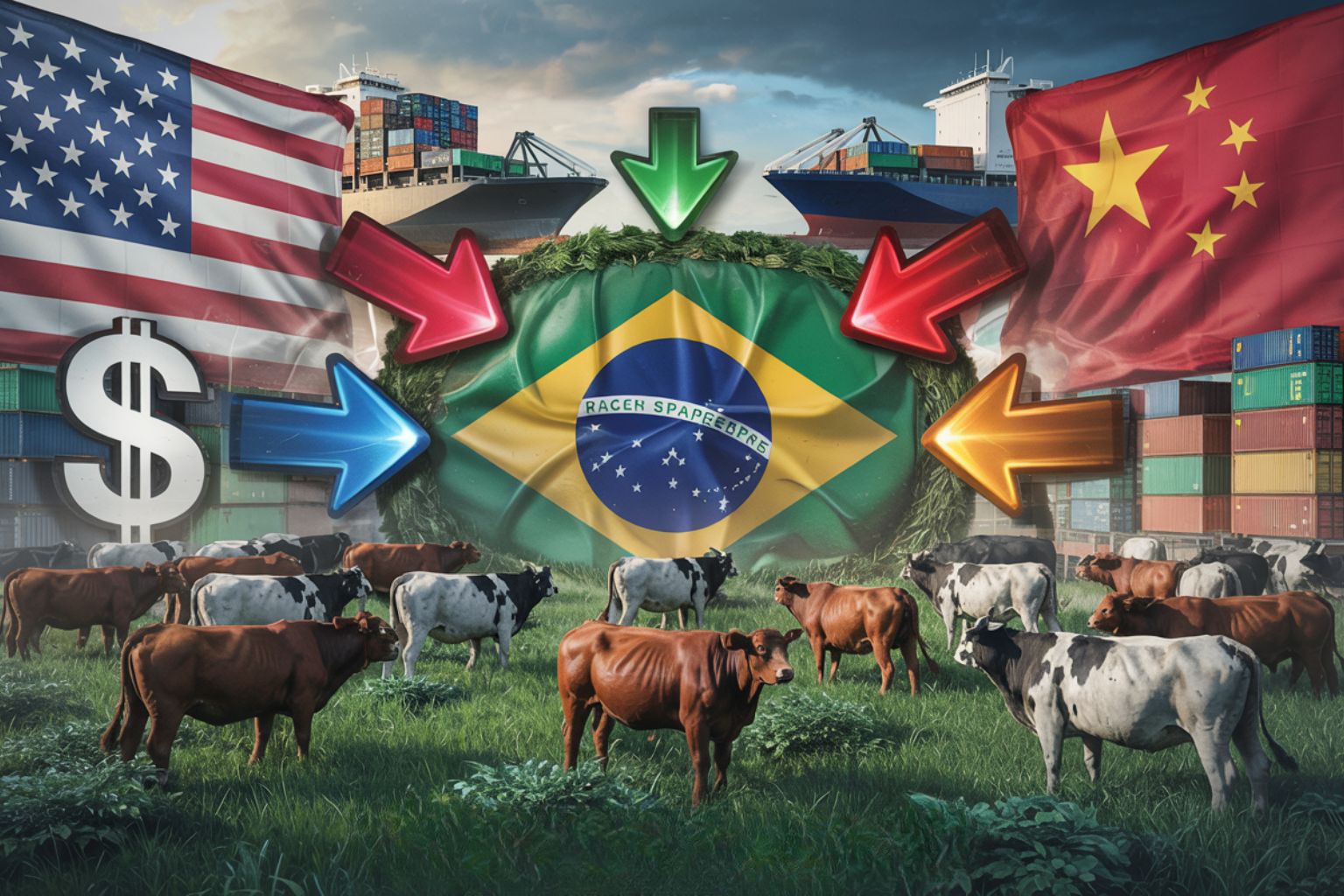


Brazil Lives Record In Beef Exports, But Dispute Between US And China Exposes Risks Of Tariffs, Dependence And Vulnerability Of The Largest Herd On The Planet.
Brazil is experiencing a historic moment in the animal protein sector. Home to the largest commercial herd of cattle in the world, with more than 230 million head, the country has cemented its position as the largest global exporter of beef, supplying both Asia and North America. In 2025, exports hit successive records, driven by two giants in competition: China and the United States.
But what could be just a Brazilian victory in international trade is turning into a delicate geopolitical chessboard. On one side, China, which accounts for more than 50% of the beef shipped from Brazil, seeks to expand food security for its population. On the other, the US, which has become the second largest destination for Brazilian beef and is now imposing tariffs that could reshape the export map. Among gains and risks, domestic producers live in growing tension: the abundance of records can turn into vulnerability in the blink of an eye.
The Weight Of China In The Beef Trade Balance
The relationship between Brazil and China in the beef sector is one of interdependence. Since 2019, the Chinese have exponentially increased their purchases, attracted by the outbreak of African swine fever that devastated the country’s pig herd. In 2024 and 2025, Chinese appetite remained high, ensuring Brazil billions in export revenues.
-
The Federal Revenue issues a good alert for Brazilian taxpayers: 60.9% are already using the pre-filled tax return, automatic refunds via Pix reach millions, and the government plans for a fully automated income tax in the coming years.

-
India announces a plan of $3.06 billion to bring aviation to forgotten regions: 100 new airports, $1.07 billion in subsidies, and regional routes guaranteed for 10 years, from 2026 to 2036, away from the centers.
-
Brazil blocked a proposal from the United States at the WTO that would make the exemption from tariffs on digital products like streaming and ebooks permanent, favoring American tech giants at the expense of developing countries.
-
IPTU exemption for seniors in 2026: see how to secure the benefit.


According to data from ABIEC (Brazilian Association of Exporting Meat Industries), in 2025 China was responsible for more than half of Brazilian exports, consolidating itself as a strategic customer. The risk, however, is clear: dependence on a single market can leave ranchers vulnerable to sudden changes in health policies or diplomatic tensions.
The Arrival Of The US As The Second Largest Buyer
If China dominates the consumption end, the United States has emerged as the second largest destination for Brazilian beef.
In the past two years, there has been an increasing opening of the American market for specific cuts, mainly fresh meat. This movement has brought diversification to Brazilian exports, reducing — at least in part — dependence on Asia.
However, in 2025, the White House adopted a different strategy. Pressured by local producers, the US raised tariffs on some Brazilian imports, under the pretext of “defending domestic industry.” For Brazil, the measure was received as a cold shower at a time of expansion. The sector fears that rising costs may reduce competitiveness against other global suppliers, such as Australia and Uruguay.
Records And Vulnerabilities
Brazil shipped, in July 2025, over 200,000 tons of beef, a historic volume for a single month. The numbers are impressive, but experts warn of a paradox: the more records are achieved, the greater the country’s exposure to international scenario variations.
If China decides to diversify suppliers to reduce dependency risks, or if the US maintains aggressive tariffs, the impact on Brazilian agribusiness could be profound. After all, two countries account for more than 65% of Brazil’s beef export revenue.
The Cost Of Tariffs And The Threat Of Losing Market Share

The tariff increase from the US has generated immediate concern. Exporters estimate that the measure could mean losses of up to US$ 500 million annually if volumes are reduced. Additionally, it opens the door for competitors to gain market share in the American territory, while Brazil may end up forced to direct even more beef to China — reinforcing the dependency already considered dangerous.
Brazilian producers also remind us that the dispute is not just commercial, but strategic. Beef is seen as a food security asset, and both the US and China view Brazil as a central piece in their supply policies.
Brazil Has The Largest Commercial Herd In The World
Brazil possesses the largest commercial herd in the world, but faces internal challenges that may affect its long-term competitiveness. Issues such as traceability, environmental requirements, and pressure for zero deforestation place the country under international scrutiny.
The European Union, for example, has already approved the Anti-Deforestation Regulation (EUDR), which will affect beef exports from 2025/2026. This means that, in addition to the US-China dispute, Brazil will have to deal with environmental and regulatory barriers that may restrict highly valued markets.
The Dispute That Goes Beyond Beef
At its core, the dispute between the US and China for Brazilian beef reflects something larger: the competition for influence over Brazil’s agribusiness and strategic resources. Those who secure a stable presence in the animal protein chain will not only gain access to food, but also geopolitical influence over a sector vital for global security.
This trade war places Brazil in an ambiguous position: from coveted supplier to hostage of tensions between the two largest powers on the planet.
The Future Of Brazilian Beef
The outlook for 2026 is uncertain. If Brazil can diversify markets, increase sales to Middle Eastern countries, and maintain robust sanitary agreements, it may reduce dependence on the two giants. But if it remains trapped in the US-China game, it risks seeing its leadership weakened.
The fact is that, with a herd of continental proportions and record production capacity, Brazil will continue to be a protagonist. The question is whether it will be a sovereign protagonist, capable of negotiating with multiple partners, or a supplier pressured by two poles of global power.







E mais e mais terreno desmatado para criar ****, ****
Nossa a reportagem falando em exportaçáo de carne bovina.vem uns estrume falar do Bolsonaro.avisa esses vermes.q quem tá governando o Brasil e o Lula.bandods de inúteis .
Cotex. O.que. Para camarada para de se querer se amostra doutor