





 Portuguese
  English
  Spanish
  6 min of reading
  3 comments


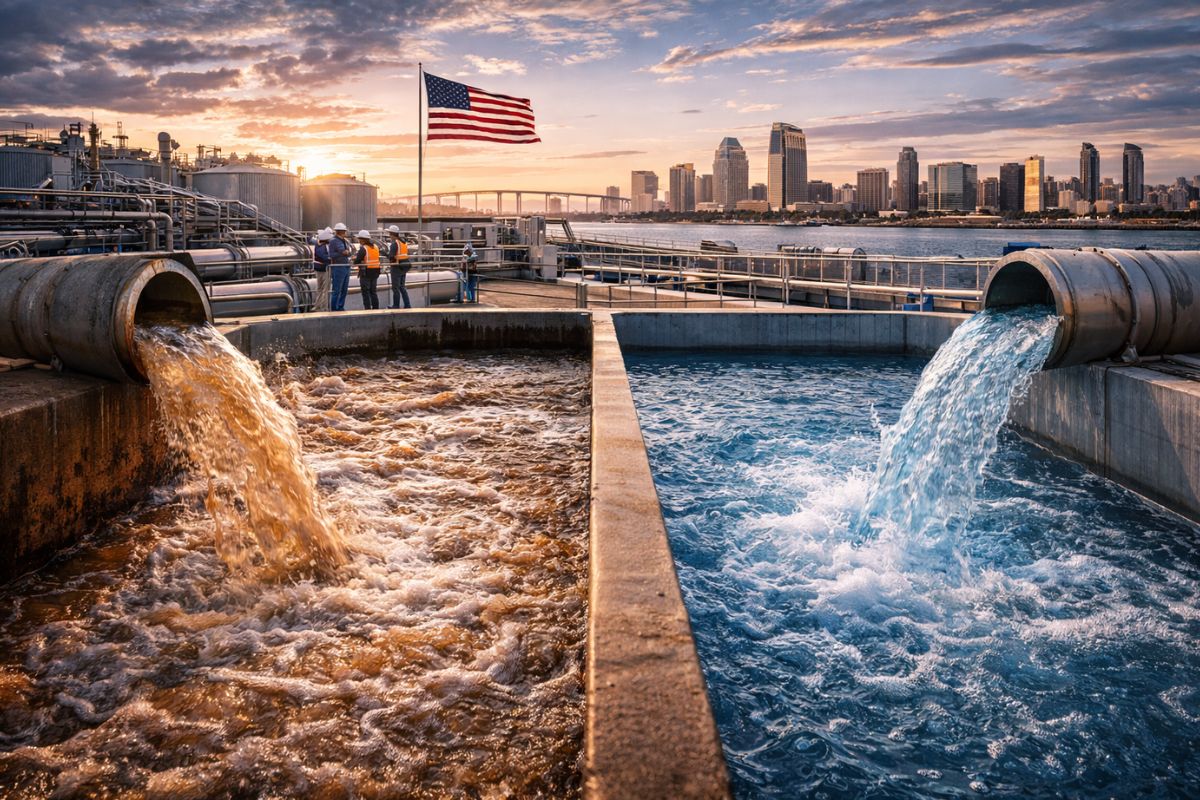


In San Diego, California, the Pure Water megaproject accelerates in 2026 to produce 83 million gallons per day by 2035, delivering 30 mgd in Phase 1 and another 53 mgd in Phase 2, reducing historic imports by 85% and cutting more than 50% of discharge at Point Loma.
The Pure Water megaproject in San Diego has entered a critical acceleration phase in 2026, in response to decades of dependence on imported water and the risk of prolonged water stress. The stated goal is to transform potable reuse into a permanent source, with gradual deliveries until 2035.
The initiative repositions treated wastewater as a resource, creating a continuous flow that injects millions of gallons per day into the municipal system. The plan combines heavy construction, integration with local reservoirs, and a regulatory shift in California that paved the way for direct potable reuse, accelerating investments and timelines.
What San Diego Tries to Avoid by 2035 and Why the Megaproject Has Become a Priority

San Diego historically imports about 85% of the water it consumes, a level of dependence that pressures costs, planning, and predictability during dry periods.
-
The most famous volcano in the world could paralyze one of the largest metropolises on the planet: Japan accelerates emergency plans for the eruption of Mount Fuji, which could bury Tokyo in ash for over two consecutive weeks.

-
The United States has a serious problem with its F-35s: China is already producing fighters at a pace that exceeds American capacity and could manufacture up to 300 aircraft per year before the end of the decade, shifting the global military balance.

-
Remains with battle wounds of over 100 soldiers from the Roman Empire are found beneath a football field in Vienna, leaving everyone surprised.
-
Elon Musk notes Brazil and lowers the price of his internet, Starlink, promising to connect all corners of the country with affordable plans, 10,000 satellites, and 1 million active users in the national territory!


The megaproject was structured to break this vulnerability with a local supply described as “drought-proof”, because it stems from the urban wastewater cycle itself.
The long-term goal is clear: to provide almost 50% of drinking water locally by 2035, replacing part of the imports with internal production.
The design of the megaproject also aims for a measurable environmental change, reducing treated wastewater discharge into the ocean by more than 50% from the Point Loma plant, by diverting volumes for advanced purification.
Phases, Timelines and Volumes: What Enters in 2026 and What Only Arrives at the End of the Cycle

The megaproject is divided into two main phases, with staggered deliveries and volumes defined in millions of gallons per day.
In Phase 1, in the northern part of the city, construction made significant progress in 2025, with over 80% completed at the main unit.
The forecast is that the first deliveries of purified water to the Miramar Reservoir will occur in 2026, adding 30 million gallons per day (30 mgd) to the system.
This milestone is treated as the entry of the “new source” into the operational routine of the city.
In Phase 2, focused on the central area, the current stage is planning, with expansion into central and southern regions.
The package adds 53 mgd by the end of 2035, bringing the total of the megaproject to 83 mgd at full capacity.
The operational reading is straightforward: 30 mgd first, 53 mgd later, until reaching a production that can cover about one-third to half of San Diego’s future water needs, according to the system’s own sizing.
Where the Facilities Are Located and Why the Construction Crosses Entire Neighborhoods


The megaproject is not a single isolated plant, but an integrated network that crosses San Diego and reorganizes flows of wastewater, recycled water, and drinking water.
The starting point is the Morena Pump Station, located in the southwest of Sherman Street, responsible for diverting wastewater to the treatment and purification set.
Along the way, the North City Water Recycling Plant (NCWRP) was expanded from 30 to 52 mgd, feeding into the purification stage.
The technological center is the North City Pure Water Facility (NCPWF), described as the heart of the system, located in Eastgate Mall, where the purification process happens in five stages.
Afterwards, the water goes to the Miramar Reservoir, where it is stored and mixed before going through final treatment.
The infrastructure also includes more than 48 km of new pipelines, crossing communities like Morena, Bay Park, Clairemont, University City, and Scripps Ranch.
In practice, this means widespread construction, simultaneous fronts, and typical logistical impacts of a megaproject, with sequential job sites to connect pumping, purification, storage, and integration into the municipal system.
How Wastewater Becomes Drinking Water: The Five Barriers of the Purification Process
The Pure Water San Diego megaproject operates with a purification process in five stages, designed as a multiple barrier system to remove microorganisms, salts, and chemical traces.
The first stage is ozonation, with ozone injection to destroy microorganisms and break down organic pollutants.
Next comes biological filtration using activated carbon (BAC), where bacteria consume about 30% to 50% of the remaining organic matter.
The third stage is membrane filtration, using hollow fibers to block microscopic particles, including bacteria and protozoa.
This is followed by reverse osmosis, which forces water through membranes capable of removing salts, minerals, viruses, and pharmaceutical compounds.
Finally, UV disinfection with advanced oxidation uses high-intensity ultraviolet light to destroy the DNA of remaining microbes and eliminate final chemical traces.
This sequence supports the safety narrative of the megaproject: it is not a single barrier, but a series of removals, each targeting a type of contaminant.
Indirect Potable Reuse: Why Water Goes Through a Reservoir Before Hitting the Tap
In San Diego, the described model is indirect potable reuse, not an immediate and direct integration into the network.
After advanced purification, the water is pumped to local reservoirs, like Miramar, where it mixes with imported and local water.
After this storage and mixing step, the volume goes through a conventional drinking water treatment plant before being distributed to homes and businesses.
The logic is to reduce risk, create redundancy, and maintain traceability at each step, reinforcing the operational control of the megaproject within the city’s existing system.
The Political and Regulatory Turn in California That Accelerated the Megaproject
The transformation of reuse into a “new permanent source” is attributed to political and regulatory changes in California.
The central point is the recent approval of rules for Direct Potable Reuse (DPR), which accelerated the development of systems capable of integrating recycled water directly into the network, creating a more favorable decision-making environment for projects of this scale.
Additionally, the megaproject has been described as supported by billions in low-cost loans and federal and state grants, signaling public priority on climate resilience.
Practically speaking, this financial and regulatory support reduces barriers and pushes timelines, especially in the construction and expansion phases.
Who Executes the Megaproject: City, Operators, Consultancies, and Contractors
The megaproject is led by the City of San Diego, but executed by consortia and specialized companies, with a division of functions for management, engineering, and heavy construction.
Construction management for Phase 1 is attributed to Black & Veatch and Parsons, coordinating multiple simultaneous contracts.
In engineering and design, Stantec, Brown and Caldwell, and Trussell Technologies appear, linked to the specialization in the purification process.
Among the major contractors for Phase 1, the design of responsibilities includes Flatiron at the Morena Pump Station, Sukut Construction on the Morena piping (South and Central), OHL on the north alignment of the pipes and tunnels, and AECOM on the initial earthworks and site preparation.
For small-scale testing related to the Central Phase, Filanc connects the planning of Phase 2 to an operational base.
This mosaic of companies explains why the work is treated as the largest infrastructure project in San Diego’s history: multiple contracts, different specializations, and execution distributed across critical points in the city.
What Changes When the Megaproject Reaches 83 mgd and Why This Redefines Supply
When the megaproject reaches 83 mgd in 2035, San Diego will have a local production large enough to supply about one-third to half of future water needs, reducing the fragility of relying on external sources.
The impact is also structural: by cutting more than 50% of ocean discharge via Point Loma, the city redesigns the fate of treated wastewater, converting part of the flow into continuous supply.
The most sensitive consequence is predictability.
Instead of mainly relying on imports, the system now features a permanent local component.
The ambition is simple to measure, but complex to execute: deliver 30 mgd in 2026, add 53 mgd by 2035, and sustain operation without failures, day after day.
Would you drink water produced by a potable reuse megaproject like this in San Diego, knowing it goes through five purification stages before entering the system?





Califórnia, muita corrupção. Duvido muito que saia no prazo
Sem duvida
Sim. Tomaria sim.
E nem precisaria da última etapa( tratar novamente no sistema convencional). Um exagero. Desperdício de dinheiro!