





 Portuguese
  English
  Spanish
  6 min of reading
  0 comments


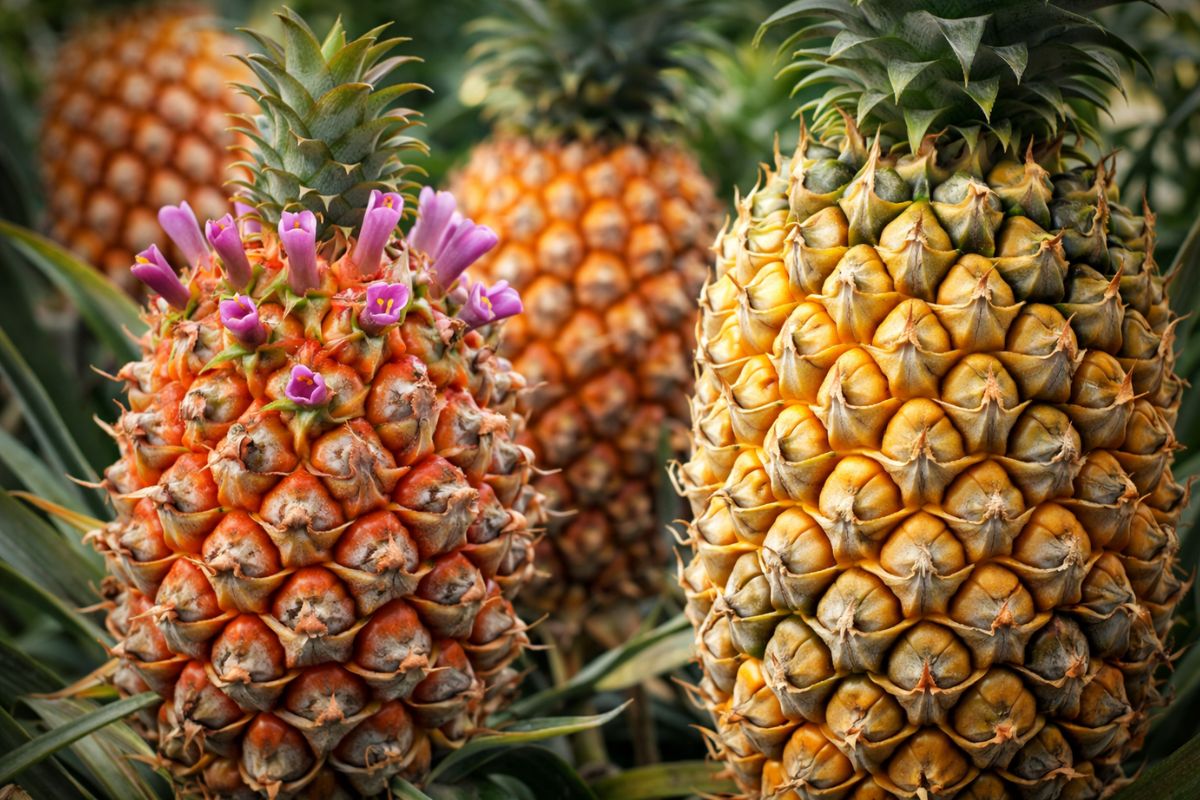
The pineapple is not a fruit; it is up to 200 fruits fused into a single structure called infrutescence, formed by flowers that open one per day for three weeks, with those closest to the base accumulating more sugar and those at the top becoming more acidic, according to researchers from Embrapa who study the genetic improvement of the species in Brazil.
The pineapple you cut in the kitchen hides one of the most fascinating processes in botany. Each piece of the pulp you eat comes from an individual flower, and a single pineapple plant can produce between 50 and 200 of these flowers. When they develop into fused fruits, the individual fruits merge into a compact structure that science classifies as infrutescence. It’s like a bunch of grapes, but instead of separate fruits, they all grow together until they become one piece.
This explanation comes from Davi Junghans, leader of the pineapple genetic improvement program at the Brazilian Agricultural Research Corporation (Embrapa), Cassava and Horticulture unit. According to him, each pineapple flower is open for only one day. From the opening of the first flower at the base to the closing of the last one near the crown, about three weeks pass. This interval determines the flavor difference between the bottom and the top of the fruit, and understanding this changes the way you eat pineapple.
Why the pineapple is technically up to 200 fused fruits

Most people look at a pineapple and see a fruit. Botanically, it is not. The pineapple is an infrutescence, a set of individual fruits that develop from separate flowers and merge during growth to form a unique structure. Each “eye” you see on the pineapple’s skin corresponds to one of these fused fruits.
-
Giant from Germany will land in China with a record investment in a 4 km² complex, with up to 32 production lines and 70 products, targeting a market that could reach 70% of the world by 2030.

-
Brazilian regions will suffer from the heat: the first heatwave of 2026 raises temperatures to up to 38°C for 5 consecutive days, driven by a heat bubble between Paraguay and Argentina that blocks cold fronts and intensifies dry air.

-
Will Artificial Intelligence replace your job? 31 million are already at risk in Brazil, salaries are falling in technical roles, while AI specialists earn up to R$27,000 and companies are paying record bonuses.

-
Second Sphinx detected under Giza with 80% reliability: radar reveals giant structure, underground cavity, and network of tunnels aligned with the pyramids that could rewrite the history of Ancient Egypt.


The number of fused fruits in each pineapple varies according to the variety and growing conditions. A plant can produce between 50 and 200 flowers, and each flower gives rise to an individual fruit.
When all these fruits grow side by side, they compress and fuse, creating the continuous pulp we know. There is no natural “glue” between them; it is the simultaneous growth that causes the walls of the fruits to incorporate into each other.
According to Embrapa, this characteristic places the pineapple in the same category as other infrutescences, such as jackfruit and fig.
But the pineapple is probably the most popular and consumed example of this botanical category, making the information even more surprising: billions of people eat infrutescences regularly without knowing they are biting into dozens of fruits at the same time.
The flower that opens for one day and defines the flavor of each piece

The flowering process of the pineapple is as precise as a clock. Each flower opens for only one day and then closes permanently. The first to open is always the one at the base of the infrutescence. The last is near the crown. Between the opening of the first and the closing of the last, approximately three weeks pass.
This time interval has a direct consequence on flavor. The flowers that open first at the base produce fruits that spend more time developing and accumulate more sugar.
That’s why the bottom part of the pineapple is sweeter. The flowers at the top, which open last, produce fruits with less maturation time and, consequently, more acidity.
In practice, this means that when you cut a pineapple in half, you are dividing fused fruits at different stages of ripening.
If you prefer sweet pineapple, the pieces from the base are the best choice. If you like the more acidic and refreshing flavor, the part near the crown is ideal. This knowledge, which comes directly from Embrapa’s research, transforms a common fruit into a more conscious gastronomic experience.
The crown of the pineapple is a seedling ready to plant
The crown—that tuft of leaves on top—is not just decoration. It is literally a seedling of the pineapple. It can be cut, planted in the ground, and give rise to a new plant that, after 18 months, will produce another pineapple. It is one of the simplest forms of plant reproduction and the one most people know.
But the crown is not the only option. The pineapple has three more types of seedlings, according to Embrapa. The pup comes from the bottom of the fruit, attached to the stem that supports the pineapple. The sucker grows underground, near the root.
And the pup-sucker arises from the base of the leaves, connected to the stem. Not all appear on the same plant; the presence of each type depends on the variety of the plant.
Reproduction by seedlings is the preferred method in commercial agriculture because it is faster and produces plants genetically identical to the original. Since the seedlings are clones, the produced pineapples all look similar—uniformity that the market demands in terms of size, flavor, and appearance. Planting by seed is possible but rare and much slower.
Pineapple with seeds exists and is rarer than it seems
Although most people have never seen it, the pineapple can indeed produce seeds. The problem is that the plant cannot use its own pollen to fertilize itself. For a seed to form, it is necessary to cross the pollen of two different pineapple varieties—a process that happens naturally with the help of pollinating insects but is avoided in commercial production.
The reason is simple: consumers prefer seedless pineapples. Fruits with seeds are less visually appealing and more difficult to consume.
Therefore, the agricultural industry invests in varieties that reproduce exclusively by seedlings, ensuring clean and uniform pineapples for the market. Embrapa, on the other hand, uses seeds in genetic improvement programs to develop new, more resistant, and productive varieties.
The existence of pineapples with seeds is yet another botanical curiosity that reinforces the complexity of this infrutescence.
Each pineapple is the result of a sophisticated reproductive system that combines up to 200 flowers, fused fruits, four types of seedlings, and the possibility—though rare—of seed production. Few plants in the world have so many reproductive strategies in a single species.
Brazil and the pineapple: from Pará to the world’s table
The pineapple originates from Paraguay and Brazil, but commercial cultivation here only began in the early 20th century. Today, all Brazilian states produce the fruit, and Pará leads national production. Brazil is the fourth largest producer of pineapple in the world, and the fruit is among the most consumed on the planet, according to data from Embrapa.
The complete production cycle takes 18 months, from planting to harvest. This means that each pineapple that reaches the supermarket has spent a year and a half growing, including the three weeks of flowering during which each flower opens individually to form the fused fruits that make up the pulp. The main producing regions are in the North, Northeast, and Southeast, with highlights for Pará, Paraíba, and Minas Gerais.
Embrapa’s work in the genetic improvement of pineapple aims to create varieties more resistant to diseases, with better flavor and more adapted to Brazilian climatic conditions. It is research that directly affects the formation of flowers, the number of fused fruits in each infrutescence, and the quality of the pulp—applied science that starts in the biology of the flower and ends on your table.
With information from the portal of G1.
Did you know that each pineapple is made up of up to 200 fused fruits? Have you noticed the difference in flavor between the base and the top? Let us know in the comments if this information changed the way you look at this fruit and if you have ever tried to plant a pineapple from the crown.






Seja o primeiro a reagir!