Portuguese
  Spanish


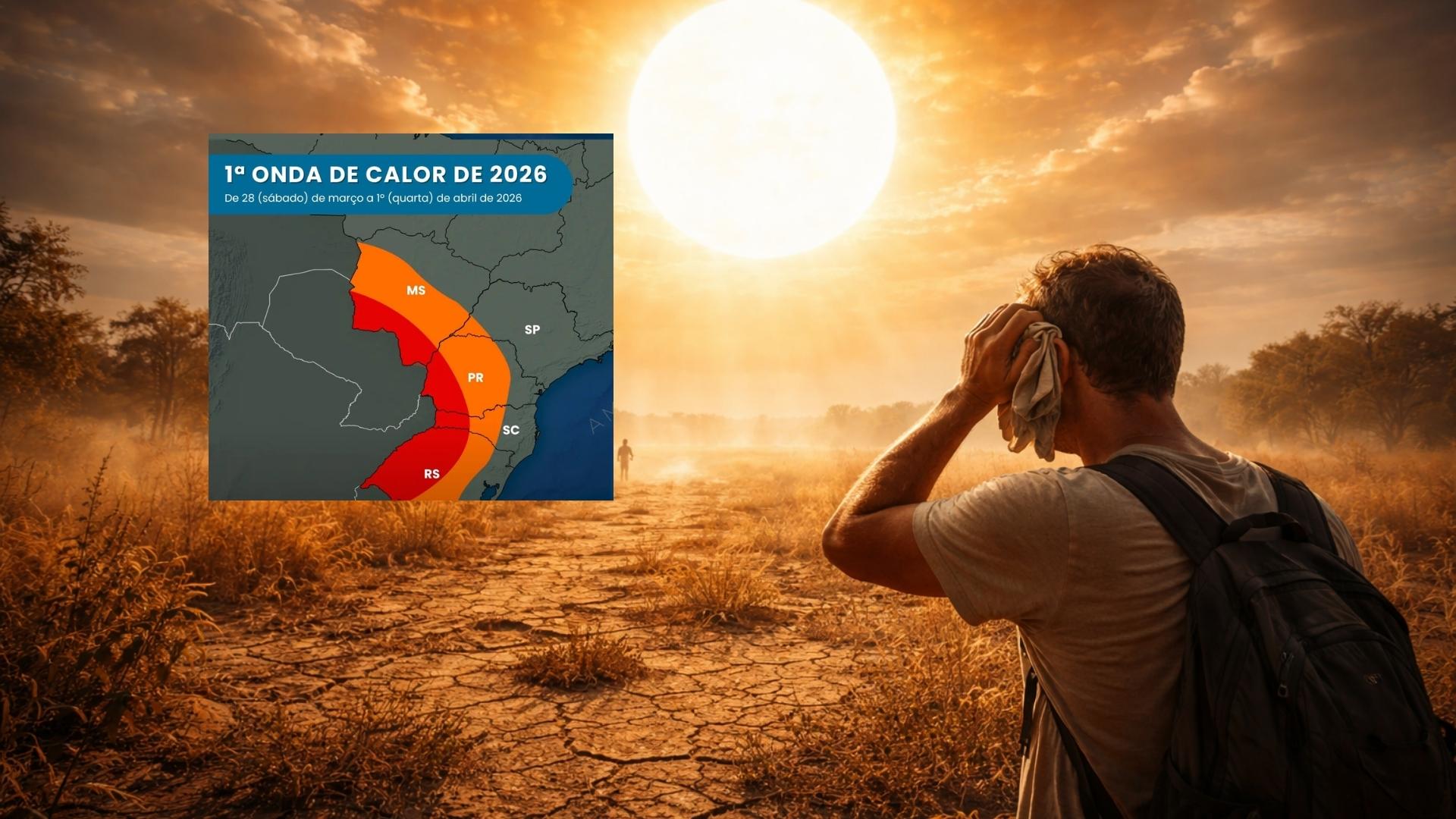

Extreme heat advances over the South and Mato Grosso do Sul with temperatures well above average, driven by atmospheric blockage that keeps dry air and prevents cold fronts, creating a sequence of hot and persistent days at the end of March.
The first heat wave of 2026 advances over part of the South of Brazil and Mato Grosso do Sul and is expected to maintain temperatures well above average between this weekend and the beginning of April.
The forecast indicates maximums of 35°C to 38°C in the most affected areas, with more intense activity between Saturday, March 28, and Wednesday, April 1, especially in the regions closest to the border with Paraguay and Argentina.
The meteorological pattern behind this scenario involves a heat bubble established between Paraguay and northern Argentina, associated with the presence of a high-pressure system.
-
Driver Crosses 100-Year-Old Railway Bridge Over Uruguay River, Encounters Rural Couple Preserving Traditional Farming Methods

-
Rural Producer Returns to Brazilian Farmland, Builds Family Agricultural Business with Children’s Support and Industry Backing
-
Goiás Couple Boosts Artisan Cheese Production from 25 to 70 Kilos Daily with Technical Support, Transforming Family Life in Rural Brazil
-
13-Year-Old Discovers Ancient Roman Ring Near Mount Carmel, Now Set for Display in Jerusalem




This atmospheric blockage reduces cloud formation, increases solar radiation incidence, and favors the persistence of hot and dry air over part of the Central-South of the country for several consecutive days.
Where the heat will be most intense in South Brazil
On the forecast map, the most significant impact is concentrated in Rio Grande do Sul, especially in the Missions, in the Campaign, in the West Border, in central areas, and also in the northern and northwestern portions of the state.
In Santa Catarina, the most intense heat is expected to concentrate in the western part of the state, while in Paraná, the trend is for higher temperatures in the south and west.
In Mato Grosso do Sul, the advance of warm air is expected to mainly affect the south and west of the state, including areas near the Pantanal.
According to the National Institute of Meteorology, the rise in temperatures is also gradually extending to other points in the South Region and to the southern territory of Mato Grosso do Sul, with deviations that can reach around 7°C above average in part of the affected area.
High temperatures and sequence of hot days
In areas directly influenced by the warm air mass, the forecast is for consecutive afternoons with strong heat and a feeling of stuffiness.
The highest values are expected in municipalities in the western part of Rio Grande do Sul, western Santa Catarina, western and southern Paraná, and southern and western Mato Grosso do Sul, where thermometers may record values occasionally exceeding the averages expected for the period.
Inmet reports that this heat episode began to gain strength between March 27 and 30, with the maintenance of atmospheric stability especially in Rio Grande do Sul and Santa Catarina.
The projection indicates persistence of the heat wave until at least April 1, which sustains a sequence of abnormally hot days in the westernmost areas of the South Region and in Mato Grosso do Sul.
This behavior meets the criteria used to characterize a heat wave, with temperatures above the climatological standard for several consecutive days.
In part of the South, there was a warning of great danger for excessive heat, associated with health risks when maximums remain persistently high and nighttime cooling is limited.
Why other regions will not have the same heat
Although the heat intensifies in the west of the South and in Mato Grosso do Sul, the rest of Central-South Brazil does not exhibit the same thermal behavior.
In several areas of the Southeast and also in parts of the South, the presence of instabilities, rain showers, and increased cloudiness helps to contain the more pronounced rise in temperatures, reducing the reach of the warm air mass outside the main core of the phenomenon.
This contrast results in an uneven distribution of the episode.
While cities situated closer to the border with Paraguay and Argentina face dry, sunny afternoons with strong warming, other regions remain under the influence of irregular rain and overcast skies for part of the day, which mitigates the advance of heat.
The atmospheric blockage behind the heat wave
The maintenance of the heat bubble over neighboring countries is one of the elements that explain the duration of the event.
When the high-pressure system establishes itself in this part of the continent, it hinders the more organized advance of cold fronts over the interior of South Brazil and prevents a more efficient renewal of air, prolonging the dominance of the warm mass.
Moreover, the combination of clearer skies, less cloud cover, and relatively dry air favors rapid heating throughout the afternoon.
This set of factors helps explain why the most intense heat concentrates in the interior of the states and in continental areas, far from maritime influence and more exposed to atmospheric blockage.
Weather forecast until the beginning of April
The trend indicated by meteorological services is for the maintenance of strong heat in the most affected areas at least until Wednesday, April 1.
In Rio Grande do Sul, Santa Catarina, Paraná, and Mato Grosso do Sul, the most critical condition remains concentrated in the interior and west, where the sequence of hot days is expected to be more persistent and widespread.
Although there are local temperature variations, the forecast converges for a significant heat episode at the end of March, with more evident impacts in the regions already highlighted by meteorologists.
Outside this warmer corridor, rain and cloudiness continue to act as a partial brake on the rise in temperatures, maintaining an important contrast on the weather map of the Central-South of the country.