





 Portuguese
  English
  Spanish
  3 min of reading
  0 comments


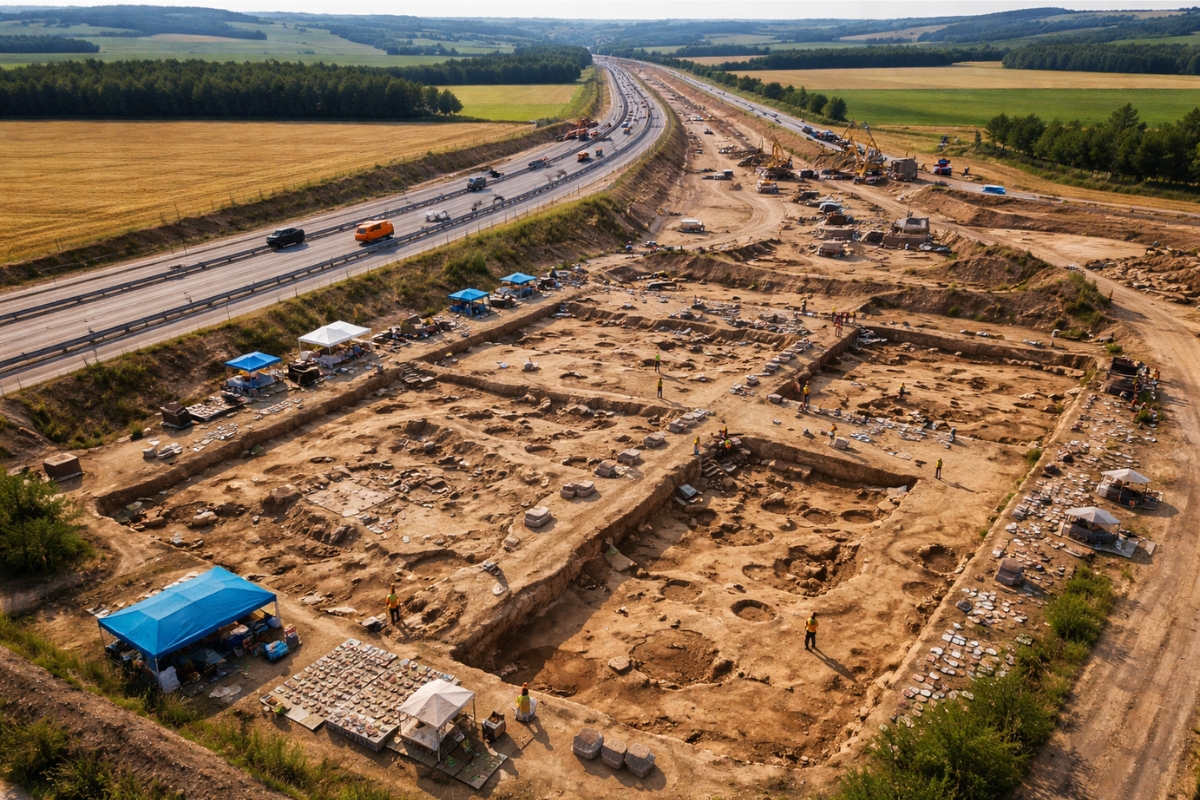
Highway construction in the Czech Republic reveals a 25-hectare Celtic city with gold, silver, jewelry, and over 22,000 objects, exposing how European trade operated many centuries before the Roman Empire.
What would have been just another road project in the Czech Republic has opened a rare window into ancient Europe. During inspections for the construction of the D35 highway, archaeologists discovered a large Celtic settlement over 2,000 years old.
The discovery stands out due to its size and the number of artifacts recovered. The site shows signs of wealth, production, and circulation of goods, indicating that extensive trade networks existed long before Roman dominance.
Highway D35 led to the discovery of an ancient city
The settlement covers about 25 hectares, a size comparable to dozens of football fields. The area was not an isolated point but rather a significant center of production and trade during the Iron Age.
-
Every pineapple you eat is actually up to 200 different fruits fused into one: discover the fascinating process in which each flower opens for just one day and produces the pieces that form the whole fruit over the course of 3 weeks.

-
Giant from Germany will land in China with a record investment in a 4 km² complex, with up to 32 production lines and 70 products, targeting a market that could reach 70% of the world by 2030.
-
Brazilian regions will suffer from the heat: the first heatwave of 2026 raises temperatures to up to 38°C for 5 consecutive days, driven by a heat bubble between Paraguay and Argentina that blocks cold fronts and intensifies dry air.

-
Will Artificial Intelligence replace your job? 31 million are already at risk in Brazil, salaries are falling in technical roles, while AI specialists earn up to R$27,000 and companies are paying record bonuses.


On the site, traces of housing, productive areas, and possible ritual spaces were identified. This reinforces the idea of an organized core, with well-defined economic and social functions.

Gold, silver, and over 22,000 objects change the weight of the finding
Among the recovered materials are hundreds of gold and silver coins, molds used in minting, brooches, bracelets, glass beads, and metal pieces from belts. In total, archaeologists recorded over 22,000 archaeological finds.
The variety and density of the objects place the site in a prominent position. Besides material wealth, the collection reveals a community with technical expertise and strong local production capacity.
The amber route connected the Baltic to the Mediterranean
The presence of amber, luxury ceramics, and items manufactured in the region indicates that the settlement was part of the Amber Route. This trade network connected the Baltic Sea to the Mediterranean and moved raw materials and valuable goods on a large scale.
According to Live Science, an international science and archaeology dissemination site, the site helps understand how these settlements operated between the 3rd century BC and 1st century BC. The lack of fortifications suggests a more open space, focused on the circulation of people, products, and knowledge.

Preserved site increased the scientific value of the discovery
One of the rare points of the case is the level of preservation. The settlement was not devastated by intensive agriculture nor did it suffer significant action from looters, something uncommon in many European sites.
This elevated the informative potential of the surface soil, where there was already a high concentration of materials. The entire collection is linked to the La Tène culture, known for its advanced metallurgy and distinctive artistic style among the Celts of the Iron Age.
Celtic city reinforces the role of the Celts in European trade
The discovery broadens the understanding of the economic weight of the Celts centuries before Rome consolidated its dominance. Instead of isolated communities, what emerges is an active, connected network capable of moving wealth on a large scale.
In the same space where highways are now being drawn, evidence of ancient logistical and productive centers emerges. The finding repositions the reading of ancient Europe and changes the strategic reading.






Seja o primeiro a reagir!