





 Portuguese
  English
  Spanish
  4 min of reading
  0 comments


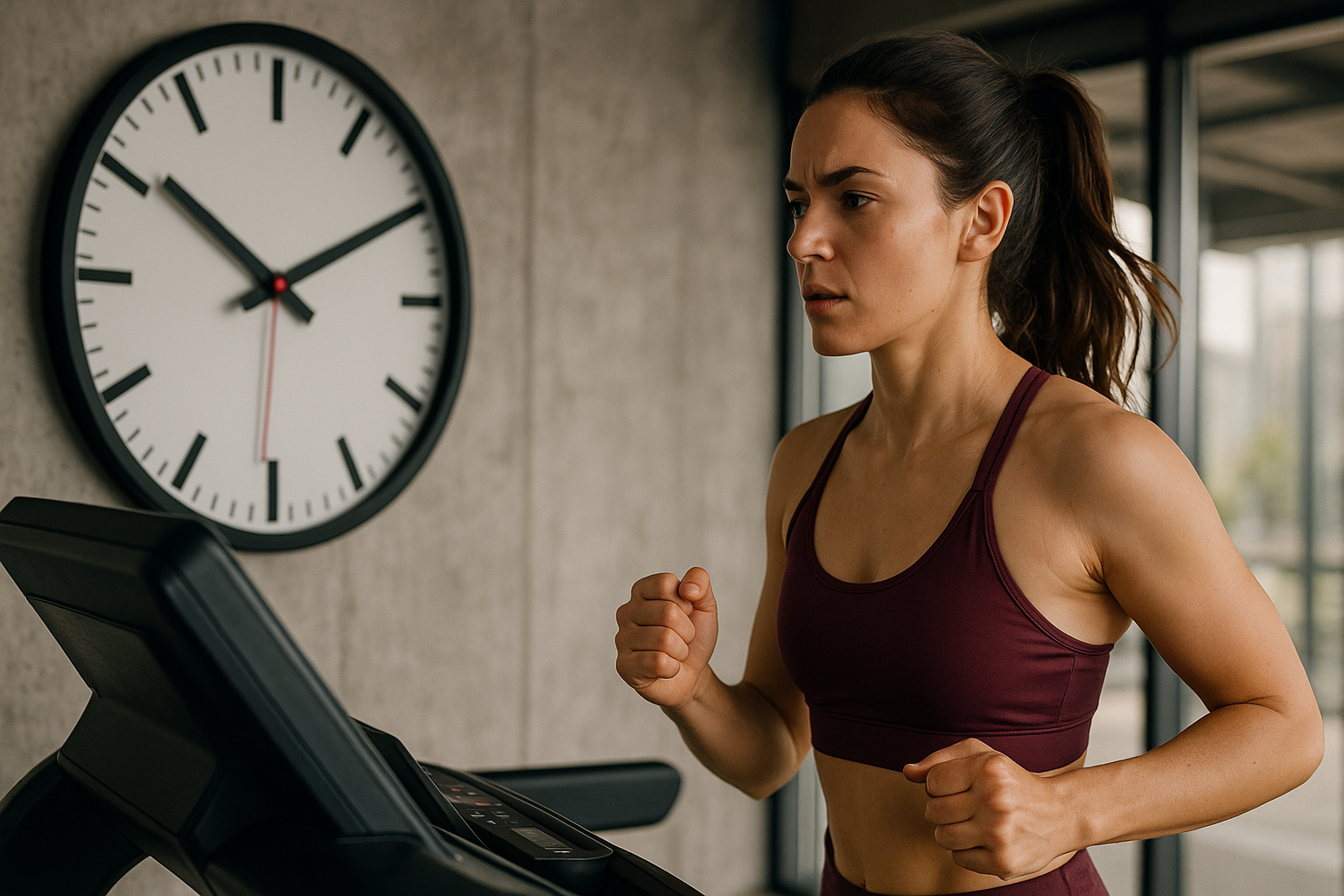
Study Shows That Exercising Makes Time Seem Slower, Regardless of Intensity or Competition.
Does time seem to slow down when we are exercising? Anyone who has run on a treadmill or completed a long set at the gym knows: minutes feel like an eternity.
But is this impression merely subjective, or is there a scientific explanation behind this sensation?
Study Reveals Distorted Perception During Physical Effort
A study published in April 2024 in the journal Brain and Behavior provided new insights on how we perceive time during physical exercise.
-
100% Brazilian technology transforms agricultural waste into a meat-scented ingredient using fungi from the Amazon rainforest. The process does not use excessive water or chemicals, and it also increases the nutritional value of the final product.

-
Psychology reveals that adults who avoid conflicts at all costs are not balanced individuals, but rather children who learned in the worst way that expressing emotions brought punishment and now live paralyzed by the fear of expressing themselves.

-
Goodbye pet hair on clothes: a washer with an internal filter promises to remove up to 5 times more hair than regular machines and uses an XL trap dryer system to capture what remains.

-
The most overlooked waste in the electricity bill doesn’t come from the refrigerator or the air conditioner; it escapes through almost invisible cracks in doors and windows, operating all day long and can steal up to 20% of the energy used for climate control, while a low-cost seal takes just a few hours to eliminate this loss.


According to the authors, the feeling that minutes drag on while we exercise is not just an impression. Tests showed that, in fact, people feel time passing more slowly during these moments.
The researchers conducted the study with 33 physically active adults, consisting of 16 women and 17 men.
All of them performed three 4-kilometer cycling tests in a virtual environment. In one of the tests, the participant cycled alone.
In the other two, they cycled alongside a virtual figure: a non-competitive peer or a direct competitor.
During the sessions, the researchers asked participants to estimate the duration of 30 seconds. This physical exercise was performed before, during, and after the workouts.
The results showed clear differences in temporal perception throughout the stages.
Time Perception Was Altered During Exercise
According to Stein Menting, co-author of the study, participants generally said “stop” at 28 seconds during physical exercise.
Before and after the effort, this same command occurred at 31.4 and 31.6 seconds, respectively. The researchers concluded that during exercise, time was perceived as moving more slowly.
This pattern was observed whether participants cycled alone or in a group, whether with a virtual peer or a competitor.
In other words, the mere presence of a “rival” did not change how time was perceived, even though it impacted other aspects of performance.
Competitions Increase Performance, But Do Not Affect Perceived Time
Although the perception of time did not change with the presence of competitors, the physical performance of participants was different.
On average, cyclists completed the course in 459 seconds when competing against another virtual person.
This time was faster than in tests with the non-competitive peer (467 seconds) and also in the solo test (470 seconds).
This shows that the stimulus of competition increased speed, even without affecting the perceived duration of the activity.
Participants also reported that the exercise felt more difficult as they progressed through the tests.
However, this increase in effort was not enough to change the perception of time, indicating that the distortion is not necessarily linked to the intensity felt.
Controlled Intensity Can Alter Perception
Despite the result, Stein Menting warned that intensity can indeed affect time perception in certain contexts.
Previous studies have shown that higher fixed intensity exercises can make time seem even slower.
In this new study, participants controlled their own intensity, which may have influenced the results.
Another relevant point is the sample composition. As explained by Andrew Edwards, also a co-author of the study, the participants were not professional athletes but were in good physical shape. This raises questions about the applicability of results in less active populations.
Edwards emphasized that the sample size was small. Therefore, the results should not be widely generalised, at least for now. New studies with larger groups and different physical profiles may provide further answers.
How the Brain Perceives Time During Exercise
The authors suggest that time slows down during exercise because the person enters a state of extreme attention.
This would heighten the perception of each physical sensation. Therefore, instead of time passing normally, it seems as if more experiences are happening in fewer seconds, creating the impression of a longer duration.
However, this attention-based explanation is questioned by other scientists. Psychologist Philip Gable from the University of Delaware believes that motivation is the main factor that alters temporal perception, not attention.
In his studies, Gable observed that the type of motivation influences perceived time. When the motivation is positive — such as the anticipation of something good — time seems to fly.
But when the motivation is to escape, that is, the desire to stop something unpleasant, time slows down.
In the case of the cycling study, Gable believes that participants were motivated to avoid extreme effort. This type of motivation creates a perception of time moving more slowly.
The brain, upon sensing discomfort, sends an “alert” that discourages continuation, making time seem longer than it is.
Time Distortion Can Affect Performance and Motivation
According to Gable, this distortion can even impact athletes’ performance.
When time seems to pass more slowly, the feeling of effort increases, and individuals may lose their rhythm, compromising results. This applies to those who train for health or leisure as well.
One of Gable’s tips is to adjust training to avoid this aversive effect. Exercises that provoke fear or extreme discomfort tend to increase the perception of time and, consequently, reduce adherence to the training plan.
“It is important to find a sustainable exercise pace that does not cause too much avoidance — you don’t want to hate your workouts,” Gable told Live Science.
The study provides evidence that time perception truly changes during exercise. Although competition increases performance, it does not alter this sensation.
The way the brain handles physical effort can be decisive for training adherence, performance in sports, and even for motivation to maintain a more active lifestyle. Future research should expand knowledge on how to control these effects.








Seja o primeiro a reagir!