





 Portuguese
  English
  Spanish
  5 min of reading
  3 comments


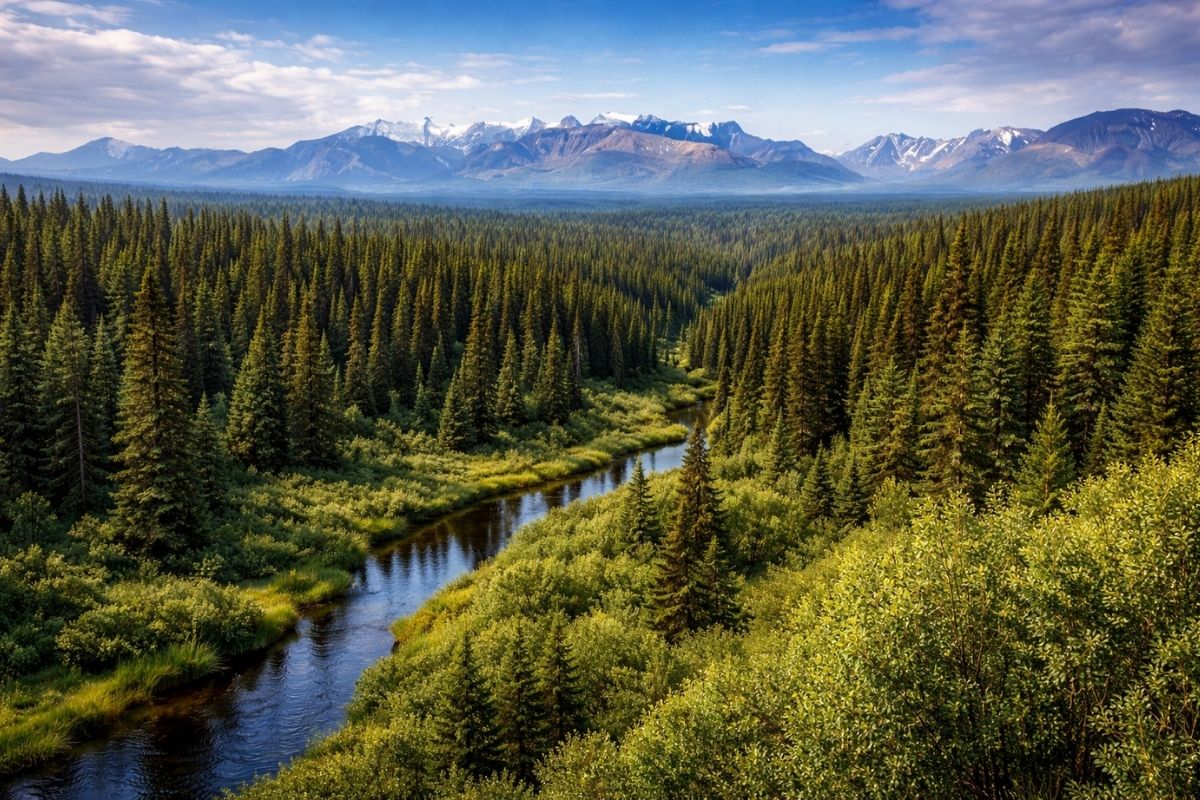


On This Amazon Day, A Giant Forest Little Remembered Appears at the Top of the Ranking: The Taiga. It Covers 12 Million Square Kilometers, Concentrates 29% of the Vegetation Cover of the Planet and Extends from Alaska to Canada, Passing Through Norway, Sweden, Finland and Siberia, to Japan on a Continental Scale.
The giant forest that surpasses the Amazon in territory is not concentrated in a single country, nor does it often appear in everyday conversations. It spreads across the Northern Hemisphere and, in the global ranking, appears with 12 million square kilometers, above the 7 million km² attributed to the Amazon Rainforest.
On Amazon Day, celebrated on September 5, the comparison gains strength because it highlights a curious contrast: the Amazon leads as the largest tropical forest, but the giant forest that takes first place in total area is the Taiga, responsible for 29% of the vegetation cover of the planet.
The Giant Forest That Leaves the Amazon Behind in the Ranking

The Taiga is presented as the largest forest on the planet in total territory, with 12 million square kilometers.
-
With more than 635,000 doctors, Brazil sees competition increasing in large cities, and recent graduates are competing for shifts at an accelerated pace while the countryside still faces shortages.

-
The world’s first octopus farm wants to open in the Canary Islands and is already provoking an international reaction: the plan aims to produce 3,000 tons per year.

-
Drought may be creating stronger superbugs in the soil and helping antibiotic resistance reach hospitals, warns a study highlighting a problem that could grow alongside extreme weather.

-
The biggest scam in history: Napoleon’s France deceived the United States by selling them a territory that was Spanish.






This places it ahead of the Amazon when the criterion is occupied area, even though they are forests with different characteristics and distributed in very distinct regions.
The Amazon appears as the largest tropical forest in the world, with 7 million km², occupying areas of Brazil and also sections of neighboring countries.
The Taiga, on the other hand, forms a continuous and vast belt in the Northern Hemisphere, spanning continents and connecting large blocks of vegetation on a scale that completely changes the map reading.
Where This Giant Forest Is Located and Which Regions It Passes Through

The Taiga is described as a forest of the Northern Hemisphere, and its geographical reach is one of the points that explain why it is so large.
It starts in the northern part of Alaska, goes through Canada, reaches the southern part of Greenland, and then advances through Europe and Asia.
Along the way, it is associated with countries and regions such as Norway, Sweden, Finland, and Siberia, also reaching Japan.
What impresses is the continuity: it is not an isolated fragment, but a formation that traverses long distances and different territories, maintaining the same general vegetation profile along a vast stretch of the globe.
Why Is It Also Called the Conifer Forest
The Taiga is also known as the Conifer Forest, a term linked to the type of tree that dominates the landscape.
The central reference is the cone shape, cited with examples like pines, which help to visually characterize this biome.
This detail is not just a label.
It serves as a kind of signature of the Taiga: when talking about conifers, it refers to a forest pattern that, in the imagination, is often associated with large cold areas and more homogeneous vegetation compared to tropical forests.
Winter, Snow and the Scenery That Transforms the Landscape
One of the most striking points mentioned is winter.
In the Taiga, snow takes over the forest, and the conifer trees are “painted white,” changing the appearance of the environment and reinforcing the extreme character of this type of landscape.
This seasonal variation helps to explain why it is often not remembered in the same discussions that involve tropical forests.
The most common image of “forest” in public debate tends to be associated with heat, rains, and tropical biodiversity. The Taiga, by contrast, is remembered for its scale and its presence in latitudes where winter is part of the dominant scenery.
Fauna of the Taiga

The fauna of the Taiga presents various survival mechanisms for cold climates, such as hibernation.
In addition, the migratory movement of birds is very common, for example, seeking refuge in warmer regions during the harsh winter of the Taiga.
Taiga animals are also adapted to the drier climate of the region, and summer is commonly the season with the greatest food availability for animals, due to rising temperatures and the occurrence of rains.
The typical animals of the Taiga are:
– reindeer;
– moose;
– brown bears;
– lynxes;
– porcupines.
Soil of the Taiga
The soil of the Taiga is varied, but, overall, quite shallow and low in nutrients. In addition, it has a whitish color, despite the large accumulation of organic matter from the trees that make up this biome.
In the Taiga, there is a low incidence of sunlight on the soil, due to the extensive vegetation cover formed by the tops of the trees.
Thus, the biological processes of the local soil are hindered due to the absence of direct solar radiation. This characteristic influences, for example, the difficulties in developing small-statured plants, which are almost non-existent in the Taiga.
Furthermore, the soil of the Taiga has low fertility, requiring the addition of agrochemicals for agricultural use.
What the Ranking of the Largest Forests Evidences on Amazon Day
Amazon Day, on September 5, often sparks discussions about preservation and the importance of forests for the natural habitat.
In this context, the ranking of the largest forests on the planet draws attention for placing very different formations side by side.
The Amazon stands out as the largest tropical forest in the world, while the Taiga emerges as the giant forest that leads in total territory.
If the Taiga is the giant forest that leads in area and covers 29% of the planet’s vegetation, why do you think it almost never comes up in conversations when the subject is forest?








A Taiga quase nunca entra nas conversas em que o assunto é floresta porque ela é considerada menos impactante no planeta ao comparado com a Floresta Amazônica ou a Bacia do Congo.
Isso ocorre pois, normalmente, as florestas tropicais produzem sua própria chuva e enviam umidade para outros lugares(através da evapotranspiração). Isso quer dizer que atividades agrícolas nestes lugares são mais fáceis de se fazer pois o solo é, quase sempre, mais fértil e mais saturado de água. E, também, se algo de ruim acontecer com uma floresta tropical, a catástrofe é global, e não apenas regional.
Do u think there might be a Yeti or two hiding in there somewhere or nah
E quanto a fauna?