Portuguese
  Spanish


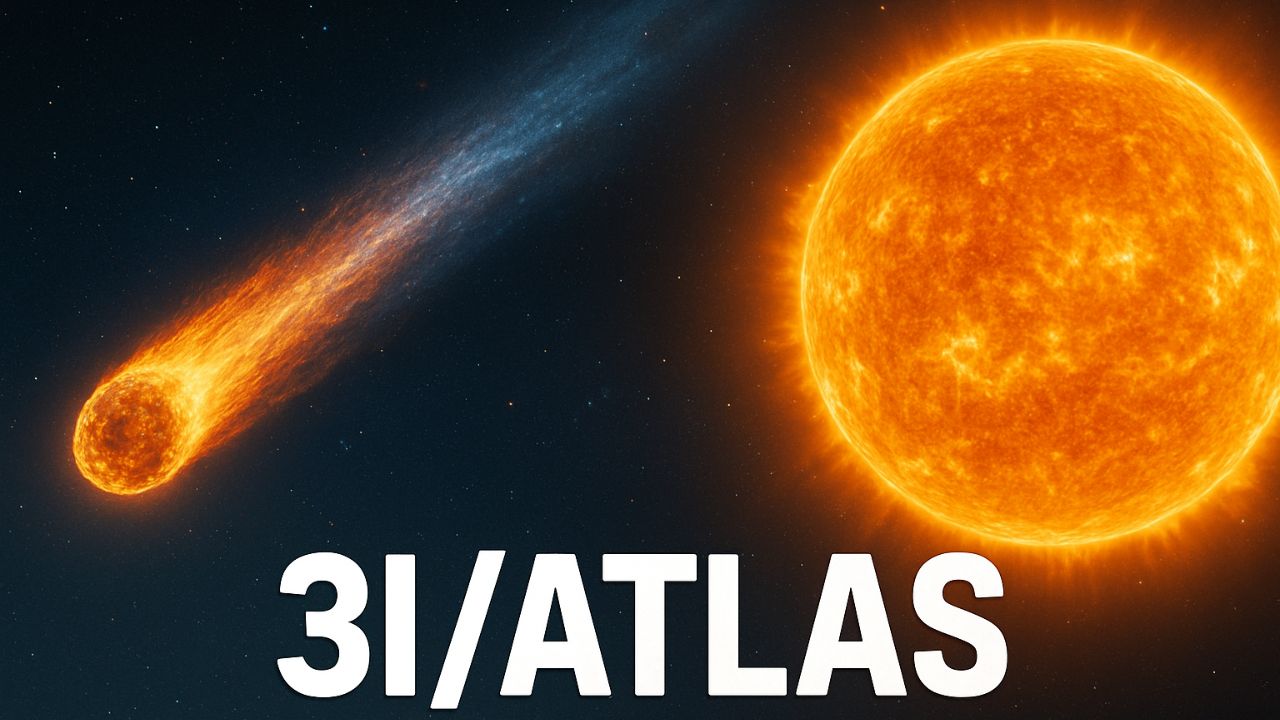


The Interstellar Visitor 3I/Atlas Travels at 57 km/s, an Extreme Speed That, According to Fatos Desconhecidos, the Most Our Star Can Do Is Deflect Its Path.
The Sun’s gravity is colossal. With a force about 28 times greater than that of Earth, it can attract objects located an impressive 3.8 light years away. Nevertheless, this force proves insufficient to capture the mysterious 3I/Atlas, a visitor from another solar system.
As detailed by the portal Fatos Desconhecidos, the key to understanding this phenomenon lies in speed. The 3I/Atlas, like other “travelers” from beyond the stars, arrives in our system at such a rapid pace that solar attraction acts merely as a “gravitational slingshot,” slightly altering its trajectory before it continues its eternal journey through the cosmos.
Visitors at Extreme Speed
When astronomers refer to interstellar objects, like the 3I/Atlas or the famous ‘Oumuamua, they describe bodies that come from far beyond our solar system. It is believed that these objects orbited their own parent stars, just like Earth orbits the Sun, until some cataclysmic event, the exact nature of which is still unknown, expelled them from their home.
-
Archaeologists Uncover 1,200-Year-Old Gold Treasure in Saudi Arabia, Ownership Remains a Mystery

-
Brazilian Startup Converts Tucumã Seeds into Bioplastic for Bicycle Pedals, Cups, and Construction Materials

-
NASA Captures Rare Encounter of South Korean “Surfboard” Spacecraft Crossing Lunar Orbit at Over 11,000 km/h

-
Germany Opens World’s Largest Smart Power Semiconductor Factory with €5 Billion Investment, Creating 1,000 Jobs and Doubling Capacity for AI and Energy Needs




What is known for sure is that they roam the universe at impressive speeds. ‘Oumuamua, the first of its kind to be detected, was traveling at 26 km/s; the second, Borisov, reached 33 km/s. The 3I/Atlas, however, surpasses both, with an incredible 57 km/s. It is exactly this speed that explains its escape: they are simply too fast for the Sun’s gravity to trap them in an orbit.
The Mystery of ‘Oumuamua: Gas or Alien Ship?


Although the norm is for the Sun to merely deflect these objects, the case of ‘Oumuamua, in 2017, remains one of the largest recent astronomical anomalies. As it passed close to our star, it not only had its path deflected but accelerated inexplicably. The solar gravity alone did not account for this extra “push.”
The most widely accepted explanation currently among the scientific community, as researched by Fatos Desconhecidos, is outgassing. The theory suggests that the intense heat of the Sun caused ‘Oumuamua to release hydrogen gas that was trapped inside it. This gas release would have acted as a natural propellant, giving it the extra boost and changing its trajectory as observed.
However, not everyone in the scientific community accepts this explanation. Renowned scientist Avi Loeb, famous for his research on extraterrestrial life, continues to assert that ‘Oumuamua was, in fact, an artificial object. He proposed the hypothesis that the object could be a type of “light sail” technology designed by another civilization, that accelerated using solar radiation pressure. While it is a strong hypothesis, it lacks, like the others, definitive proof.
What If 3I/Atlas Collided with the Sun?
We know that the 3I/Atlas is too fast to be captured. But what would happen if, by chance, its trajectory was on a direct collision course with the Sun? Fatos Desconhecidos provides an answer that may be a relief for many: absolutely nothing that we could perceive from here on Earth.
The physics behind this scenario is extreme. If the 3I/Atlas were coming toward the Sun, it would gain absurd acceleration as it approached, easily surpassing 600 km/s. In addition to speed, its temperature would also increase drastically. Long before the object could even “touch” the solar surface, it would reach millions of degrees.
At that point, even if it had several kilometers in diameter, the comet would simply evaporate and disappear into the cosmos. It’s crucial to remember that the Sun converts about 4 million tons of mass into energy every second. An interstellar visitor, no matter how large, would be insignificant in the face of this nuclear furnace.
The trajectory of the 3I/Atlas is a clear example of how the universe operates on scales of speed and energy that challenge our intuition. The Sun is powerful, but not enough to trap a traveler that arrives at escape velocity.
Fatos Desconhecidos raises an interesting point: for some scientists and theorists, the paths of these visitors are not random but rather “carefully calculated.”
And you, what do you think about these mysterious objects? Do you believe in the scientific explanation of gas release for ‘Oumuamua, or does Avi Loeb’s hypothesis about alien technology make more sense? Leave your opinion in the comments.