





 Portuguese
  English
  Spanish
  5 min of reading
  0 comments


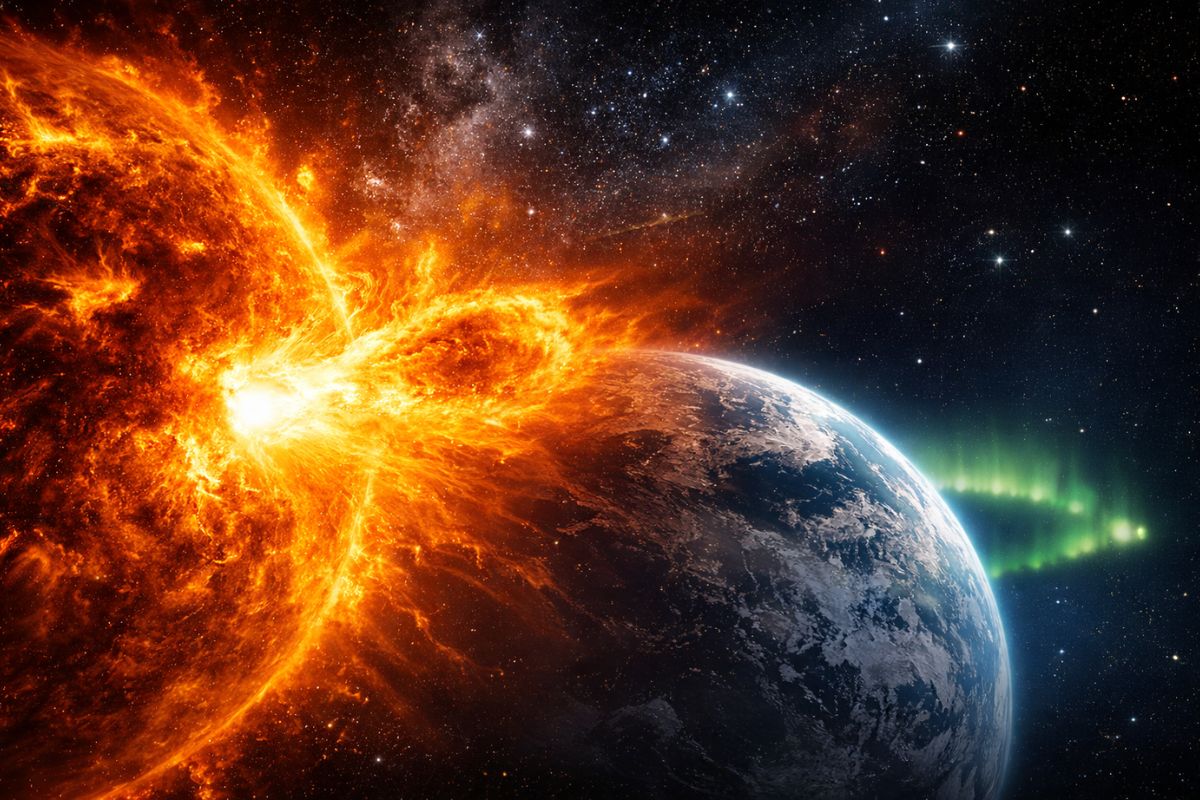
A solar eruption of class X8.1 registered on Sunday opens the way for a solar storm that is expected to cross the Earth by the end of Thursday. According to NOAA, the phenomenon may interfere with communications and increase auroras. The region AR4366, ten times larger than Earth, remains under watch.
The Earth came under monitoring after the Sun registered an eruption classified as X8.1, of significant magnitude. The event occurred on Sunday (1st) and, by the indicated projection, may trigger a solar storm that passes by the Earth by the end of the day on the 5th (Thursday).
The information was attributed to the National Oceanic and Atmospheric Administration (NOAA) of the United States, an agency that monitors such activities and their potential effects. When the origin is a class X eruption, the “point of attention” is no longer just the Sun and becomes the Earth’s response.
What Happened on the Sun and Why the Earth Entered the Radar
A solar eruption is an event involving intense energy release in the Sun’s atmosphere. In this case, it was classified as X8.1, a category at the top of the scale used to describe severity. What makes this type of episode relevant is not just the explosion itself, but the possibility that its effects may reach the Earth.
-
The coldest region of Brazil will experience very hot weather in the first days of April, with maximum temperatures reaching up to 35 degrees in Rio Grande do Sul, and only in the last week of the month an intense cold front is expected to finally lower the temperatures in the South and Southeast.
-
Goodbye common refrigerator: essential appliance starts to gain competition with technology that preserves food for longer and reduces waste.

-
Germany discovers how to reuse old window glass without melting anything and can transform 220,000 tons per year into new high-performance panels, using material from nearly 150 million old windows that would be discarded.

-
China creates hypersonic engine that can make planes and missiles fly more than 6 times the speed of sound with less weight, more range, and without system change.


The forecast associated with the episode indicates that the solar storm related to the event will “pass by the Earth” by Thursday. This time frame matters because the impact window is not usually an isolated moment: the behavior of the space environment can vary throughout the period, with moments of greater or lesser influence on communications and the intensity of auroras.
How the Classification of Solar Eruptions Works and What X8.1 Means

The classification mentioned (X, M, C, B, and A) organizes solar eruptions by magnitude, with class X representing the most severe. Within class X, the numbers can vary from X.1 to X.9, providing an additional sense of intensity within the same “level” of severity.
The description associated with class X emphasizes that these are eruptions of great magnitude, capable of interfering with communications and releasing large amounts of radiation, in addition to generating intense auroras.
Class M appears as “medium-sized,” with the potential to cause brief interruptions in radio communication and also generate auroras.
Classes C, B, and A are described as smaller, with less and less noticeable effects on Earth, in a progression where B is 10 times smaller than C, and A is 10 times smaller than B. In practice, this helps translate an astronomical phenomenon into potential risk for routine on Earth.
The Region AR4366 and Why a Size Detail Is Striking
The eruption was associated with a region of the Sun classified as AR4366. The data that provides dimension to what is being observed is straightforward: this region is about 10 times the size of Earth. When an active area is described at this size, it becomes a “fixed point” in monitoring, as it concentrates energy and tends to be observed more closely over the days.
It is important to understand what this type of information prompts in the public’s reading. Upon hearing “ten times larger than Earth,” many people imagine a single “hole” or a solid object the size of a planet. In practice, the comparison serves to communicate the scale of an active region of the Sun, without automatically transforming this into a proportional effect on Earth. The size is impressive, but what determines impact is the combination: magnitude of the event, conditions of the space environment, and response of Earth’s magnetic field.
What Can Change on Earth When a Solar Storm Arrives
The central alert associated with the episode was straightforward: the phenomenon may interfere with communications and also favor more intense auroras. Interference in communications is the type of effect that often becomes an immediate “symptom”, as it may appear as signal instability, especially at times when the space environment is more agitated.
In the case of auroras, the point is almost the opposite: for many people, the visual effect draws attention, but it is a “marker” that the interaction between particles and the atmosphere is more active. Even without turning this into a promise of spectacle, the mention of intense auroras is an indication that the event is relevant for Earth, not just for astronomical observation.
Why Forecasts Have Uncertainty and How to Read the Alert Without Exaggeration
Even when the classification is high, there is an essential detail: the confirmation of what has actually reached the Earth and with what intensity depends on analysis and monitoring. So much so that the information released emphasizes that the details would be analyzed concerning the content and the evolution of the phenomenon. In events like this, the difference between “may affect” and “will affect” is precisely what separates science from rumor.
Another point that increases confusion is vocabulary. “Solar storm” sounds like a singular, closed event, but the real scenario often consists of a sequence of variable conditions over time. This helps explain why the window “by Thursday” is so often cited: it acts as a window of attention, not as a disaster timer. The best thermometer is to observe what official monitoring confirms along the way, rather than treating an alert as a verdict.
What to Observe in Routine While the Earth Is in the Path of the Phenomenon
For those who just want to understand what this means in day-to-day life, it’s worth simplifying: the word “communications” is the most practical axis of the alert. If there is instability, it tends to appear as noise, momentary failures, or variations in signal quality in certain scenarios.
The most sensible recommendation is to treat any oscillation as a possibility, not as a certainty, because the effect may be localized, episodic, and dependent on multiple conditions.
For those following science, the interest is in the “process”: the classification X8.1, the observation of the region AR4366, and the monitoring of the period until Thursday form a picture of continuous monitoring. This is precisely where the topic becomes more relevant.
When Earth enters the path of an event classified as X, it’s not just astronomy that becomes news: it’s the interface between the Sun and technology.
An X8.1 solar eruption, associated with an active region the size of ten Earths, has placed the Earth in a window of attention until Thursday, with the possibility of interference in communications and more intense auroras. The episode also sends a clear message: space is not “far away” when modern life depends on signals, networks, and invisible stability.









-

-

-

9 pessoas reagiram a isso.