





 Portuguese
  English
  Spanish
  5 min of reading
  0 comments


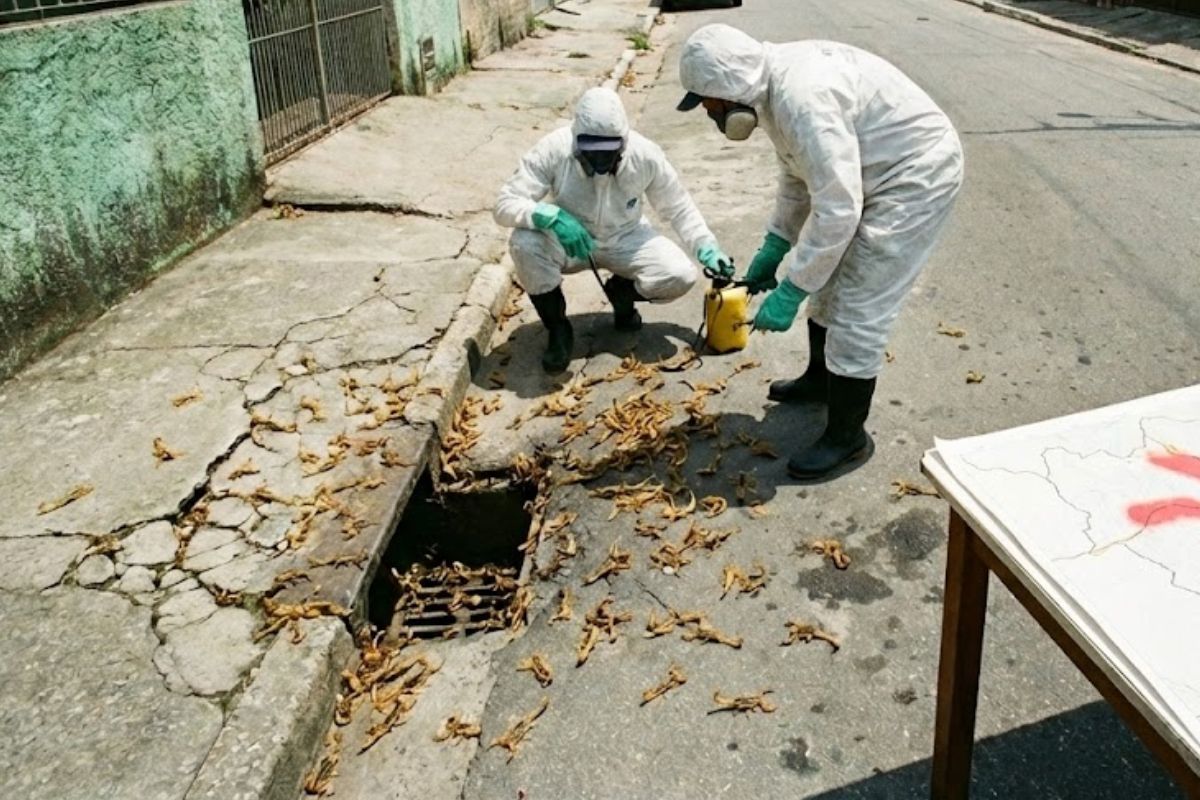
With Higher Temperatures in Summer, Mafra, in Northern Santa Catarina, Sees Scorpions Increase and Pressure Epidemiological Surveillance. In 2025, 98 Samples Were Sent to the Laboratory, Almost Triple That of 2024. Centro I, Centro II, Jardim Moinho, and Vila Nova Lead Captures, with Peaks in November and December.
The presence of scorpions in Mafra, in Northern SC, has ceased to be an isolated report and become routine for residents and health teams, especially with the advance of heat. The Municipal Epidemiological Surveillance has raised an alert after observing a significant jump in records and a pattern of concentrated increase at the end of the year, precisely when temperatures rise.
Official data released by the agency shows that, in 2025, 98 samples of scorpions were sent to the entomology laboratory throughout the year. This volume represents almost triple that recorded in 2024, when only 37 specimens had been cataloged, reinforcing that the municipality is experiencing a scenario of accelerated growth.
What the Numbers Reveal About Mafra
The samples sent to the laboratory did not come from a single type of occurrence. Part was reported through spontaneous demands from the population, when residents found the animal in homes, backyards, sidewalks, or service areas and contacted public services.
-
With more than 635,000 doctors, Brazil sees competition increasing in large cities, and recent graduates are competing for shifts at an accelerated pace while the countryside still faces shortages.

-
The world’s first octopus farm wants to open in the Canary Islands and is already provoking an international reaction: the plan aims to produce 3,000 tons per year.

-
Drought may be creating stronger superbugs in the soil and helping antibiotic resistance reach hospitals, warns a study highlighting a problem that could grow alongside extreme weather.

-
The biggest scam in history: Napoleon’s France deceived the United States by selling them a territory that was Spanish.






Another portion was gathered during field actions conducted by health teams, which aim to identify higher risk points and map where the presence is recurring.
Although the records indicate locations with a higher concentration, the Surveillance emphasizes one crucial point: the numbers reflect only the cases officially reported to the Health Department.
In practice, this means that the presence may be underreported and that the occurrence is not limited to neighborhoods with formal records, possibly appearing in any area of the city, including regions that have not yet concentrated captures in the report.
Where Scorpions Most Appear in the City
The mapping by neighborhoods indicates an advance that draws attention for reaching areas of intense circulation and established residential zones.
The neighborhoods with the highest incidence of captures were Centro I and Centro II, which together accounted for 34 scorpions.
Close behind, Jardim Moinho recorded 32 occurrences and Vila Nova had 20.
Vila Formosa and Restinga recorded six samples each, showing that the problem is not concentrated in one specific point but is distributed across different regions.
This neighborhood breakdown helps to size the phenomenon but should not be interpreted as a definitive risk map.
The technical guidance itself emphasizes that, even in areas with fewer records, the presence may exist and be detected at any moment, depending on environmental conditions and opportunities for shelter and food.
Summer and Year-End: Why the Peak Is Concerning
The behavior of records throughout the year raised a warning signal for a simple reason: the growth was neither gradual nor discreet.
The peak of occurrences was recorded in the last months, with November accounting for 54 captures and December totaling 21 records.
This pattern, combined with higher temperatures, reinforces the perception that summer functions as a critical period when the chance of sightings increases and attention needs to be heightened.
In addition to the captures, there is a piece of data that amplifies the severity: Sinan (National Notification Injury System) recorded 13 accidents with scorpions in Mafra in 2025.
This number should also be interpreted under the logic of formal reporting, meaning it represents the cases notified within the system and highlights that the advance is not merely statistical but has a direct impact on health.
The “5 As” and Urban Failures Favoring Proliferation
Health teams point out that the proliferation is directly linked to favorable environmental conditions known as the 5 “As”.
In practice, this translates into a set of factors that, when combined, create the perfect scenario for scorpions to settle close to people.
The first element is Shelter, which arises when there are debris, piles of wood, and accumulated materials, creating easy and protected hiding spots.
Next comes the Environment, especially when there are warm and humid locations, a common condition during periods of heat and in poorly ventilated spots.
Access also plays a role: cracks, drains, and openings facilitate the animal’s entry into homes.
Food enters the equation when there are insects, such as cockroaches, that sustain the scorpion’s presence.
Lastly, Water appears in the form of available moisture sources, which maintain areas favorable for the animal’s persistence.
Therefore, the health service’s recommendation focuses on routine actions: keep environments clean, reduce moisture points, seal possible access points, and avoid accumulating materials that may serve as shelters, especially in outdoor areas, storage spaces, and places where objects remain for long periods.
What to Do Upon Finding Scorpions and Why the Response Needs to Be Quick
Given a scenario of growth, the guidance is to treat any encounter with scorpions as a domestic and public health alert.
In case of a sting, the recommendation is to seek immediate emergency care, as poisoning can be severe, with increased attention for children and the elderly, who may experience a more delicate progression.
When scorpions are sighted in Mafra, the population should contact the Surveillance at (47) 9233-0307.
Capture can be done safely provided there is caution: the animal should be placed in a rigid container with a lid and taken along for treatment when necessary.
The Surveillance emphasizes a point that allows no improvisation: never capture the scorpion with your hands, not even with regular gloves, as this increases the risk of accidents and does not replace a safe procedure.
The advance of scorpions, the concentration in central neighborhoods, the peak of captures in November and December, and the 13 accidents recorded in Sinan paint a picture that demands continuous vigilance.
This is not just an inconvenience, but a problem that involves urban prevention, care within homes, and a rapid response from the health system, especially when the heat rises and the risk of encounters grows.
In your street or neighborhood, have you noticed scorpions appearing more frequently in recent months?









-

-

-

4 pessoas reagiram a isso.