





 Portuguese
  English
  Spanish
  5 min of reading
  0 comments


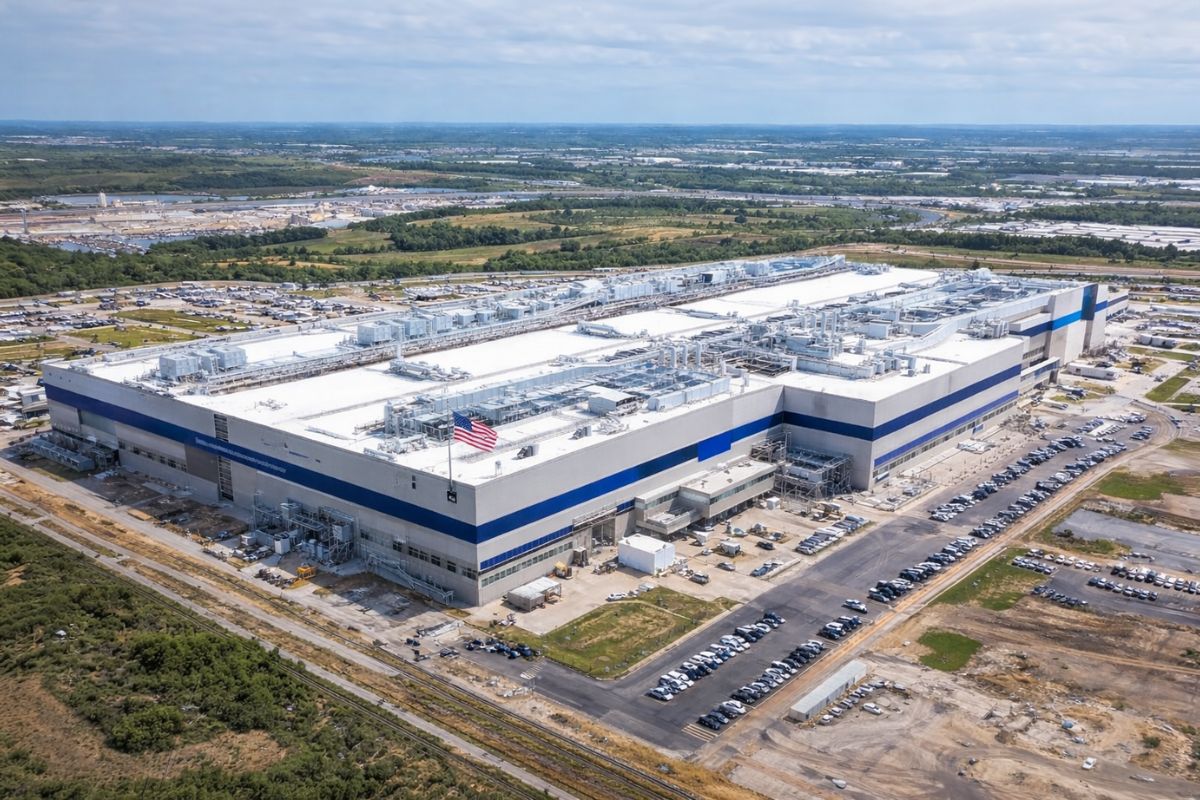
Factory 52, built by Intel in Arizona, is the most advanced chip manufacturing facility in the United States, with a capacity of 10,000 wafers per week, 1.8 nanometer technology, and an investment exceeding 5 billion dollars in the global semiconductor race.
There is a quiet race happening in the Arizona desert that could define who will lead global technology in the coming decades. Factory 52, built by Intel on the Ocotillo campus, known as Silicon Desert, is today the most advanced chip manufacturing facility on American soil. With 270,000 square meters, a capacity to produce 10,000 wafers per week, and cutting-edge 18A technology (equivalent to 1.8 nanometers), the factory represents the most ambitious bet by the United States in the global semiconductor race.
The investment of over 5 billion dollars is not just a demonstration of financial strength. Factory 52 surpasses the capacity and technological sophistication of TSMC units in Arizona, the Taiwanese manufacturer that dominates the global chip market. While TSMC produces chips using 4 and 5 nanometer processes in its first American phase, Intel is already working with significantly more advanced 18A technology. The difference in capacity is also impressive: Factory 52 produces double the wafers per week compared to TSMC’s phase 1 in the same state.
What makes Factory 52 the most advanced chip facility in the United States
The technical superiority of Factory 52 begins with the transistors. Intel uses RibbonFET architecture with gate-all-around (GAA) design and the PowerVia system, which delivers power from the back side of the chip.
-
While BYD lays off 100,000 in China due to falling profits, the factory in Brazil remains strong: the unit in Camaçari, Bahia, could generate up to 20,000 jobs and become an export hub for all of Latin America.
-
The two largest powers of BRICS are putting rivalries aside: China and India are making historic advances in rapprochement and plan to use their consecutive presidencies of the bloc to deepen ties and reshape the global balance of power.

-
China alone accounts for 70% of trade within the BRICS, while Brazil establishes itself as an essential supplier of food and minerals: understand how the group, which already represents nearly 40% of the world’s GDP, is changing the game.

-
Starting in May, those who do not have registered biometrics will not be able to apply for Bolsa Família, sickness benefits, or unemployment insurance: understand the new rule that changes access to benefits for millions of Brazilians.

These two innovations represent generational leaps over traditional semiconductor manufacturing methods and place Factory 52 at the absolute forefront of chip engineering.
To enable this production, Factory 52 has four ASML Twinscan NXE extreme ultraviolet (EUV) lithography systems, including at least one NXE:3800E, the most advanced Low-NA EUV equipment from ASML. This system can process up to 220 wafers per hour.
The other three machines are NXE:3600D systems that process 160 wafers per hour. When the Ocotillo campus is fully equipped, it will have at least 15 EUV scanners, a concentration of cutting-edge technology that few places in the world can gather.
The numbers of Factory 52 that explain the size of the investment
The scale of Factory 52 translates into numbers the ambition of Intel in the semiconductor race. The capacity of 10,000 wafers per week corresponds to approximately 40,000 wafers per month when the factory operates at full capacity.
This volume is twice that of the current phase 1 of TSMC Fab 21 in Arizona and will remain comparable even when the Taiwanese manufacturer completes its second phase of expansion.
The 270,000 square meters of Factory 52 house clean rooms with extreme environmental control, where microscopic particles can compromise the production of chips that operate on a nanometer scale.
Every square meter of this facility has been designed to meet the most demanding standards of the semiconductor industry. The investment of over 5 billion dollars covers not only the physical construction but also the acquisition of equipment that costs hundreds of millions of dollars each, such as the EUV lithography systems from ASML.
The race between Intel and TSMC that Factory 52 represents on American soil
The construction of Factory 52 does not happen in a vacuum. It is the American response to a dangerous dependence on semiconductors manufactured in Asia, especially in Taiwan, where TSMC concentrates most of the global production of advanced chips.
The United States has realized that national security and economic competitiveness depend on the ability to manufacture cutting-edge semiconductors on its own soil.
TSMC chose to start its operations in Arizona with already proven technologies, allowing for rapid production and high capacity utilization from the start. Intel, with Factory 52, chose the opposite path: to bet on immediate technological leadership, even if it means a longer period to achieve full efficiency.
It is a fundamental strategic difference. TSMC prioritizes reliability. Intel bets on the cutting edge. And the race between the two in the Arizona desert is defining who will dominate semiconductor manufacturing in the United States.
The challenges that Factory 52 still needs to overcome
Despite the impressive numbers, Factory 52 faces a real obstacle: the time needed to optimize production yields on 18A technology.
The factory is ramping up production of Panther Lake processors, but the process is still in the early stage of the yield curve. Intel expects that yields will only reach world-class levels by early 2027.
Until then, the company will not increase production beyond a certain level, which means that part of Factory 52’s capacity will remain temporarily idle. It is the price of working with technology that no one else on the planet fully masters.
Intel’s strategy represents a bet on long-term leadership within American territory, even if the path to full utilization of Factory 52 is slower than the gradual approach taken by the competition.
What Factory 52 means for the future of technology and chip geopolitics
The existence of Factory 52 in Arizona is a milestone that goes beyond engineering. It signals that the United States is willing to invest billions to avoid dependence on a single country in the semiconductor supply chain, components that are in virtually every electronic device in the modern world, from cell phones to cars, from satellites to medical equipment.
With massive investments in cutting-edge technology, Factory 52 demonstrates that the race for semiconductors is as strategic as the space race was in the last century.
Whoever manufactures the most advanced chips controls the foundation of the digital economy. And at this moment, in the Arizona desert, Intel is building the American response to this question with a factory that combines scale, technology, and ambition at a level that few believed possible on American soil.
What do you think about the global race for semiconductors and the role of Factory 52 in this scenario? Do you believe that the United States will be able to reduce dependence on Asian chips? Leave your opinion in the comments. This is the type of investment that defines who will lead technology in the coming decades.










Seja o primeiro a reagir!