





 Portuguese
  English
  Spanish
  4 min of reading
  0 comments


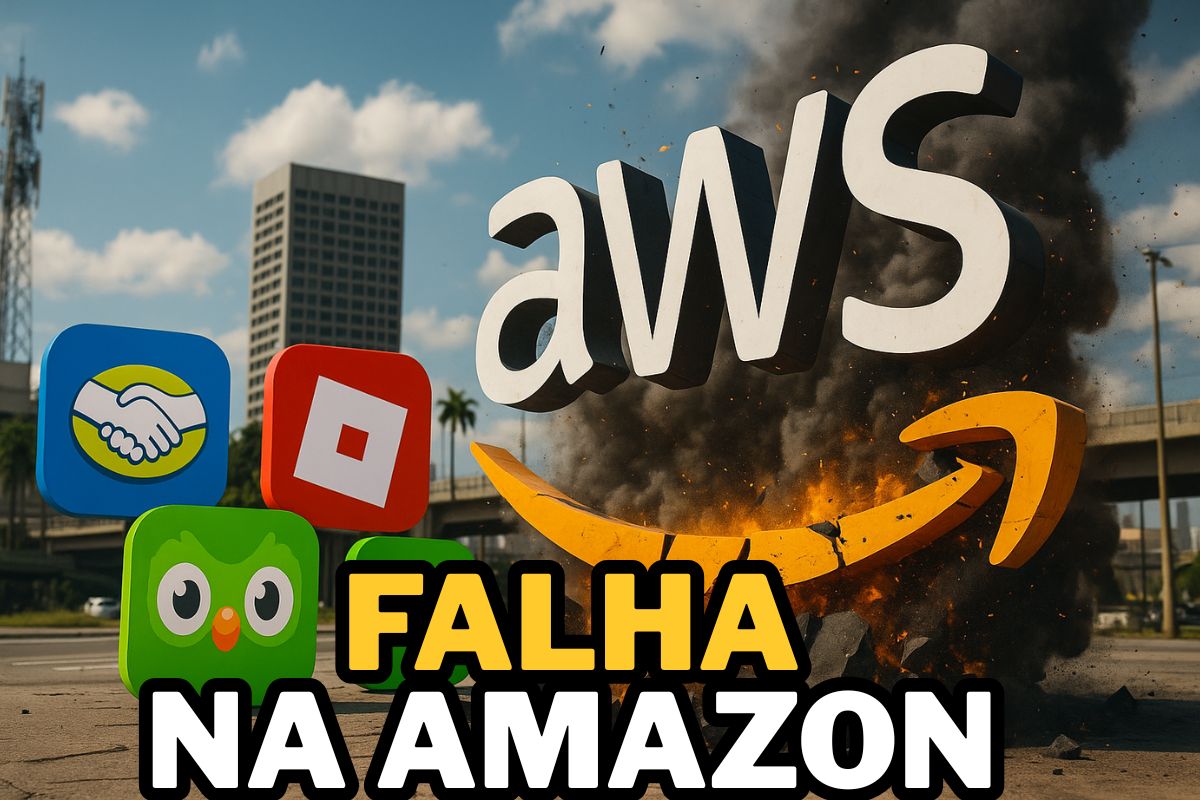
AWS Data Center Outage in the United States Affected E-Commerce Platforms, Digital Banks, Social Networks, and Productivity Apps Worldwide.
A global failure in Amazon Web Services (AWS) caused simultaneous instability in over 500 online apps and services this Monday (20), temporarily bringing down platforms such as Mercado Livre, Roblox, Duolingo, Canva, PicPay, and Fortnite. The digital blackout, which lasted about three hours, primarily hit the US-East-1 region in Virginia (USA), one of Amazon’s main global infrastructure hubs.
According to information from the Tech Tudo portal, the outage, classified as “critical,” generated a cascade effect: systems relying on AWS for data storage and operations processing became unavailable or slow, impacting users and businesses in various countries. Searches on Google Trends skyrocketed, with queries like “AWS down,” “PicPay not working,” and “OLX crashed.”
What Caused the Outage in AWS
According to Amazon itself, the incident was caused by DNS resolution issues related to DynamoDB, the company’s database system. Technically speaking, the apps could not communicate with the cloud servers, suspending basic operations like login, payment, file saving, and content loading.
-
The coldest seawater ever recorded in Earth’s history was hidden under extreme ice 717 million years ago and reached an impressive -15°C.

-
China has launched the world’s first floating artificial island, a scientific structure designed to face open seas, test equipment weighing hundreds of tons, and reach depths of 10,000 meters.

-
China accelerates global science and may surpass the United States in 2 years with increased public investment, continuous growth, and direct impact on the global technological competition.

-
Scientific studies indicate that drought may be strengthening a much greater silent threat: more resistant superbugs.


The error was concentrated in a single US-East-1 zone, but because it is the most used by large companies, the impact spread globally. The company stated it had adopted “parallel paths to accelerate recovery” and that services were restored gradually by the end of the morning.
Main Services Affected by the Global Outage
The reach of the global failure in Amazon was extensive, affecting everything from entertainment to finance. Gaming and streaming platforms, such as Roblox, Fortnite, and Prime Video, went offline. Education and productivity apps, like Duolingo, Canva, and Trello, also experienced slowdowns and connection errors.
Mercado Livre reported instability in searches and transactions, while PicPay and other digital wallets reported failures in transfers.
Even Alexa, Amazon’s virtual assistant, stopped responding to voice commands, although it recognized visual requests. In total, over 500 services experienced some type of partial interruption.
How Users Were Affected
In Brazil, thousands of reports were recorded on the Downdetector site between 6 AM and 10 AM. Users reported authentication errors, payment failures, and intermittent crashes in apps. E-commerce companies and digital banks particularly suffered from the overload of requests and congestion of APIs.
Although systems resumed operations, full restoration took time, and many services remained unstable during the stabilization phase.
Experts highlight that, in such cases, the internal processing queues formed during the outage can take hours to clear, even after technical correction.
The Power (and Risk) of Amazon Web Services
AWS accounts for about 30% of the global cloud computing market, serving millions of corporate clients from startups to giants like Netflix, Meta, Disney, and governments.
Its structure centralizes data storage, processing, and essential APIs for a significant part of the global digital economy.
This concentration explains the impact: when a region of AWS goes down, much of the internet slows down as well. Although outages are rare, the incident reinforces companies’ dependence on few cloud providers, a scenario that increases systemic risk.
A localized technical failure can turn into a global blackout, like what occurred this Monday.
The outage recalls recent incidents, such as the CrowdStrike outage in 2024, when a faulty update brought down operating systems and caused flight cancellations and billion-dollar losses.
Such cases illustrate how modern digital interconnection multiplies the reach of errors: a single line of code can paralyze banks, planes, and hospitals.
For infrastructure experts, the solution lies in redundancy strategies, using multiple cloud providers and local contingency plans.
Companies that rely exclusively on AWS become more vulnerable, as any instability in Amazon affects the entire operation.
How to Reduce the Impact of New Failures
Even with no control over global incidents, companies and users can minimize losses. Organizations should distribute their data across different regions and providers, a practice known as multicloud, in addition to maintaining backup routines and emergency plans.
For the general public, having offline alternatives and multiple access channels, such as local versions of documents and diversified payment options helps to avoid disruptions when platforms crash.
The global failure in Amazon once again exposed the fragility of the infrastructure supporting digital life. AWS is the heart of the global cloud, but its dependence is also its most vulnerable point.
Three hours of instability were enough to paralyze hundreds of services, affecting millions of people and businesses across all continents.
And you? Were you impacted by this outage? Do you believe that companies rely too much on a single provider or that these failures are inevitable in a connected world? Share your opinion in the comments your input helps to understand the real extent of cloud impacts on everyday life.









-

-

2 pessoas reagiram a isso.