





 Portuguese
  English
  Spanish
  8 min of reading
  0 comments


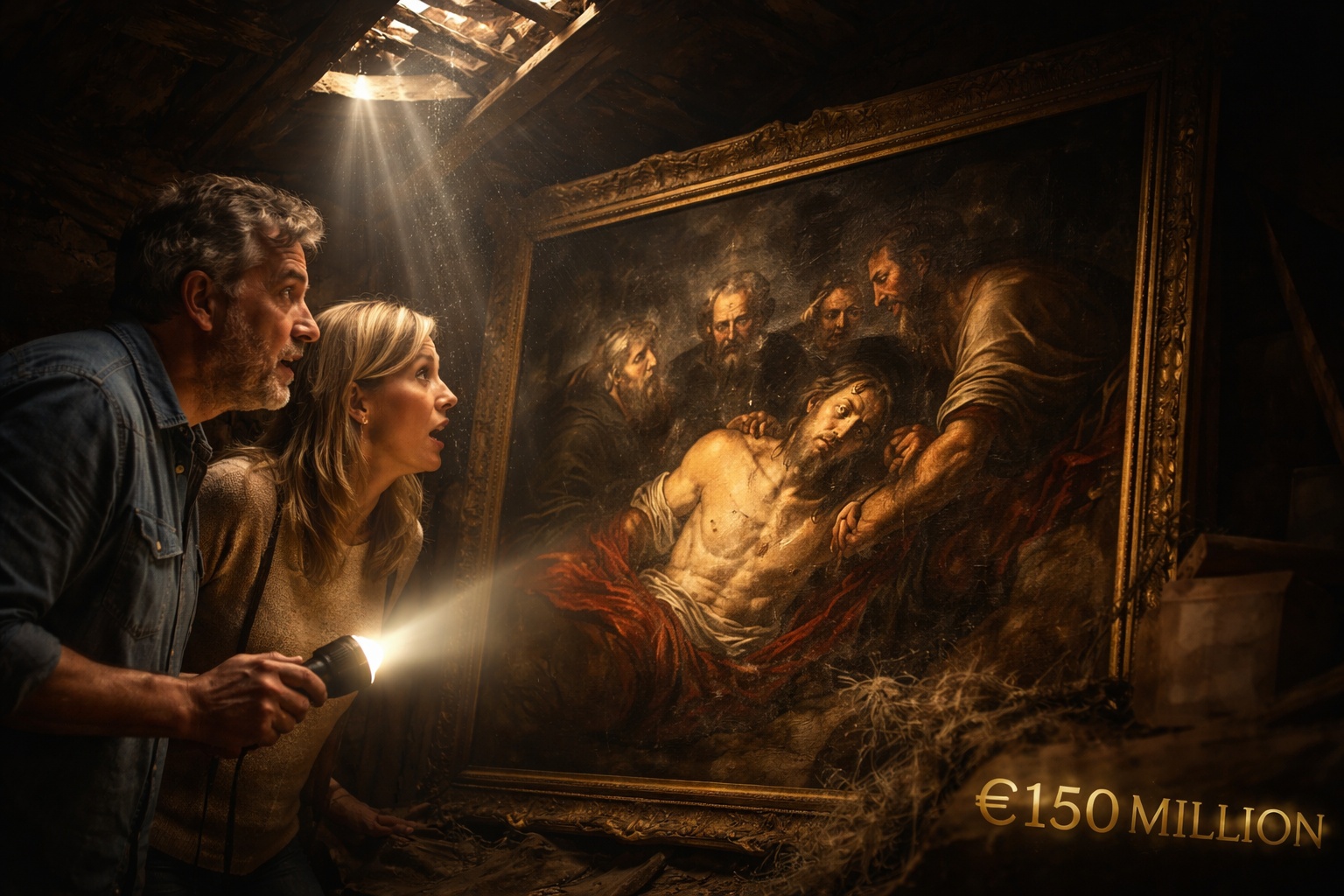
French Family Opens Sealed Attic to Investigate Leak and Finds Biblical Painting Attributed to Caravaggio; Work Undergoes Expert Analysis and Could Be Worth Hundreds of Millions of Euros.
In April 2014, a family from the south of France went up to the attic of their own house to investigate where a leak in the ceiling was coming from. The attic had been sealed for years, and opening it required forcing a door for which no one had keys anymore. Inside, covered in dust and with signs of moisture, there was a huge canvas leaning against the wall. The family called an acquaintance: Marc Labarbe, a local auctioneer with some fame in the Toulouse region. Labarbe went to the attic, took a damp cloth, and wiped the surface of the canvas. Under the dirt accumulated for over 150 years, a scene of biblical violence emerged: a woman beheading a sleeping general. The painting was large, masterfully executed, with that brutal contrast between light and shadow that seemed to leap from the canvas.
Labarbe took a photo and sent it to Eric Turquin, the leading Old Masters specialist in France, with an office in Paris. The response would take two years.
The Scene That Disappeared for 400 Years
Turquin recognized the theme immediately: Judith and Holofernes. The story comes from the Book of Judith, in the apocryphal texts of the Old Testament.
-
He started running at 66 years old, broke records at 82, and is now a subject of study for having a metabolic age comparable to that of a 20-year-old, in a case that is intriguing scientists and inspiring the world.

-
Oldest tree on the planet reappears after 130 years of searches: Wattieza, 385 million years old, was 10 meters tall and had no leaves or seeds; Gilboa fossils in New York solved the mystery in 2007.

-
A 48-square-meter house assembled in hours with 4,000 bricks made of recycled plastic that does not absorb moisture, has natural thermal insulation, and costs less than 90,000 reais in a complete kit.

-
Luciano Hang revealed that Havan’s air fleet has already accumulated more than 20,000 landings, 10,000 flight hours, and 6 million kilometers traveled, and he says that without the planes, the company would never have grown so quickly.


Holofernes was an Assyrian general sent to destroy the city of Bethulia. Judith, the widow of the city, infiltrated the enemy camp, seduced the general, waited for him to fall asleep drunk, and beheaded him with his own sword. The city was saved. Judith went home with the head of the general in a bag.
Caravaggio had painted this scene for the first time between 1598 and 1599. That canvas is now in the Palazzo Barberini in Rome and is one of the most famous works of Western Baroque. But there were historical records of a second version — painted around 1607, when the artist was in Naples, in hiding. This second Judith had disappeared around 1619. Four centuries later, no one knew where it was.
The canvas from the attic of Toulouse measured more than two meters in length. Same composition. Same violence. But with technical and stylistic differences that indicated it was not a copy — but rather a later, bolder original, painted by someone who had radically changed their way of working.
Turquin spent two years studying the canvas in absolute secrecy. According to him, the work was kept in his own room during part of that period — for safety.
The Painter Who Killed a Man and Fled with the Head as a Prize
To understand what that canvas could be, it is necessary to understand the moment it was painted and who the man who probably painted it was.
Michelangelo Merisi da Caravaggio was born in 1571, in Milan. He grew up in the small town that would give him his artistic name. He arrived in Rome as a young man, without money, and spent years doing minor jobs before landing a major commission in 1599: the decoration of the Contarelli Chapel in the Church of San Luigi dei Francesi. From that point on, his career exploded. He was the most talked-about and sought-after painter in Rome.


But Caravaggio was also a man of explosive temperament, with a long history of fights, arrests, and legal troubles. He threw a plate of artichokes in a waiter’s face. He broke windows. He assaulted colleagues. He walked armed through the streets of the city and accumulated police records with a disconcerting regularity for an artist at the height of fame.
On May 28, 1606, everything fell apart. In a street brawl — apparently over a ten-scudo unpaid bet — Caravaggio killed a young man named Ranuccio Tomassoni. The most accepted version by historians is that the intention was to injure him, not to kill him, but the injury was fatal. In the same year, Pope Urban VIII himself signed a death sentence against the painter: any inhabitant of the Papal States was authorized to execute him in exchange for a reward.
Caravaggio fled Rome that very night. He would never return.
Four Years of Flight, Painting Masterpieces
The exile lasted until 1610, when Caravaggio died of fever on the shore of a beach in Porto Ercole, Tuscany, at the age of 38. During those four years, on the run and in constant movement, he painted some of the most extraordinary works in the history of art.
He passed through Naples — where he was protected by Spanish jurisdiction, beyond the reach of the papacy. He then went to Malta, where he was even made a Knight of the Order of Saint John, but ended up imprisoned again after a new fight with a high-ranking knight. He escaped from prison. He was expelled from the Order. He continued painting. Sicily, Naples again, constant threats.
In Naples, in 1607, Caravaggio left two paintings in the workshop shared by the Flemish painters Louis Finson and Abraham Vinck. A letter sent that same year by the painter Frans Pourbus to the Duke of Mantua mentioned, among the treasures for sale at the workshop, a Judith and Holofernes by Caravaggio. The asking price was less than three hundred ducats.
The canvas was not sold. Finson died in 1617 and left the painting to Vinck in his will. After that, the painting disappeared from historical records. For four centuries, no one knew what had happened to it.
April 2016: The Announcement That Shook the Art Market
On April 12, 2016, Turquin called a press conference in Paris. The canvas was presented to the world with a direct statement: it was the lost Caravaggio from 1607. The expert had dedicated two years to technical, scientific, and historical analyses.
X-rays revealed pentimenti — correction marks made by the artist during execution, something that would not make sense in a copy.
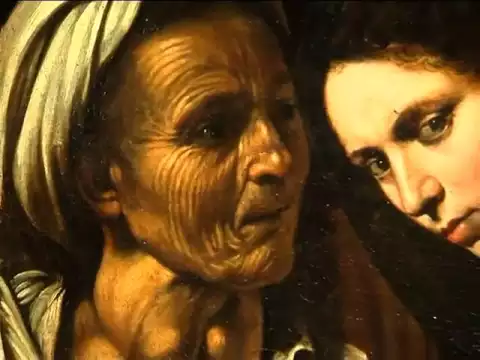
Infrared analysis showed absence of preparatory sketches, a feature known from Caravaggio’s working method. The type of canvas and the chemical composition of the paints were consistent with other works from the artist’s Neapolitan period.
Turquin stated that he had identified in the Toulouse canvas the same model that appears in the painting The Crucifixion of Saint Andrew (1607): an elderly woman with a deeply wrinkled face and visible goiter on her neck. It was the same person, painted at the same period, by the same artist.
The French Ministry of Culture, informed of the discovery weeks earlier, had declared the canvas a national treasure back in March 2016 and prohibited its export for 30 months. The initial valuation: €120 million. The news spread worldwide within hours.
The Controversy That Remains Unresolved
Not everyone agreed. Mina Gregori, at 95 years old the leading living authority on Caravaggio studies, declared that the canvas was the work of Louis Finson, the same Flemish painter who had kept the painting after Caravaggio’s death. Gianni Papi, a Caravaggio specialist at the University of Florence, considered it to be a second copy by Finson, not an original.
When the canvas was exhibited at the Pinacoteca di Brera in Milan, an art historian resigned from the museum’s board in protest over the exhibition — the institution ended up presenting the attribution with an asterisk.
Critic Jonathan Jones of The Guardian published a detailed analysis demolishing the attribution. He pointed out that the lighting of the canvas did not correspond to any known period of Caravaggio’s work, that the composition was too loose for the master, and that Judith seemed too distracted for someone committing murder.
Turquin confidently responded that he had spent five years studying the work and that no critic had presented a conclusive technical argument against the attribution. “After five years of analysis, no one presented a counterargument,” he said. “They say it’s impossible because Caravaggio painted only 65 canvases. For them, the history of art is over.”
Louvre Refused. An American Bought It
The French government, by declaring the canvas a national treasure, hoped that the Louvre would take advantage of the embargo period to acquire the work for the French collection. The Louvre refused. The institution did not want to take a stand in an authenticity dispute that remained unresolved.
In December 2018, the embargo expired. The canvas could now leave France.
Labarbe and Turquin then organized a public auction for June 27, 2019 — an unusual auction, conducted by Labarbe’s own house in Toulouse, the same city where the painting had been found.
Estimate: between €100 million and €150 million, with no minimum reserve price. In the months preceding the auction, the canvas toured: London (Colnaghi gallery), Paris, New York, Toulouse. It is estimated that 20,000 people went to see it.
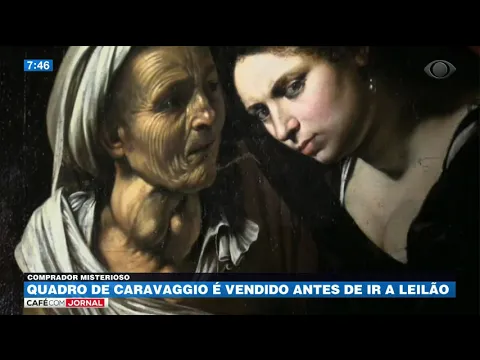
Two days before the auction, on June 25, 2019, Labarbe and Turquin made an announcement: the auction was canceled. The canvas had been sold in a private negotiation to an anonymous foreign buyer. Price undisclosed, protected by a confidentiality clause. The buyer’s identity: also confidential.
The next day, the New York Times identified the buyer: J. Tomilson Hill, former vice president of Blackstone, board member of the Metropolitan Museum of Art, and founder of the Hill Art Foundation in New York. Hill reportedly paid above the initial minimum bid of €30 million — how much exactly has never been confirmed. The painting left France.
What This Story Tells Us About the Art Market
The canvas from Toulouse is, regardless of who painted it, an exemplary case of how the art market works and how uncertainty surrounding an attribution can move fortunes.
There are about 65 canvases in the world that are certainly attributed to Caravaggio. If the canvas from Toulouse is confirmed as original, it becomes the 66th. If it is confirmed as a work by Finson, a competent but infinitely less famous painter, its market value plummets to a minimal fraction. The difference between the two attributions is worth, concretely, more than €100 million.
The American buyer has committed to displaying the work in a major museum. To this day, the Judith from Toulouse has not appeared in any confirmed public exhibition. Authenticity remains disputed. The question raised by the French family’s attic in 2014 still has no definitive answer.









-

-

-

-

-

-

25 pessoas reagiram a isso.