





 Portuguese
  English
  Spanish
  5 min of reading
  0 comments


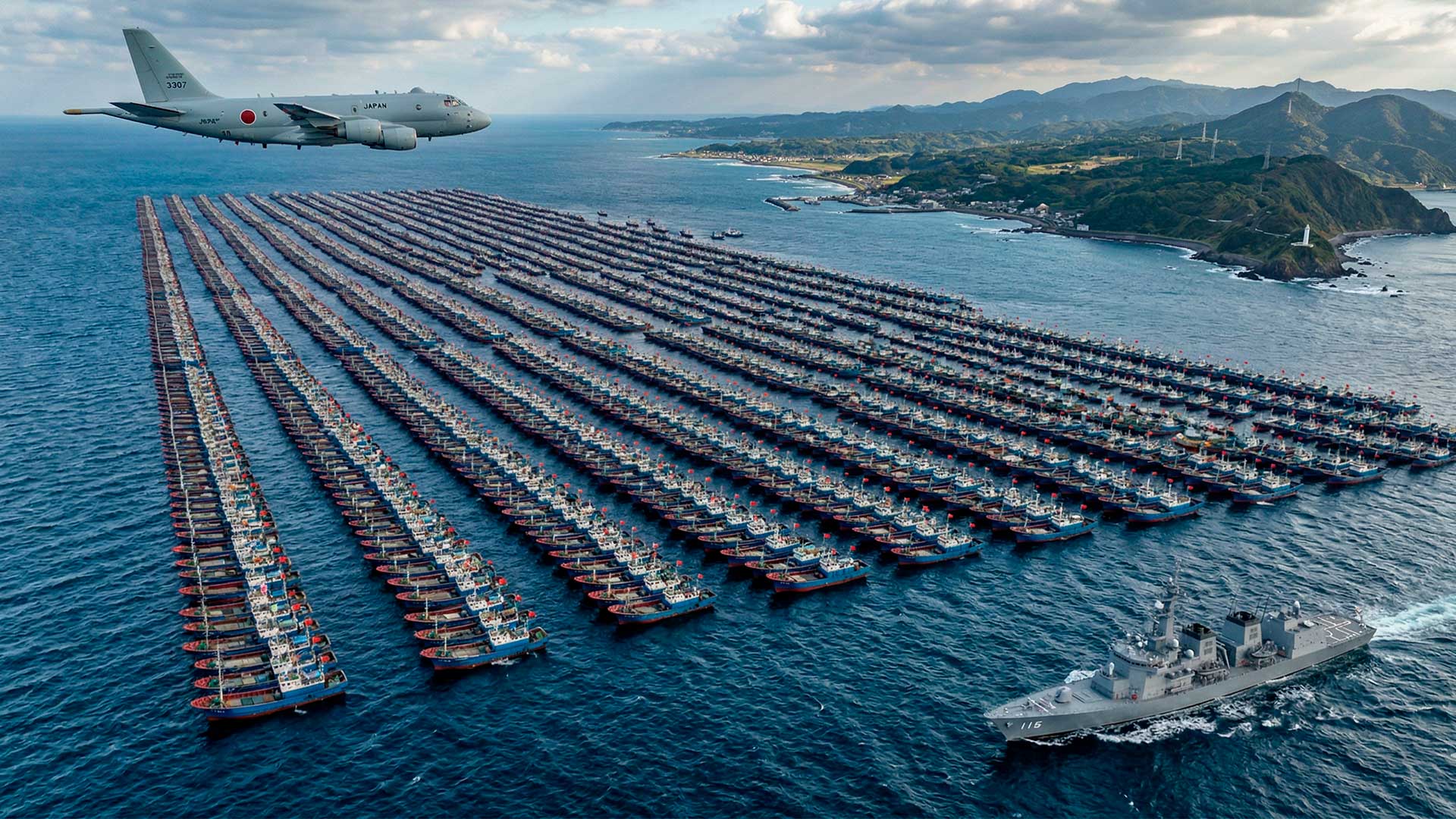
Satellite images and tracking data exposed unusual activity in the East China Sea, with thousands of Chinese vessels aligned in a sensitive area near Japan.
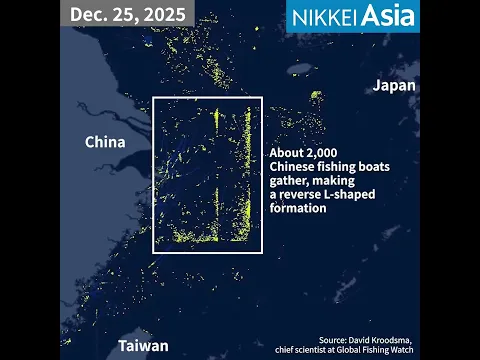
What appeared, from a distance, to be a large fishing operation revealed something much more delicate. Up to 2,000 Chinese boats were seen near the median line between China and Japan, in extensive and static formations, at a strategic point in Asia.
The movement gained political weight after Japan detained a Chinese fishing boat within its exclusive economic zone, about 170 kilometers from Nagasaki.
The captain was arrested after refusing to undergo inspection, at a time when relations between Tokyo and Beijing had already been deteriorating rapidly.
-
A man found a children’s book at his parents’ house in Greece that should have been returned to a library in the United States in 1989 and decided to take it back 36 years later because he felt it was the right thing to do.

-
The Federal Revenue Service raises a warning signal for heirs.

-
Rubberized paint made with four inexpensive ingredients creates a rubberized paint that waterproofs exterior walls, withstands sun and rain, and also covers small cracks.

-
An archaeologist announces that scanning technology has found an unknown structure in the depths of the Great Pyramid of Khufu, a 30-meter void with a sealed door that has not been opened for 4,500 years, hidden within the last of the Seven Wonders of the Ancient World still standing, and says that the full revelation will come in 2026.
The incident is not treated as an isolated case. It fits into a sequence of signs of maritime, military, and diplomatic pressure against the backdrop of the regional dispute over the Senkaku Islands, called Diaoyu by China, and the growing tension surrounding Taiwan.
Detention of Chinese boat near Nagasaki reignited a crisis that had been forming for weeks

The capture of the Chinese vessel by Japan acted as a trigger. The case occurred within Japan’s exclusive economic zone, an area where the country maintains specific rights for exploration and enforcement, and the captain’s refusal to accept inspection aggravated the incident.
This movement occurred in a broader context of political friction. The Japanese government had been making harsher statements about Taiwan’s security, while Beijing reacted with warnings to its citizens to avoid travel to Japan, escalating the tone of diplomatic confrontation.
In the East China Sea, this type of gesture rarely remains confined to the local level. Each naval approach, each patrol, and each vessel moved typically forms part of a larger message about power, presence, and willingness to test limits.
AIS data and Planet Labs images showed lines of boats for hundreds of kilometers, separated by less than 500 meters
The scale of the operation drew attention for a simple reason. The boats were not behaving like a typical fishing fleet, even in an area known for disputes and intense surveillance.

Information from the AIS system, used for maritime tracking, and satellite images from Planet Labs, combined with records from Marine Traffic, indicated unprecedented concentrations. In some stretches, the formations extended for hundreds of kilometers, with vessels less than 500 meters apart.
Another piece of data reinforced the suspicion that it was not just about fishing. Even under adverse weather conditions, many boats remained in practically static positions for over 24 hours, something difficult to justify as mere commercial activity at sea.
This pattern transformed the scene into a clear geopolitical warning. The massive presence of civilian vessels in a sensitive area serves to gauge reactions, pressure the adversary, and demonstrate mobilization capability without formally deploying the navy.
Chinese maritime militia operates in the so-called gray zone and increases pressure without crossing the threshold of open conflict
Much of these vessels are part of what analysts classify as the Chinese maritime militia. This is a civilian network that operates in cooperation with the state and China’s military apparatus in operations that remain below the threshold of declared war.
In practice, this structure gives Beijing a very useful tool in the so-called gray zone. The country can occupy space, monitor routes, test responses, and create diplomatic embarrassment using boats that, on paper, appear as civilian and fishing vessels.
This model complicates the reaction from the other side. If Japan responds with force, it risks appearing disproportionate against civilian vessels; if it does not respond, it opens the door for the consolidation of Chinese presence in strategic points of the sea.
The result is a type of constant and calculated pressure. What seems like economic activity can, in a matter of minutes, turn into informal blockades, saturation of maritime routes, or logistical rehearsals for larger actions in the Indo-Pacific.
Taiwan, Okinawa, and Senkaku Islands explain why the movement goes far beyond commercial fishing
The maneuvers occurred at a time when the Japanese government began to assert more clearly that a crisis in the Taiwan Strait would represent an existential threat to the country. This assessment changed the weight of each Chinese movement around the Japanese archipelago.
For Beijing, Taiwan is part of its territory, and the use of force has never been ruled out. For Tokyo, any clash in the region could compromise defense lines, supply, and trade, especially in areas close to Okinawa and the first island chain.
At the same time, the presence of the Chinese coast guard around the Senkaku Islands reached new records. The islands, administered by Japan and claimed by China as Diaoyu, remain among the most sensitive points in the maritime dispute in East Asia.
Beijing also released, for the first time, images of patrols in disputed waters. This detail matters because it shows a strategy of controlled exposure, where the public demonstration of presence becomes part of the very instrument of pressure.
In addition, the aircraft carrier Liaoning expanded its operational radius near Okinawa, while China continues to advance infrastructure on its side of the maritime median line. All of this forms a coherent picture of permanent pressure, rather than a random sequence of events.
The concentration of thousands of boats reveals a dry run of civil-military mobilization with impact for the entire Indo-Pacific
Experts see this operation as a direct test of the civil-military fusion policy promoted by Beijing. The logic is simple and powerful: use civilian assets to extend strategic reach, shuffle response rules, and project power without firing a shot.
Successfully gathering thousands of vessels in a short time in such a sensitive area sends a clear message. China shows that it can saturate maritime spaces, disrupt trade routes, and create faits accomplis quickly, ambiguously, and difficult to neutralize.
This alters the calculus not only for Japan but for the entire region. Countries in the Indo-Pacific begin to observe that the local balance can be shaped by seemingly civilian actions, yet coordinated with strategic logic and state support.
In the end, the so-called ghost fleet reveals less about fishing and more about power. What appeared in the images signed by Planet Labs, Marine Traffic, Anna Frodesiak, and Micromesistius was a preview of how the dispute in the East China Sea may evolve without the classic appearance of war.
And you, is this Chinese tactic an intelligent form of pressure or a dangerous step towards a larger crisis in Asia? Leave your comment and say whether Japan should react more firmly or avoid escalating this maritime dispute further.








Seja o primeiro a reagir!