





 Portuguese
  English
  Spanish
  5 min of reading
  0 comments


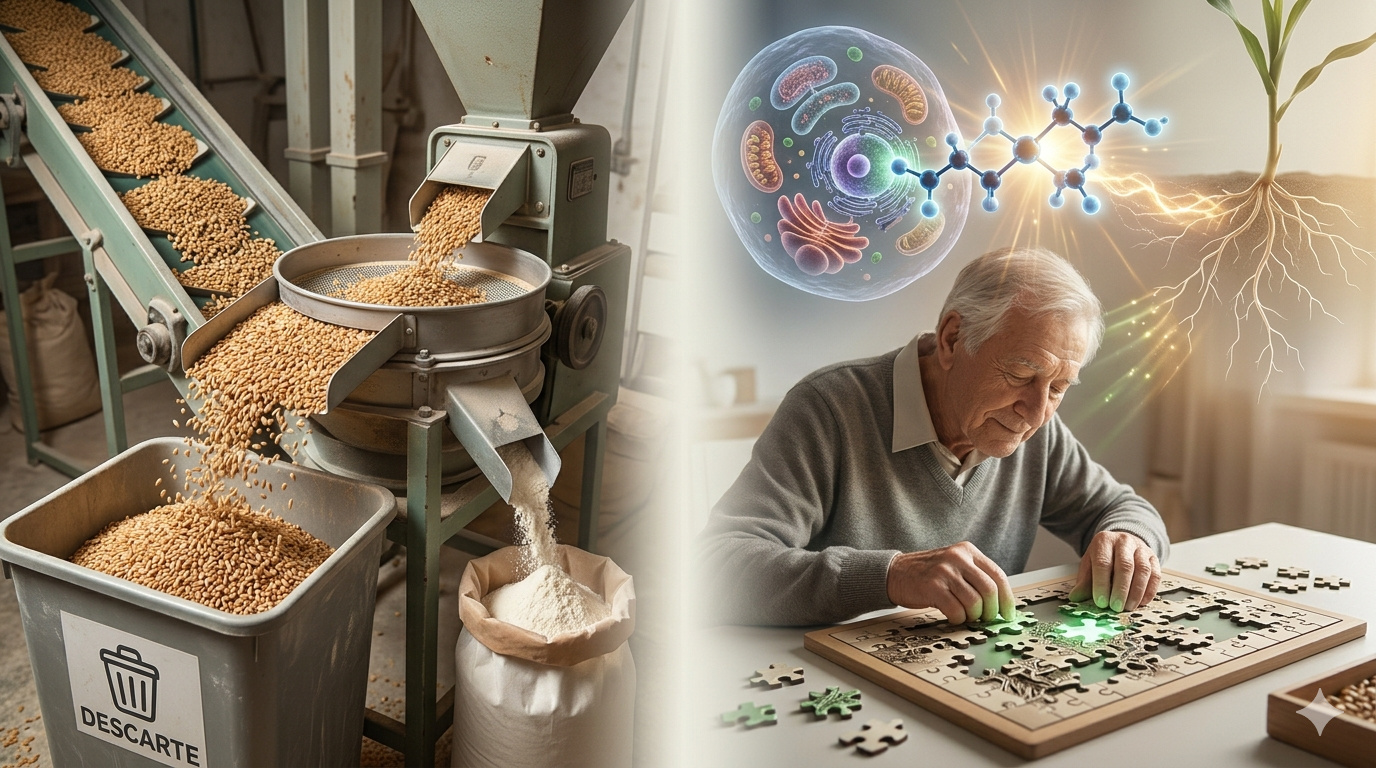
Wheat germ concentrates spermidine, a compound linked to longevity and cell health, reveals study with mortality reduction of up to 20 years
For much of the 20th century, wheat refining was treated as an industrial advancement, allowing for whiter flour, softer bread, and longer shelf life. However, this process removes two of the three parts of the grain: the bran and the wheat germ. According to researchers from the University of Graz in Austria, as described in recent studies on nutrition and aging, the discarded wheat germ concentrates the highest known food levels of spermidine, with levels between 150 and 243 mg per kg, a compound that has been associated with fundamental cellular processes linked to longevity.
This discovery repositions a widely ignored byproduct of the food industry as one of the most studied elements in aging science in recent years.
What is spermidine: biochemical compound linked to autophagy and cell aging
Spermidine is a polyamine, an organic molecule produced naturally by the body from amino acids. Its name dates back to the 17th century when it was first identified in human semen, remaining for centuries as a secondary compound in biochemistry.
-
NASA and China issued a joint alert because a 60-meter rock could hit the Moon, and the impact could generate a storm of debris in space that would knock out the internet, satellites, and GPS worldwide for years.

-
What the James Webb telescope found on the planet K2-18b is raising alarms in the scientific community: gases that on Earth only exist because of living organisms have been detected in the atmosphere of an oceanic world 124 light-years away from us.

-
Divers found a nearly intact 23-meter Greek ship on the bottom of the Black Sea, so well preserved that it seems to have been frozen in time for 2,400 years.

-
The blood of astronauts is undergoing mutations in space, coagulating too much when it shouldn’t and too little when it needs to: three recent discoveries reveal that our bodies were simply not made to live outside of Earth.




The shift in relevance occurred in the 2000s when Frank Madeo’s lab at the University of Graz demonstrated that spermidine could prolong the life of yeast in the lab. The central mechanism identified was autophagy, a cellular process responsible for removing damaged structures.
Autophagy functions as an internal cellular recycling system, eliminating defective proteins and compromised organelles, which reduces inflammation and oxidative stress — factors directly associated with aging.
Autophagy and longevity: how spermidine acts in cellular cleaning
Autophagy is one of the most critical mechanisms for maintaining cellular health. As age advances, this process loses efficiency, leading to the accumulation of cellular waste.
Spermidine acts directly in activating this system. Studies show that its levels in the body decrease with aging, exactly when the need for cellular maintenance increases.
This relationship between declining spermidine and failure in autophagy places the compound at the center of research on healthy aging, often compared to effects observed in caloric restriction.
Bruneck Study: spermidine consumption associated with mortality reduction
In 2018, researchers from the Universities of Innsbruck, Cambridge, and Graz published in the American Journal of Clinical Nutrition the results of the Bruneck Study, which followed 829 adults over 20 years.

The participants were divided into three groups based on spermidine intake. The results showed a progressive decline in the mortality rate:
- 40.5 deaths per thousand person-years in the lowest consumption group
- 23.7 in the intermediate group
- 15.1 in the highest intake group
This represents a difference equivalent to 5.7 years less in biological age in the group with the highest consumption, after adjustments for factors such as age, sex, and lifestyle.
Among 146 nutrients analyzed, spermidine showed the strongest association with lower mortality, surpassing vitamin C, fiber, and omega-3.
Intermittent fasting and spermidine: discovery of 2024 explains molecular mechanism
In 2024, a study published in Nature Cell Biology brought a relevant discovery: intermittent fasting increases intracellular levels of spermidine.
This increase triggers the activation of autophagy, explaining the beneficial effects of fasting in different organisms, including humans.
When spermidine production was blocked in the lab, the positive effects of fasting disappeared. This indicates that spermidine is the central biochemical link between fasting and metabolic benefits, including reduced inflammation and cardiovascular protection.
Spermidine and brain health: studies on memory and cognitive decline
Research on spermidine has also advanced in the neurological area. Studies in animal models have shown improved memory associated with the removal of accumulated proteins in synapses.
Clinical trials in humans have yielded mixed results. In 2019, a study with older adults indicated moderate improvement in memory after supplementation. In 2022, a larger trial found no statistically significant differences across all markers.

In 2025, an Austrian study pointed to cognitive improvement in 42% of participants with mild to moderate dementia.
Despite the limitations, the data indicate a consistent potential of spermidine in preserving cognitive function, still under investigation.
Foods rich in spermidine: wheat germ leads concentration

Wheat germ is the primary food source of spermidine. A tablespoon contains about 1.2 to 1.5 mg of the compound.
Other sources include:
- Natto and tempeh
- Mushrooms such as shiitake and maitake
- Aged cheeses
- Legumes and cruciferous vegetables
The difference is that wheat germ concentrates significantly higher levels, but is rarely consumed due to the wheat refining process.
Bioavailability and limitations: what science is still investigating about spermidine
Despite the advances, there are still important gaps. It is not entirely clear how much of the ingested spermidine actually reaches the brain.
Studies indicate that the compound can cross the blood-brain barrier in animals, but evidence in humans is still limited.
Furthermore, the body tightly regulates spermidine levels, which may limit the impact of high-dose supplementation.
The removal of wheat germ during industrialization resulted in significant nutrient loss. The focus on texture, durability, and appearance led to the discarding of one of the most nutritious parts of the grain. This process transformed a functional food into a byproduct, often directed to animal feed or discarded.
Safety and regulation of spermidine as a dietary supplement
Spermidine derived from wheat germ has been recognized by the European Food Safety Authority as “Novel Food,” allowing its commercialization as a supplement in Europe.
However, supplementation should be monitored by health professionals, especially in individuals with a history of cancer, due to the still-studied relationship between polyamines and cell proliferation.
Research on spermidine shows that a component widely discarded by the industry may play a relevant role in cellular health and aging.
The wheat germ, historically removed to improve commercial characteristics of foods, emerges as one of the richest natural sources of a compound associated with longevity, reinforcing the importance of consuming whole foods.
As new research advances, current evidence already repositions this byproduct as a central element in modern functional nutrition.







Seja o primeiro a reagir!