





 Portuguese
  English
  Spanish
  5 min of reading
  1 comment





Twenty Years Ago, Brazil Tested an Electric Car with Salt Battery and Almost No One Noticed: With a Range of Up to 120 km in Urban Cycle, Fiat Palio Could Recharge at Home
Imagine a car that doesn’t use gasoline, makes no noise, charges from a wall socket, and still runs as if it made 60 km per liter. Does it sound like cutting-edge technology? Well, that was reality in Brazil… in 2006. And the name behind this unusual story is well-known to everyone: Fiat Palio. The model, which was born as one of the most popular compacts in the country, gained an electric version produced in Betim (MG) with an ambitious proposal for the time: to run on salt battery.
It Didn’t Look Different, but Inside It Was a Different Story
From the outside, everything looked the same: four-door body, the same basic look of the conventional Palio. But just turning the key made it clear that something was different. The combustion engine had been replaced by a three-phase asynchronous electric motor, installed in the front and cooled by water. And the sound? None. The silence was so absolute that Fiat had to install a bell to alert pedestrians when the car was reversing.
If you were looking for performance, it was better to sit and wait: going from 0 to 100 km/h took a long 28 seconds, and the top speed barely exceeded 110 km/h. But that was the trade-off: instead of performance, the electric Palio offered a low cost per kilometer driven. Plugged in overnight, the cost of use was equivalent to that of a car that achieved 60 km per liter of gasoline.
-
With over 14 million baskets of earth moved, an ancient North American metropolis built a monumental pyramid of 30 meters and established a city with 20,000 inhabitants nearly a thousand years ago.

-
A 1,900-year-old treasure emerges from a Roman house destroyed by fire and sealed since antiquity in Romania, with coins and metals fused among the ashes.

-
The Brazilian colonial city that stopped in time and shares territory with a rocket launch base.

-
79-year-old woman challenges limits, visits 193 countries in the world after 56 years of planning and reveals the behind-the-scenes of a global journey that few have managed to accomplish.


Born from a Partnership with Itaipu
The project was commissioned by Itaipu Binacional, the largest hydropower plant in the world, which at that time still depended on a fleet powered by fossil fuels. The proposal was simple: develop, together with Fiat, a national electric car technology viable for institutional use. “By 2008, the goal is to make this prototype viable. Nationalize parts, lower costs, increase range, and reduce recharge time,” stated Carlos Eugênio Dutra, then product director at Fiat.
The model was far from ideal, but it promised a lot. The internal structure was entirely adapted, with the 165 kg of batteries being installed in place of the spare tire, at the back, while the electric motor weighing only 42 kg was in the front. The weight distribution changed so much that the car’s dynamic behavior was altered. Even with only 69 kg more than the original version with a 1.0 Fire engine, the front suspension was not recalibrated, and the result? At launch, the electric Palio could even leave tire marks.
The Battery of the Fiat Palio Was Made of… Salt
The biggest technical differential of the project was at the heart of the system: sodium chloride batteries, developed by the Swiss company MES-DEA. That’s right, salt. According to the manufacturer, the system had a lifespan of 150,000 km, and the batteries were partly recyclable and biodegradable, which made the project even more promising in light of the environmental issues surrounding lithium batteries.
The recharge was also simple: just a common socket of 110 or 220 volts, with a current of up to 16 amps, lower than that of an electric shower. In about eight hours, the car was ready to drive up to 120 km in the city or 110 km on the road. A button called “Recover” activated energy regeneration during braking and deceleration, extending the range by up to 20 km and simulating engine braking — something essential on long descents, like on the Immigrants Highway.
A Modest But Functional Proposal
Everything was designed to be simple, functional, and cheap. Fiat kept the brake system structure, adapting only the servo with an electric pump to generate the vacuum that used to come from the combustion engine. Even the 12V battery and the radiator were reused from the original version. The idea was clear: to create an electric model aimed at institutional fleets, without luxury, but with efficiency.
Fiat Palio Electric Became a Rarity, but It Existed
Over time, the project evolved. In 2009, an electric version of the Palio Weekend emerged, with 38 hp and the same battery set, but still limited to a top speed of 100 km/h. In total, only 66 units were produced, used in strategic locations such as the Iguaçu National Park in Paraná and the Fernando de Noronha Archipelago in Pernambuco. Fiat never sold these models to the public, and today they are unknown relics even to fans of the brand.
For those who think that electric cars in Brazil are a novelty, it’s worth remembering: Fiat was already betting on this technology two decades ago, with a 100% national model, silent, and that, if launched today, could stand out among urban popular cars.
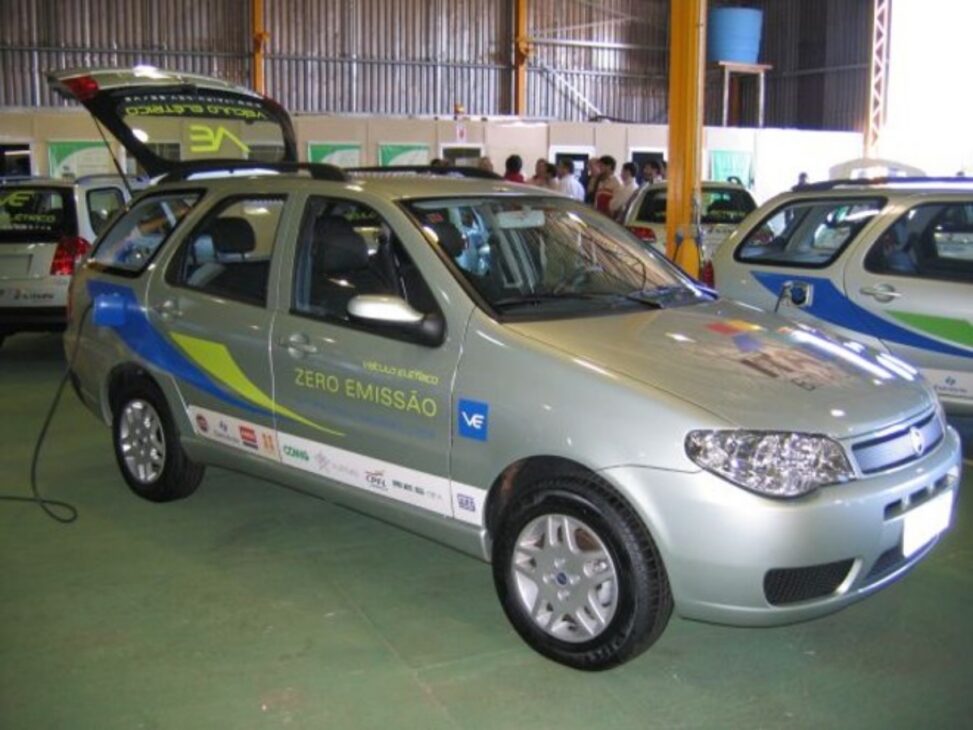
Technical Specifications: Fiat Palio Electric (2006)
- Motor: front, electric, three-phase asynchronous, water-cooled
- Power: 37.8 hp at 9,000 rpm
- Torque: 12.6 mkgf at 9,000 rpm
- Transmission: motor rotation direction defines forward or reverse gear; front-wheel drive
- Total Weight: 1,029 kg
- Range: up to 120 km in urban cycle
- Top Speed: 110 km/h
- Suspension: McPherson in the front, torsion beam in the rear
- Brakes: disc in front, drum in the back, with electric brake booster
- Wheels/Tires: 145/80 R13
- Trunk: 290 liters
- Charging: 110/220V, current up to 16A, full charge in 8h
And Today? Does Fiat Still Invest in Electric Cars?
Fiat has strongly returned to investing in the electrified segment. The compact 500e is one of the brand’s best-selling electric models in Europe and has already arrived in Brazil, focusing on urban consumers. The growing success of electric vehicles in the country, still limited by high prices, shows that the seed planted by the electric Palio may not have blossomed at that time but left a legacy that is beginning to take shape now.
Models like the Fiat 500e, along with hybrid proposals and partnerships with energy brands, show that the future of Fiat, and the Brazilian market itself, is indeed plugged into the socket.
Did you enjoy learning about this forgotten story of the Brazilian automotive industry? Then leave your comment below: would you have a Fiat Palio with a salt battery in your garage today? Share with friends who also enjoy cars and technology!








Quero comprar um desse pra mim….como faço?