





 Portuguese
  English
  Spanish
  5 min of reading
  19 comments


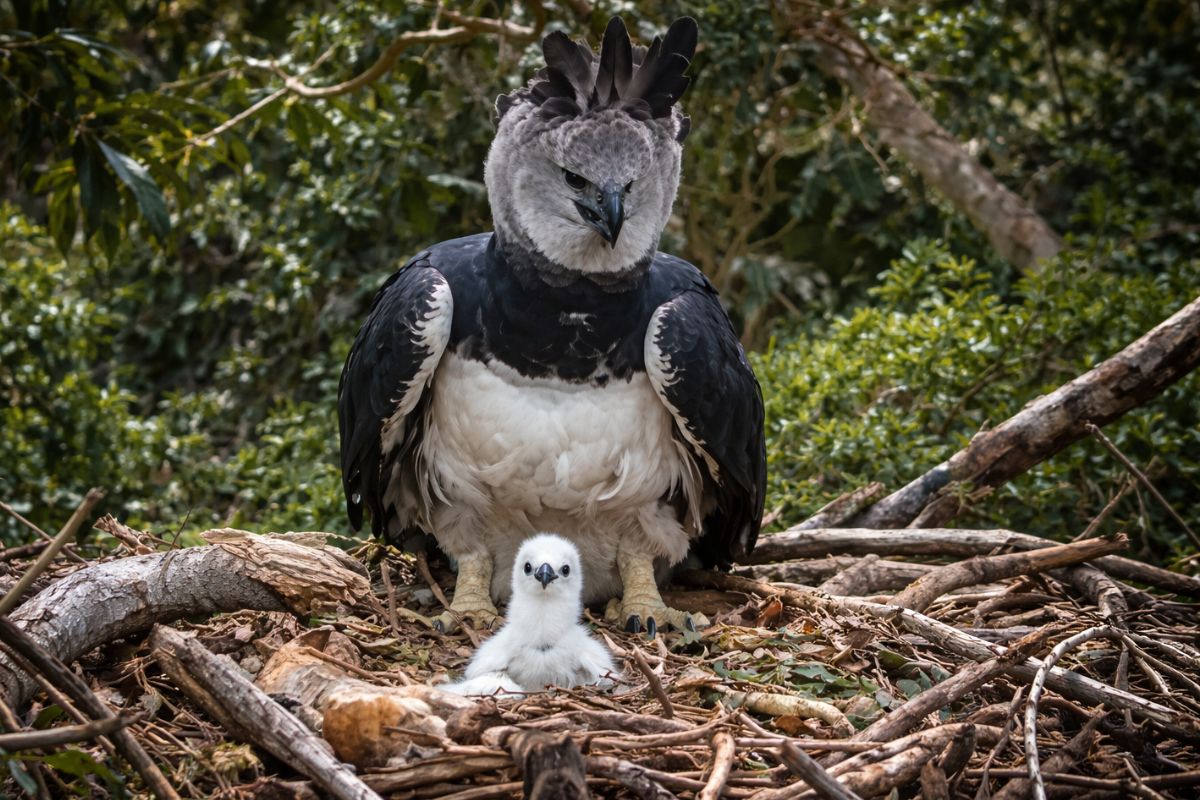


In Early January 2026, Researchers Confirmed a Harpia Chick in Corumbá, in the Pantanal of Mato Grosso do Sul, After Monitoring Began in 2025. Images Show Female in the Nest of the Urucum Massif. The Case Reinforces Risks of the Nearly Threatened Species, Pressured by Hunting and Habitat Loss.
The harpia regained the spotlight in the Pantanal after researchers confirmed a live chick in a monitored nest in Corumbá, in early January 2026. It’s not just good news; it’s a rare marker of reproduction in a region where the species has been sought after for years, with constant monitoring since 2025.
The confirmation reignites hope but also imposes caution. The harpia has a slow reproduction cycle, requires prolonged parental care, and depends on preserved environments to sustain an active nest. When a chick appears, it signals that there were minimal conditions for the species to persist, but it also shows how fragile that persistence is.
The Nest That Turned Into a Watchpoint in the Urucum Massif

The chick was born in early January 2026 and was confirmed by monitoring done on the only known active nest in the region.
-
A Mercado Livre customer opened their package and found 32 resumes of people looking for jobs crumpled as protective paper inside the box, exposing names, addresses, documents, and phone numbers of dozens of candidates.

-
Iceberg A23a, one of the largest in the world, is undergoing accelerated collapse and may disappear: what explains the end of the ice giant?

-
The simplest swap at home can reduce energy consumption by up to 90% without changing habits, using a technology that lasts up to 25 times longer and consumes only a fraction of the electricity.

-
With over 14 million baskets of earth moved, an ancient North American metropolis built a monumental pyramid of 30 meters and established a city with 20,000 inhabitants nearly a thousand years ago.


The confirmation was attributed to biologist and photographer Gabriel Oliveira, who has been tracking the bird in the Urucum Massif, a mosaic of areas that blends wildlife, striking relief, and hard-to-access points, where observation must be careful so as not to interfere with the couple’s behavior.
This nest didn’t appear by chance. One of the nests used by the couple was located in July 2025, after years of searching in the area, and the discovery helped end a period of uncertainty about where the species was reproducing.
The nest of the chick was first recorded in November 2025, and according to monitoring, another nest seen in July served as a reserve.
This alternation of structures suggests a strategy to reduce risks but also highlights how valuable each reproduction point is.
What the Parental Care of the Harpia Reveals in the First Months

In the first 60 days, the female remains almost all the time with the chick in the nest, protecting and regulating the most vulnerable phase of the harpia’s life.
Afterward, the pattern changes: the female starts to go out to hunt alongside the male, and returns to the nest become less frequent. It’s a natural adjustment of routine, but it depends on available food, safety in the surroundings, and the absence of constant disturbances.
The time of parental care is long and helps explain why each chick matters so much. Monitoring indicates that a chick can be under the care of its parents for up to two and a half years if female, or about a year and a half if male.
This means that the harpia invests a lot of time in a single individual, reducing the capacity to “replace losses” quickly.
When the species loses habitat or suffers illegal hunting, the impact is multiplied because recovery does not keep pace with the speed of the threat.
Why a Chick Changes the Debate About a Rare Species in Brazil
The harpia, also known as the great harrier, is described as a large bird, with a wingspan of up to 2.20 meters and strong talons.
This size can be impressive, but it is not synonymous with invulnerability. On the contrary: large species with low reproductive rates and high dependence on preserved areas tend to suffer more when there is habitat fragmentation and human pressure in the surroundings.
The conservation status reinforces the urgency. The harpia is classified as “near threatened” by the Chico Mendes Institute for Biodiversity Conservation (ICMBio) and as “threatened” on the state list of Mato Grosso do Sul.
Among the cited risk factors are the loss of natural habitat and illegal hunting. One confirmed chick does not erase these pressures; however, it creates a window of opportunity to consolidate knowledge and protection around the nest.
How the Images Emerged and the Challenge of Observing Without Interfering
The record of the nest and the chick happened in the context of birdwatching and wildlife tourism in the Pantanal, conducted by Icterus Ecoturismo.
The capture of images was done in partnership with Planeta Aves, aimed at scientific dissemination and environmental education. This detail is important because when observation is organized responsibly, it can enhance public interest and support for conservation.
At the same time, the topic requires criteria. Active nests are sensitive areas, and any excessive approach can alter patterns of vigilance, rest, and feeding.
The line between “recording” and “pressuring” is thin, especially with a rare species, which is why the presence of technical monitoring and low-impact behaviors is crucial to ensure that exposure does not become a risk.
What This Confirmation May Indicate for Research and Conservation in the Pantanal
Researchers had been trying to locate a breeding site for the harpia in the Pantanal for over a decade, and the first record of an individual in the area occurred in 2012.
The confirmation of the chick, therefore, is not an isolated event but a chapter in a long search, made with persistence and with the understanding that discreet species can exist without appearing for years until a nest is found.
From here, the most immediate gain is scientific and practical: confirmed reproduction allows observing stages of development, patterns of parental care, nest alternation, and the couple’s responses to changes in the environment.
The more continuous the monitoring, the clearer the difference becomes between a “point-in-time” nest and a reproductive presence that can sustain over time, something crucial for planning conservation, oversight, and environmental education based on evidence, not assumptions.
The confirmed harpia chick in Corumbá, in the Pantanal of Mato Grosso do Sul, has become a symbol of hope because it represents something rare: recorded reproduction, an active monitored nest, and a real chance to understand how the species maintains itself in a pressured environment.
The story is beautiful, but it is also a harsh reminder that the survival of the harpia depends on refuges, silence, food and protection against hunting and habitat loss. And, when the care cycle can last for years, every human decision around the nest weighs more than it seems.







Existen muchos esfuerzos por reactivar de nuevo el proyecto del Águila Arpía como especie emblematica en Panamá como rescate de una especie aviar tan importante dentro de la bioversidad.
Que vayan a decir que hay en la naturaleza, no me importa. 🤬😡😡😡
No estoy de acuerdo. Debe ser casado en desaparecido. Se comen los animales salvajes. Se comen las Zorrita. Se las comen vivas. No puedo creer que la humanidad este de acuerdo. Sobre bestia