





 Portuguese
  English
  Spanish
 4 min of reading
  1 comment


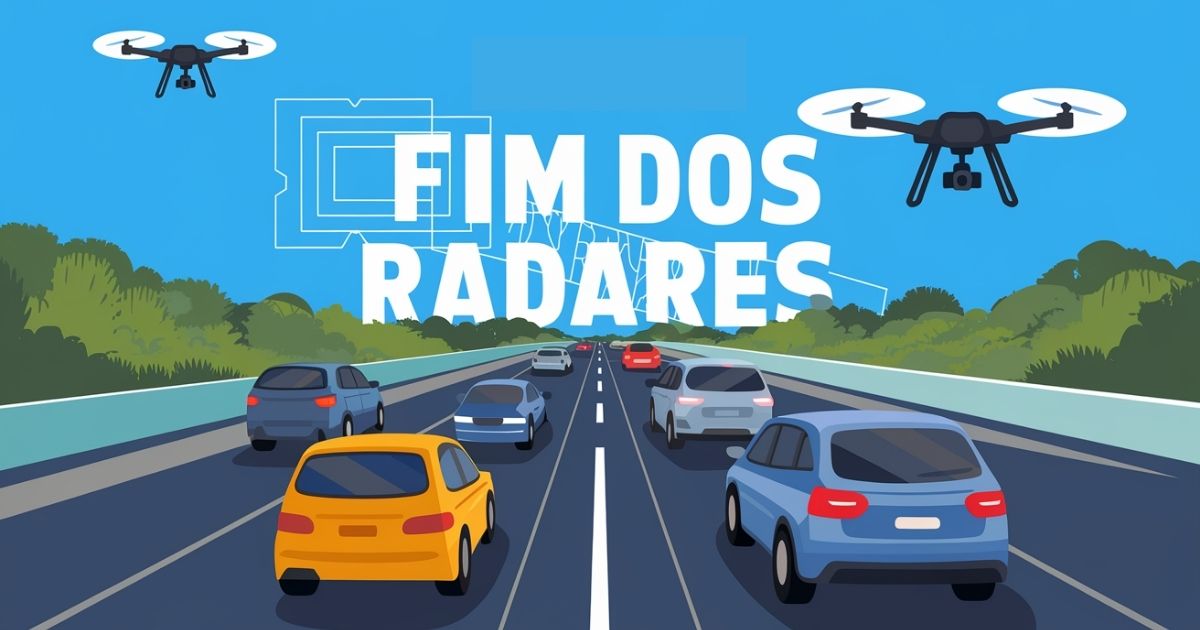

Bill Suggests Drones to Replace Mobile Radars, Promising More Transparency. Critics Warn of Security Risks and Question Legal Viability.
Have you ever thought about driving on roads without mobile radars, with the promise of a more modern and fair enforcement?
This is the focus of a bill presented in Santa Catarina, which proposes replacing mobile radars with drones.
The measure, authored by Deputy Sérgio Guimarães (União Brasil), promises more transparency in the application of fines but has faced criticism and debates regarding security and legality.
-
“No one will make us change the Pix,” says Lula after the US report.

-
Less than a Tera TSI, up to 710 km of range and charging in 9 minutes: the new BYD Song Ultra expands the Chinese brand’s bet on increasingly faster, more technological, and competitively priced electric SUVs.

-
Lula responds directly to Trump and says that Pix is from Brazil and will not change under pressure from anyone, after a report from the United States pointed out the Brazilian payment system as an American trade barrier.

-
Amazon has just announced a new fee on all deliveries, and your online purchases will become more expensive starting April 17, including for those buying from the United States here in Brazil.


End of Mobile Radars: What Does the Bill Propose?
The bill suggests the elimination of mobile radars from the state highways of Santa Catarina, replacing them with drones that would monitor speed.
According to Sérgio Guimarães, the main objective is to end the feeling of a “fine industry” and offer a clearer enforcement model for drivers.
For the legislator, mobile radars are not transparent and are often seen as a means of revenue generation.
“Drones are a more efficient technology, capable of monitoring without causing the same feeling of persecution among drivers”, says Guimarães.
However, the idea does not please everyone. Experts warn that mobile radars play an essential role in reducing accidents and that their replacement could lead to serious consequences.
Is Security at Risk?
Although the bill seems promising to many drivers, road safety professionals are concerned.
Currently, mobile radars help control speeding in critical sections of highways.
Without these devices, the number of violations may increase, as well as the risk of serious and fatal accidents.
The commander of the Military Highway Police of Santa Catarina, Marcus Vinícius dos Santos, is one of the critics of the proposal.
According to him, recent data indicate that the state is already facing alarming rates of fatal accidents on its highways, and the removal of radars could worsen this situation.
For Santos, drones may complement enforcement work, but they cannot replace mobile radars, which have the capacity to monitor specific segments with a high incidence of accidents.
Legal Issues May Block the Bill
Another controversial point of the proposal is its legal viability. Traffic and road enforcement legislation is a federal competence, and any significant change must align with national standards.
Legal experts highlight that the bill may face difficulties in being approved and implemented.
Without the Union’s approval, the idea could end up being blocked or facing lawsuits, which would delay its application.
Guimarães, however, believes there is room for adjustments. “We are seeking solutions that respect federal legislation but provide direct benefits for Santa Catarina and, perhaps, for other states in the future”, says the deputy.
What Do the Latest Data Say?
In November 2024, Santa Catarina recorded an 8% increase in the number of fatal accidents compared to the previous year, according to information released by the State Highway Police.
The most dangerous sections are precisely those where mobile radars are used, reinforcing the arguments of those who advocate for the maintenance of these devices.
On the other hand, the use of drones in enforcement is not new in Brazil. In São Paulo and Rio de Janeiro, this technology is already employed in specific operations, but always as a complement to radars and not as a replacement.
Bill Processing and Next Steps
Currently, the bill is under analysis in the Legislative Assembly of Santa Catarina. After being approved by the Constitution and Justice Commission, it will proceed to the Taxation and Finance Commission, where its economic and legal impact will be evaluated.
In the legislature, the topic divides opinions. While some legislators support the innovation and modernization of enforcement, others fear that the replacement of radars may put lives at risk.
The final decision has no set date yet, but the debate is expected to be heated.
Impacts for Brazil
If approved, the bill could serve as inspiration for other Brazilian states, reopening discussions on the balance between road safety and drivers’ perception of freedom.
However, experts emphasize that any changes in this direction must be made with caution and technical grounding.
Is replacing mobile radars with drones the path to fairer enforcement, or does it pose a risk to road safety?







Bem uma legislador que não conhece a legislação, está no mínimo equivocado, visto que a matéria é de competência federal, e na verdade irá aumentar a arrecadação, pois multas de ultrapassar em locais proibidos também serão lavradas. Os radares móveis devem estar presentes com as viaturas para inibir as mas condutas dos motoristas