





 Portuguese
  English
  Spanish
  5 min of reading
  1 comment


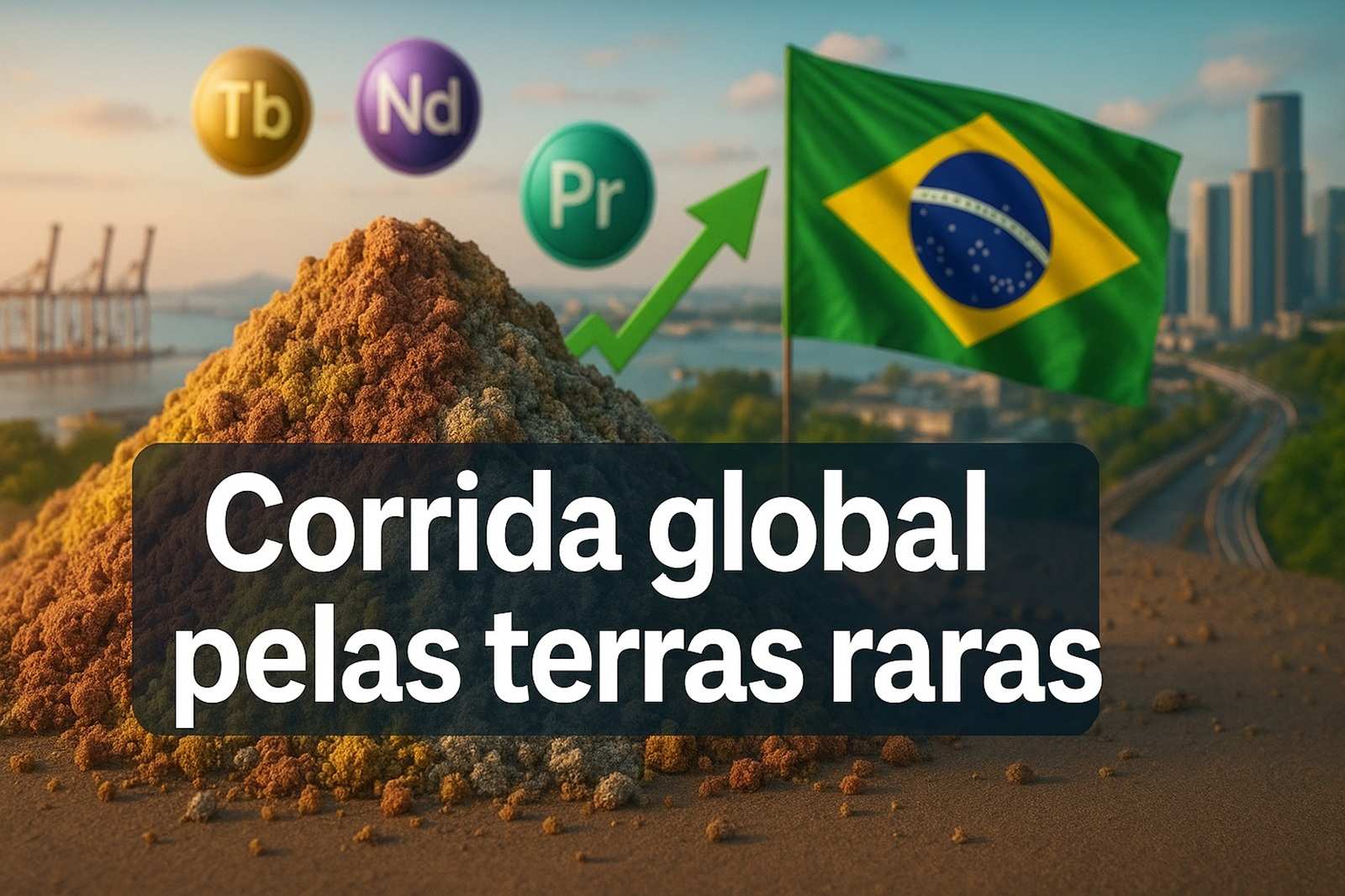


With Reserves of 21 Million Tons, Brazil Seeks to Transform Rare Earths into High-Value Industry, Targeting Strategic Autonomy in Sectors Such as Clean Energy, Mobility, and Technology.
On Monday, U.S. President Donald Trump stated that China needs to supply magnets to Americans or face 200% tariffs “or something like that.”
This statement reinforces the tense atmosphere in the trade and technological dispute between the two largest economies in the world, which have been imposing retaliatory measures on each other since the beginning of the tariff ramp-up.
China, on the other hand, has sought to maintain control over the supply of rare earths.
-
The institute that trained the greatest aerospace engineers in Brazil has just opened its first campus outside São Paulo after 75 years: ITA Ceará will have R$ 445 million, new courses in energy and systems, and classes are expected to start in 2027.
-
Luciano Hang, owner of Havan, goes to Juiz de Fora after the tragedy in February, brings R$ 1 million, hands out R$ 2,000 cards, and donates up to R$ 15,000 to victims in the region.

-
The Brazilian passport allows legal residence in dozens of countries without the need for a prior visa, and most Brazilians are unaware that they can apply for residency directly upon arriving in nations in South America, Africa, and even Europe.

-
Petrobras sends a message to Brazilian truck drivers after fuel collapse and reveals plan to have 100% domestic diesel.

In April, the government included magnets and other strategic items on its export restriction list, in direct response to Washington’s pressures.
This scenario underscores the importance of critical minerals and shows how they have become targets of diplomatic and economic disputes.
Magnets are part of this game because they are present in practically all modern technology. From cell phones to rockets, they support sectors that generate trillions of dollars.
Therefore, the impact of their supply goes far beyond trade: it affects the sovereignty of countries and the security of entire industrial chains.
What Are Rare Earths
Rare earths are a group of 17 chemical elements. Despite their name, they are not exactly rare, but their extraction and refining require high technology and investments.
They are essential for manufacturing smartphones, electric cars, wind turbines, medical equipment, defense systems, and even rockets.
The world’s most powerful magnets are produced from alloys that include neodymium and samarium. In high-performance applications, such as electric vehicle motors or military jets, dysprosium is added to ensure greater thermal stability.
These technical details explain why controlling this market is seen as a strategic weapon.
According to the U.S. Geological Survey, Brazil has about 21 million tons in rare earth reserves.
This number places the country in second position globally, behind only China.
In addition to abundant reserves, Brazil also has clean and competitive energy, a factor that can be decisive in attracting investors seeking sustainable alternatives.
Brazil on the Rare Earths Map
Despite its natural wealth, Brazil still exports a large part of its minerals in raw form.
This means that the added value of the industrial chain ends up remaining in other countries.
The Ministry of Mines and Energy (MME) acknowledges this gap but is optimistic about the possibility of creating a robust industry based on existing potential.
In recent years, initiatives have begun to sketch a new scenario.
Among them is the MagBras Project, developed by SENAI, which aims to structure a national production chain for permanent magnets focused on electric cars, renewable energy, and electronics.
Another highlight is the R$ 1 billion participation fund for mineral research, focusing on junior companies that can bring innovation.
Incentivized debentures for projects related to the transformation of strategic minerals are also underway.
Additionally, a public call for R$ 5 billion, organized by BNDES, FINEP, and the MME itself, supports industrial plants and business plans in the sector.
The Brazilian Geological Service (SGB) is conducting studies to better map reserves and analyze the reuse of mining waste.
Billion-Dollar Opportunity
The strategic value of rare earths goes far beyond mining. The real economic impact lies in their transformation into high-value industrial products.
While raw export generates limited gains, refining and producing magnets can generate billions of reais.
This shift can reduce Brazil’s external dependence in key sectors. Today, practically all permanent magnets used in the national industry are imported, mainly from China.
Creating internal production capacity means not only generating jobs and attracting investments, but also strengthening industrial chains related to clean energy, electric mobility, and cutting-edge technology.
Moreover, the bet on rare earths could enhance Brazil’s relevance on the global stage.
At a time when major powers compete for these resources, those with the capacity to explore and refine gain negotiation power.
This is where the country can transform into a strategic player, balancing dependence and autonomy.
The Global Dispute
As Brazil organizes itself to occupy space, the international dispute remains fierce. This year, the United States established a partnership with Ukraine to explore its mineral potential.
Trump also announced a supposed deal with China for temporary supply of magnets and rare earths, although Beijing has never officially confirmed it.
Despite these movements, experts assert that the advantage still lies with China.
In addition to concentrating the largest reserves already under exploration, the country dominates processing, holds patents, and has developed technological know-how over decades.
This combination ensures that Beijing maintains enormous bargaining power capable of affecting global production chains.
Perspectives for Brazil
The chance for Brazil to establish itself as a protagonist depends on quick decisions. The time is favorable, as the pressure between the U.S. and China opens space for new suppliers.
The global race for critical minerals demands that countries diversify their supply chains.
If it can advance in refining technology and create industrial hubs, Brazil can become a reliable alternative. This does not mean rivaling China, but occupying a space that can yield billions and reduce external vulnerability.
The path, however, requires overcoming obstacles such as bureaucracy, regulatory insecurity, and the lack of large-scale private investments.
The effort also depends on coordination between government, universities, and companies. Only then will it be possible to transform reserves into finished products and compete in the international market.
The gains go beyond the trade balance: it can generate skilled jobs, attract research centers, and create an integrated innovation chain.
Brazil, holding the second-largest rare earth reserve in the world, is still far from converting this potential into industrial leadership.










Eu gosto de comentar. Por isso me lembrei do nosso Presidente da República dizendo que as nossas terras raras não sairiam do subsolo (?!) Mas… se nós ocupamos uma posição de comerciantes de commodities e as terras raras são a **** da vez basta ter um pouco mais de tecnologia para extrair e processar essa matéria-prima e poder tirar disso algum lucro. Difícil é nós estarmos faz 40 anos estagnados no crescimento econômico principalmente por esse tipo de pensamento que nos governa.