





 Portuguese
  English
  Spanish
 4 min of reading
  0 comments


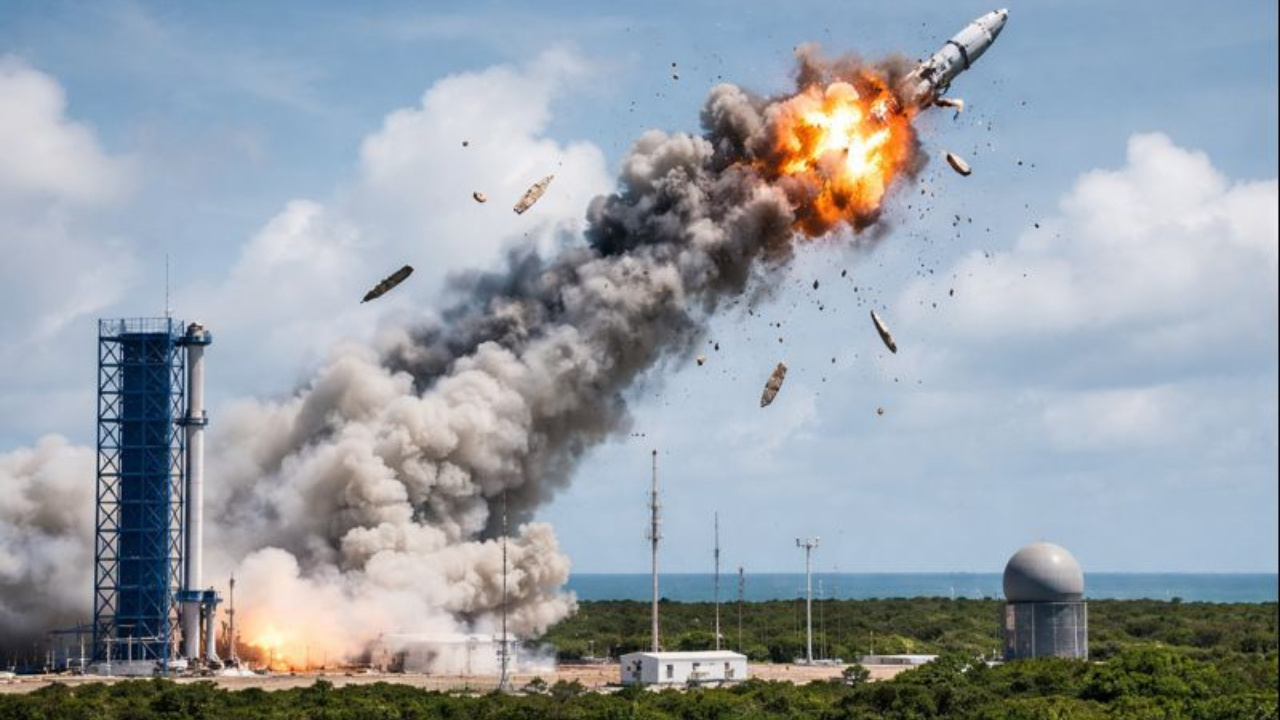
Explosion in Alcântara Marks Failure in the Flight of the HANBIT-Nano Rocket and Raises New Challenges for the Brazilian Space Program.
On the night of this Monday (22), the rocket HANBIT-Nano suffered an explosion in Alcântara just moments after being launched at 10:13 PM from the Alcântara Launch Center in Maranhão.
The unmanned vehicle was part of the Spaceward mission coordinated by the Brazilian Air Force (FAB) and the Brazilian Space Agency (AEB), carrying scientific experiments from institutions in Brazil and India.
The failure occurred during the initial flight when the live transmission displayed the message “We experienced an anomaly during the flight,” indicating a technical anomaly.
-
Something is happening around the Earth: Inside the huge explosion of fireballs in 2026

-
A hot air bubble coming from Argentina expands over Brazil, causing thermometers to exceed 38 degrees with a thermal sensation of 40 degrees in late March, affecting 6 states at once.

-
The radish leaf that almost everyone throws away has more polyphenols, flavonoids, and fiber than the consumed root, and a 2025 study showed that the leaf contains compounds that protect the intestine, combat inflammation, and may inhibit the growth of cancer cells.

-
A planet that seemed to defy the laws of physics has intrigued scientists for decades, until the James Webb revealed what is really affecting Saturn’s rotation.


Shortly after, the signal was interrupted. The incident directly impacts the Brazilian space program, which seeks to expand its presence in the international launch market.
What Happened During the Launch of the HANBIT-Nano Rocket
Shortly after takeoff, the transmission followed the HANBIT-Nano rocket for just over a minute.
Two cameras installed on the vehicle’s stages showed part of the ascent. At one point, the rocket reached Mach 1, the speed equivalent to breaking the sound barrier.
While heading towards Earth’s orbit, the vehicle reached the so-called MAX Q, the phase in which a rocket experiences the most aerodynamic stress while traversing the atmosphere.
Shortly after this critical point, the company cut the transmission, making it impossible to follow the rest of the flight, and later confirmed the explosion in Alcântara.
Immediate Response and Actions by Authorities at the Alcântara Launch Center
After the incident, teams from the FAB and the Fire Department of CLA were dispatched to assess the debris and check for possible risks in the impact area.
The authorities confirmed that the fragments of the HANBIT-Nano rocket fell in a base area, without any casualties, as the mission was unmanned.
The authorities isolated the location and initiated safety procedures and technical analysis.
This protocol is standard in occurrences of this type and aims to preserve both the integrity of the facilities and the necessary evidence for the investigation.
Spaceward Mission and the Interrupted Scientific Objectives
Named the Spaceward mission, the operation planned to send five satellites and three technological devices into space.
Institutions in Brazil and India would use these devices in research distributed across more than five areas of knowledge.
According to AEB, the South Korean company Innospace entered into a service agreement with the Brazilian government for a minimum compensation to the State.
This contractual modality does not foresee direct profit, reinforcing the strategic and scientific nature of the initiative within the Brazilian space program.
Technical Characteristics of the HANBIT-Nano Rocket
The HANBIT-Nano rocket measured 21.9 meters in height, 1.4 meters in diameter, and weighed approximately 20 tons.
In comparative terms, its height is equivalent to a seven-story building, while its mass is similar to that of four African elephants.
During the planned trajectory to orbit, the vehicle could reach speeds of up to 30,000 km/h, about 30 times faster than a commercial airplane.
These numbers help illustrate the complexity of the operation and the challenges involved in orbital launches.
Why the Alcântara Launch Center is Strategic
Built in the 1980s, experts consider the Alcântara Launch Center one of the most advantageous locations in the world for space launches.
Its proximity to the Equator allows rockets to consume less fuel to reach orbit, reducing operational costs.
Additionally, the base is near a wide stretch of coastline, has low air traffic density, and offers various orbital inclinations.
The lower the latitude, the higher the rotational speed of the Earth’s surface, which enhances launch performance.
History of Challenges and Impact on the Brazilian Space Program
Despite the geographical advantages, Alcântara has been underutilized for decades. One of the main factors was the serious accident that occurred in 2003 when the explosion of the VLS-1 rocket, three days before launch, killed 21 civilians who were working at the base.
The tragedy directly impacted the consolidation of the Brazilian space program in the international market.
Moreover, land issues involving local quilombola communities led to prolonged legal disputes that reached international courts.
These conflicts delayed agreements and limited the expansion of space activities in the area.
Repercussions and Next Steps After the Explosion in Alcântara
The explosion in Alcântara during the Spaceward mission reignites discussions about safety, investments, and governance in the space sector in Brazil. Meanwhile, technical analyses are expected to identify the causes of the failure in the HANBIT-Nano rocket.
Experts believe that despite the setback, the incident does not negate the potential of the Alcântara Launch Center.
On the contrary, it reinforces the need to enhance processes and solidify international partnerships to sustainably strengthen the future of the Brazilian space program.






-

-

-

5 pessoas reagiram a isso.