





 Português
  Inglês
  Espanhol
  5 min de leitura
  0 comentários


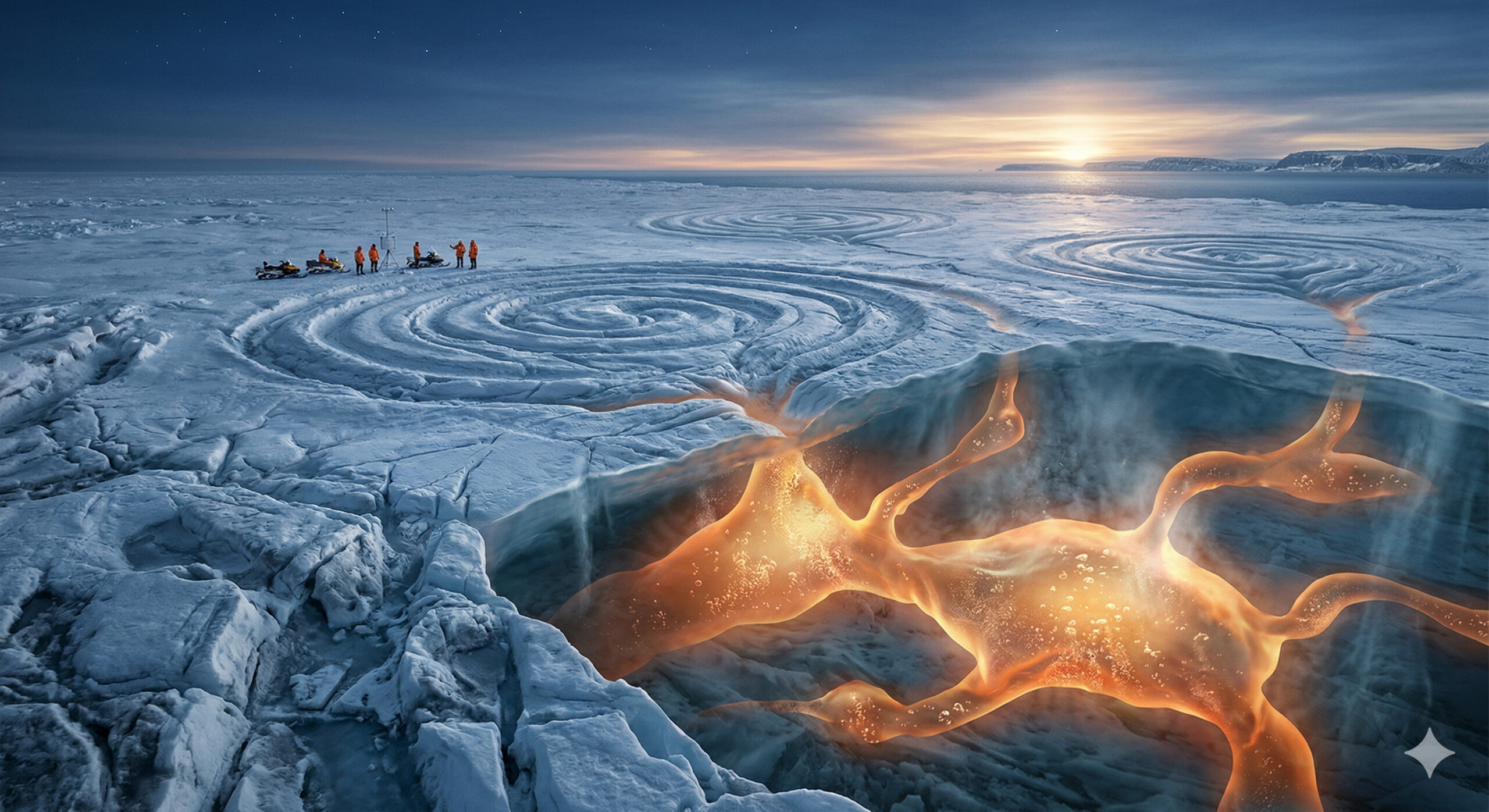
Study reveals thermal convection in Greenland ice, a phenomenon that could alter sea level models and ice sheet dynamics
For more than a decade, scientists have observed unusual structures in the depths of the Greenland ice sheet without being able to explain them. In 2026, a study published in the journal The Cryosphere by researchers from the University of Bergen, NASA, the University of Oxford, and ETH Zurich revealed that these formations are caused by thermal convection in the ice, a physical phenomenon previously associated only with fluids like magma and water.
The structures, detected by radar, appear as spiraled columns that unexpectedly deform internal layers of the ice. The discovery redefines scientific understanding of the internal behavior of glaciers and may directly impact climate models and sea level rise projections.
Scientific mystery in Greenland: radar-detected plumes challenged models for over 10 years
The structures were identified through radio stratigraphy, a technique that uses radar to map internal layers of ice. Normally, these layers appear as regular horizontal lines, representing periods of snow accumulation over the years.
-
A gigantic freshwater reservoir appears beneath the Great Salt Lake, between 3 and 4 kilometers deep, surprising scientists with an unexpected flow towards the interior of the lake.

-
At over 8,800 meters above sea level, the summit of Mount Everest is made up of rocks that originated at the bottom of an ocean about 500 million years ago and were pushed to the highest point on Earth by the collision of tectonic plates.

-
Japan targets a remote island in the Pacific measuring only 1.51 square kilometers, located 1,900 kilometers from Tokyo, to store nuclear waste for up to 100,000 years, raising alarms at sea.

-
A 1,900-year-old papyrus found in the Judean Desert reveals a crime of the Roman Empire involving fraud, forgery, and a detailed court hearing.

However, in deep regions of northern Greenland, these lines were distorted, forming ascending spiral patterns. These “frozen whirlpools” were not predicted by traditional glaciological models.


The behavior contradicted the idea that ice, being solid, could not move convectively, raising one of the greatest recent uncertainties in climate science.
Thermal convection in ice: the same physics that moves magma and tectonic plates
The team led by glaciologist Robert Law applied to ice the same mathematics used to model convection in the Earth’s mantle.
Thermal convection occurs when there is a temperature difference between regions of a material. The warmer, less dense part rises, while the cooler part sinks, creating a continuous cycle.
This process is responsible for:
- Tectonic plate movement
- Formation of currents in the Earth’s mantle
- Boiling of water
In the case of Greenland, the phenomenon occurs with solid ice. Colder ice surrounds slowly rising warmer ice columns, forming internal spiral structures.
Deep ice is up to a million times more malleable than rock
The discovery is only possible because deep ice does not behave like conventional rigid solids.
Under high pressures and temperatures found kilometers deep, ice becomes highly viscous and deformable. Studies indicate that it can be up to a million times softer than the Earth’s mantle.
According to Robert Law, this makes convection possible even in a solid material. Researcher Andreas Born compared the phenomenon to a pot of boiling water, but in slow motion and with ice.
New discovery shows Greenland ice is up to 10 times softer than previously expected
The results indicate that deep ice may be about ten times more malleable than previous models considered.
This difference directly alters how ice flows internally toward the ocean. Flow dynamics are one of the most critical factors in predicting sea level rise.
This means climate models may need to be revised, as they used incorrect stiffness parameters.
Researchers emphasize that more malleable ice does not necessarily imply faster melting. Thermal convection affects the internal deformation of the ice, not directly its melting rate at the surface.
However, the discovery reduces uncertainties in climate models, which is crucial for more accurate predictions about future environmental changes.
Geodynamic model ASPECT confirms thermal convection in Greenland
To validate the hypothesis, scientists used the geodynamic model ASPECT, typically applied to the study of the Earth’s mantle.
The parameters were adjusted for ice, including:
- Temperature
- Density
- Thickness
- Viscosity
- Snow accumulation rate
The results showed that, in specific regions of northern Greenland, all the necessary conditions for convection were present. This confirmed that the phenomenon observed by radar was the result of real thermal convection.
Radio stratigraphy reveals internal deformations in the Greenland ice sheet
The Greenland ice sheet is over a thousand years old and can exceed 3 kilometers in thickness.

Each annual layer can be identified by radar, serving as a historical climate record. When convection occurs, these layers are distorted, creating irregular patterns visible in the data.
These deformations serve as direct evidence of the internal movement of the ice, similar to tree rings altered by internal forces.
Greenland could raise sea level by up to 7 meters
The Greenland ice sheet contains enough water to raise global sea levels by about 7 meters if it were to melt completely.
Therefore, any change in the internal behavior of this ice mass has global implications. The discovery of thermal convection could significantly improve climate projections, reducing uncertainties about the future of coastal regions.
The origin of convection lies in the heat coming from the Earth’s interior. Greenland has passed over a volcanic hotspot over millions of years, creating an irregular distribution of geothermal heat beneath the ice sheet.
A study published in PNAS in 2025 confirmed this thermal variation, showing that some regions at the base of the ice are warmer than others.
These differences create the ideal environment for the emergence of thermal convection, acting as a “heat source” that fuels internal movement.
Old Greenland ice models ignored internal convection
Before this discovery, glaciological models treated deep ice as a uniform material. The possibility of thermal convection was not considered, meaning that simulations may have underestimated or overestimated ice flow.
The inclusion of this new variable could significantly alter future climate projections, especially in long-term scenarios.
The article was selected as a highlight by the journal The Cryosphere, a recognition reserved for high-impact scientific research. The collaboration involved institutions from three continents, including NASA and the University of Oxford.
The main implication is clear: ice is not just a passive solid, but a dynamic system that can behave like a fluid under specific conditions.
Human and cultural impact of the Greenland ice sheet
Greenland is home to about 56,000 inhabitants, mostly of Inuit descent, and the ice sheet directly influences the climate, economy, and local culture.
The new discovery is not just scientific. It directly affects the understanding of the environment in which these populations live, with implications for the future of the region.
The discovery of thermal convection in Greenland ice represents a fundamental shift in climate science. The phenomenon shows that, even at extremely low temperatures, the physics of convection continues to operate.
Ice, under certain conditions, is not static — it is dynamic, slow, and in constant internal movement, redefining the understanding of one of the largest ice masses on the planet.










Seja o primeiro a reagir!