





 Portuguese
  English
  Spanish
  6 min of reading
  1 comment


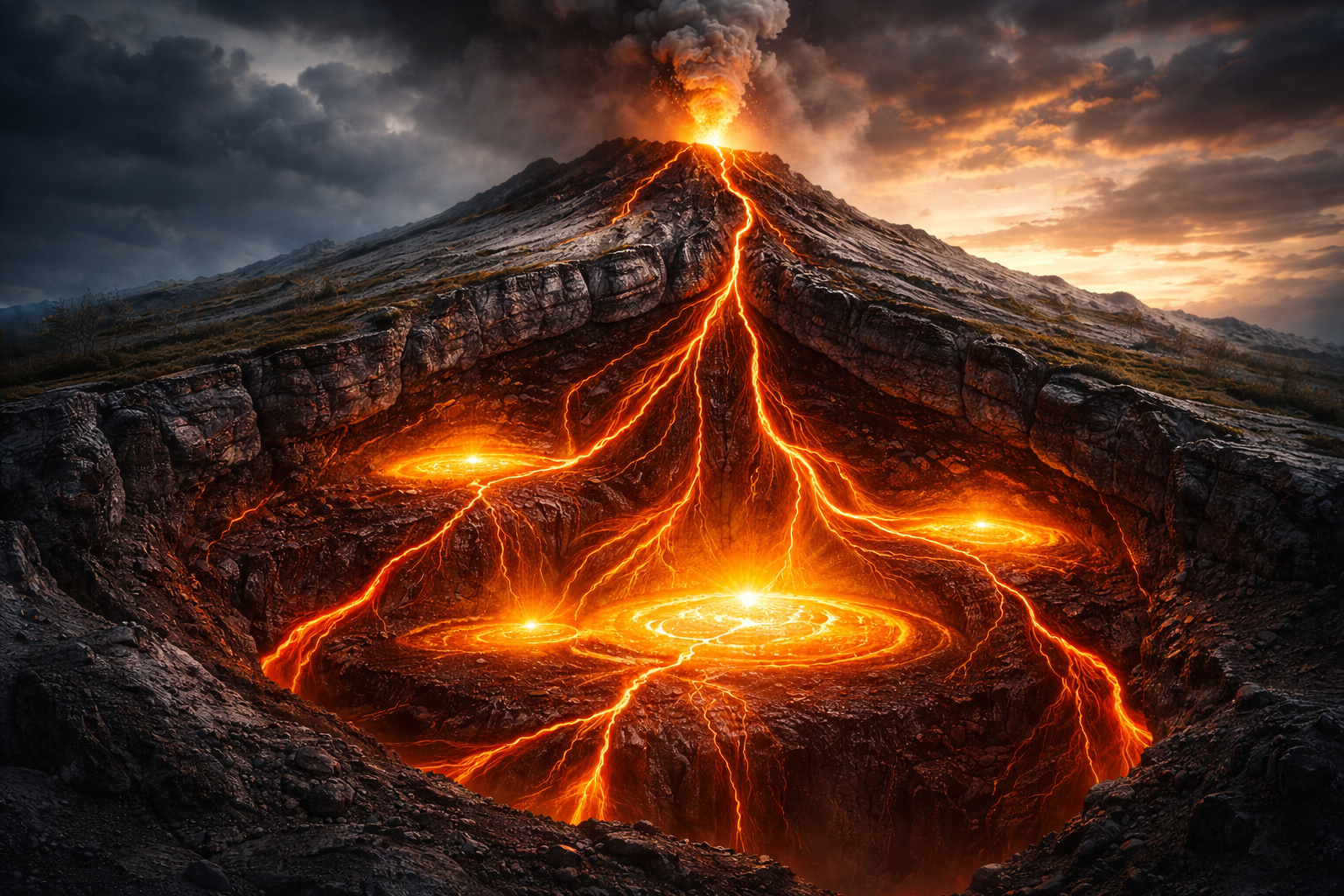

Study maps in near real-time the magma of Etna and reveals how the volcano stores and releases material before eruptions.
In 2021, a study published in the scientific journal Communications Earth & Environment, from the Nature group, presented an unprecedented high-resolution portrait of the interior of Mount Etna, in Italy. Based on 4D seismic tomography and the analysis of seismicity recorded between 2019 and 2021, the researchers were able to identify recent changes in the volcano’s magma feeding system and map, with unusual precision for this type of study, how the magma had been accumulating beneath the volcanic structure.
Etna is one of the most active volcanoes on the planet and, precisely for this reason, has become a natural laboratory to investigate internal processes of the Earth. According to the article and the explanation released by the Istituto Nazionale di Geofisica e Vulcanologia (INGV), what emerges is not a single magma chamber, but a complex magmatic system, with three main storage zones at different depths, from the central region of the volcanic edifice to about 10 to 12 km below the surface.
What was previously invisible has come to be described as a dynamic system, where volumes of fractured rock and molten material change distribution over time. The study also indicates that the deepest region identified between 4 and 9 km concentrates signals compatible with the arrival of new magma, while the detected anomalies suggest a fraction of magma of about 4% of the volume of these zones, enough to sustain eruptive activity for years.
-
Ancient Romans were obsessed with a plant that they said was a contraceptive and an aphrodisiac – then it became extinct.
-
NASA astronaut goes viral by showing “alien potato” in space during mission at the International Space Station and reveals a surprising detail that explains the curious appearance of the experiment in microgravity.
-
Innovative case turns into a “memory card” and promises to revolutionize the iPhone 17 Pro: records directly to MicroSD up to 2 TB, features a 1.6” AMOLED touch screen, USB-C 45 W, and raises questions about limits in ProRes 4K 60 fps.

-
The CIA used for the first time a secret technology capable of detecting heartbeats from a distance to find an American pilot hidden for 40 hours in a mountain in Iran.
The volcano is not a unique reservoir, but an active subterranean network
For decades, the prevailing view was that volcanoes had a kind of “main magma chamber.” However, the data obtained from Etna shows a much more complex scenario.
The system identified by scientists reveals the existence of different magma pockets distributed at varying depths, connected by channels that allow the movement of molten material.
This model functions more like an interconnected network than a single reservoir, with regions that temporarily store magma before it is redistributed or released.
This discovery helps explain why Etna can exhibit multiple eruption points and rapid changes in its behavior.
How seismic tomography revealed the invisible
The technique used by researchers is based on something similar to an “ultrasound of the Earth.” Seismic waves generated by small tremors are monitored by sensors spread around the volcano.
When these waves pass through regions with different properties — such as solid rock or partially molten magma — they change speed and direction. By analyzing these variations, it is possible to reconstruct images of the interior of the volcano.

In the case of Etna, the large amount of available data allowed for the creation of three-dimensional models with high temporal resolution, showing how the system evolves over time.
This allowed for the observation not only of the structure but also of the dynamics of moving magma, something that until then was extremely difficult to capture.
Deep reservoirs feed the surface system
One of the most important points of the study was the identification of deep magma storage zones, located several kilometers below the surface.
These reservoirs act as main sources of molten material, which is gradually transferred to shallower levels through subterranean channels.
As the magma rises, it can accumulate in intermediate pockets, where it undergoes changes in pressure and composition before eventually reaching the surface.
This multi-step process explains why eruptions can be preceded by long periods of seismic activity and ground deformation.
The volcano behaves like a system in constant reorganization
One of the most striking conclusions of the research is that the magmatic system of Etna is in constant reorganization. It is not a static mechanism, but a dynamic environment, where magma moves, accumulates, and redistributes continuously.
At times, certain reservoirs expand, indicating increased pressure. At other times, they contract, suggesting the release of material or internal redistribution.
This behavior resembles a living system, reacting to internal and external changes continuously, adjusting over time.
This view helps to understand why Etna exhibits such frequent and varied activity.
The relationship between magma accumulation and eruptions
By tracking the evolution of the magmatic system, scientists were able to correlate internal changes with eruptive episodes.
Before certain eruptions, it was possible to observe the accumulation of magma in specific regions, followed by upward movement and increased seismic activity.
These signals act as indicators that the system is approaching a critical point, where internal pressure may lead to the release of material at the surface.
This monitoring capability is essential for improving eruption prediction and reducing risks for nearby populations.
The role of Etna as a natural laboratory
Mount Etna occupies a unique position in the study of volcanoes. Its frequent activity and the presence of an extensive monitoring network make it one of the most observed volcanoes in the world.
This allows scientists to collect real-time data and test models that can be applied to other volcanic systems.
What is learned at Etna can help understand volcanoes in different parts of the planet, including those with the potential to cause global impacts.
Technological advancements allow for detailed monitoring of subterranean processes
The research also highlights the advancement of geophysical monitoring technologies. The combination of seismic sensors, computational modeling, and analysis of large volumes of data has allowed for an unprecedented level of detail.

From: Hidden pressurized fluids prior to the 2014 phreatic eruption at Mt Ontake
This type of approach is transforming the way scientists study the Earth, allowing for the observation of processes that could previously only be inferred indirectly.
Today, it is possible to monitor the evolution of subterranean systems almost as if they were visible, reducing uncertainties and improving the understanding of natural phenomena.
Implications for volcanic risk prediction
Understanding how magma moves and accumulates is essential for predicting eruptions. Although it is still not possible to accurately predict when a volcano will erupt, studies like this significantly reduce the margin of error.
By identifying behavioral patterns, scientists can issue alerts with greater advance notice and precision.
This has a direct impact on the safety of populations living near active volcanoes, allowing for more efficient evacuations and long-term planning.
A new look at the functioning of volcanoes
The study of Etna reinforces a paradigm shift in geology. Instead of simple and static systems, volcanoes are now seen as complex and dynamic structures, with multiple internal interactions.
This more detailed view paves the way for new questions and investigations, expanding knowledge about the functioning of the planet.
What was once interpreted as a single reservoir is now understood as an active and constantly transforming network.
Did you imagine that a volcano could function like a living system beneath the surface?
Etna shows that, even in a largely studied world, there are still fundamental processes happening beyond the direct reach of human vision.
With new technologies, we are getting closer to understanding these systems in detail — but the complexity that arises may be even greater than previously imagined.





Thoughtful analysis! I’ve taken a similar approach in my research, which I’ve shared on my site.